
Are Old Stamp Collections Worth Anything?
An inherited stamp album needs careful screening, not a catalog-price total. Learn what deserves a specialist review, how to preserve it, and how to compare selling options.

In this guide · 11 sectionsShow
- 01Why is the catalog price different from the cash value?
- 02Which old stamps are worth little, and which deserve a closer look?
- 03How do I screen an inherited stamp collection at home?
- 04How should I store stamp albums until someone reviews them?
- 05Should I ask a stamp club or pay for an appraisal?
- 06Can I use old stamps as postage?
- 07Where can I sell an inherited stamp collection?
- 08How should an estate sale company handle a stamp album?
- 09What should treasure hunters look for at an estate sale?
- 10What about the Inverted Jenny that sold for $2 million?
- 11Frequently asked questions
Yes, some old stamps are worth money, but age alone is not a valuation. The American Philatelic Society (APS) recommends evaluating the collection before selling; USPS rules also give eligible unused U.S. stamps postage value. Separate possible collector material from ordinary postage, and compare offers rather than adding up catalog prices.
A desk drawer can hold three generations of albums, envelopes and handwritten prices. None of those numbers tells you what a buyer will pay today. Your first job is simpler than becoming a stamp expert: preserve the collection, understand what kind of material you have, and decide whether it deserves specialist attention.
This guide is for families sorting an inherited album, estate sale companies handling a collection, and treasure hunters deciding whether a box deserves a closer look. It offers a screening process, not a remote appraisal. The APS inherited-collection guidance is the starting point; the postage rules below come directly from USPS.
Why is the catalog price different from the cash value?
A catalog helps identify material and provides reference values. It is not a standing offer to buy your collection. In an appraisal article published by APS, Richard Colberg distinguishes estimated catalog value from fair market value. Condition and what is actually present matter more than a grand total penciled inside a cover.
Catalog-versus-cash box
A catalog number identifies a stamp variety; a catalog value is a reference price for specified material and condition; an offer is what a particular buyer will pay for your actual lot. Net proceeds are what remains after applicable selling costs. Do not substitute one number for another.
For illustration only, imagine an album with a handwritten “$1,000 catalog” total. That does not establish a $1,000 sale price, a guaranteed percentage of $1,000, or even that the identifications were correct. Ask which stamps account for the total, which catalog edition was used, and what condition the entries assume. This example is arithmetic context, not a market comparable.
Keep four separate notes if you have them: the collector's catalog total, any insurance value, a specialist's valuation for a stated purpose and date, and actual purchase offers. Mixing these figures is one reason families disagree about whether an offer is fair. Our guide to valuing inherited items before giving them away explains the broader problem.
Collection routing board · not an appraisal
Three next steps. No imaginary price tag.
Documents or specialist material?
Keep the order → request specialist review
Certificates and notes are clues, not a guaranteed valuation.
Ordinary unused U.S. postage?
Check collector interest → check USPS eligibility
Postage value is not a guaranteed cash resale price.
Common mixed album after review?
Compare like-for-like collection offers
Keep the same contents in every quote; compare net proceeds.
Which old stamps are worth little, and which deserve a closer look?
Use this as a routing table, not a price list. APS publishes a blunt warning about large post-1940 U.S. mint-sheet and plate-block accumulations selling below face value, and about low values for many post-1940 first-day covers. Those observations are not a rule that every later stamp is worthless. They are a reason to check demand before assuming a thick album means a large inheritance (APS appraisal article).
| What you find | Sensible first expectation | What to do next |
|---|---|---|
| Large quantities of ordinary post-1940 U.S. mint sheets or plate blocks | Collector resale can be below face value | Compare a collection offer with eligible postage use; do not assume a premium |
| Many ordinary post-1940 first-day covers | Often low resale value | Keep envelopes intact and ask whether anything is specialized |
| A general album with lots of inexpensive entries | Thickness alone says little | Ask which individual items, if any, drive the value |
| Certificates, specialist notes, purchase invoices or an existing inventory | Useful evidence, not a guaranteed current price | Match the paperwork to the actual stamps without removing them |
| A focused collection or material the owner specifically identified as important | Worth a knowledgeable review | Preserve its order and request a subject-appropriate opinion |
| A suspected printing error or a stamp resembling a famous rarity | Unconfirmed, not a windfall | Ask a specialist about identification and authentication |
| Old letters with stamps still attached | The complete item may matter | Keep the entire envelope and correspondence together |
The last rows are prompts to seek help, not claims that every certificate, old letter or unusual-looking stamp has high value. The estate-planning guide hosted by APS specifically encourages inventories, preserving expert certificates and identifying significant material for heirs.
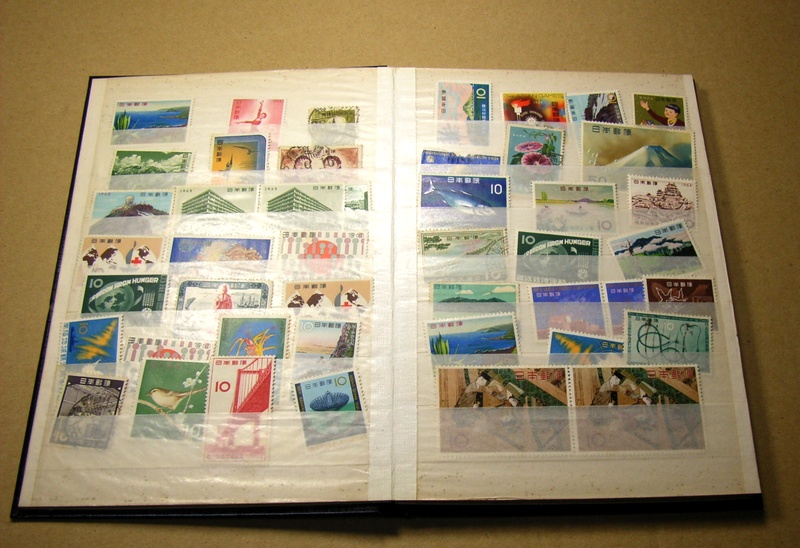
Real reference photograph, not the inherited collection described in this guide: itchys, “My stamp collection book opened,” via Wikimedia Commons, CC BY 2.0. Unaltered. The picture illustrates organization, not value.
How do I screen an inherited stamp collection at home?
The goal is to make a useful record without changing the evidence. Follow this sequence before anyone prices the album or separates it into bargain boxes. It adapts the preservation and inventory approach in the APS-hosted guide for heirs.
- Gather the associated material. Bring albums, stockbooks, loose envelopes, purchase records, catalogs, certificates and the owner's notes into one secure work area. Keep the original groupings. If several relatives own different albums, mark ownership before combining anything.
- Record the containers first. Assign temporary IDs such as “Stamp album A” and “Envelope box B.” Count albums and boxes rather than trying to count thousands of stamps. Photograph closed covers and existing labels.
- Photograph representative pages. Include whole-page views that preserve context and closer views of any items singled out by the owner. Use clear, evenly lit pictures. Crop personal correspondence details from public listing images, but preserve the originals privately.
- Look for documentation. Note an inventory, insurance schedule, specialist correspondence, certificates and receipts. Record where each document belongs. An old purchase price is a clue to investigate, not proof of today's resale price.
- Describe rather than diagnose. Write “apparently unused U.S. sheets,” “mixed-country album,” or “envelopes with stamps attached” when you are uncertain. Avoid labels such as “rare,” “mint never hinged,” or “error” unless a qualified person has confirmed them.
- Leave attachments alone. Do not soak stamps, peel hinges, detach stamps from envelopes, separate stuck pages, trim margins or try to improve appearance. The safe family-screening rule is to stop before an action changes the object.
- Request a preliminary opinion. Send an overview, the container count and selected photographs to a stamp club or specialist. Ask what additional images would help before transporting the collection.
Do not turn the first pass into a family competition to find the most expensive-looking stamp online. Record uncertainty honestly. If someone thinks an item is important, flag its page in your notes instead of pulling it out to carry around.
A parallel coin collection needs its own workflow: see what to do with an inherited coin collection. And before the rest of the house gets cleared, review what not to throw away before an estate sale.
If you are the executor, carry these album IDs into your probate inventory so the collection, supporting paperwork and eventual disposition stay connected.
How should I store stamp albums until someone reviews them?
Keep them in a cool, dry living area rather than an attic or basement. The APS-hosted heirs' guide warns that humidity and moisture can destroy value and recommends storing albums upright so pressure does not cause stamps to stick to pages.
For the household handoff, put the album IDs and contact person on an external inventory, not on stamps or original envelopes. Keep drinks, cleaning products and busy packing operations away from the review area. Do not tape a price label to an album page or write a lot number across an envelope that might be part of the collection.
If pages are stuck or material appears damp, stop handling it and ask for preservation advice before attempting repairs. This guide deliberately does not recommend a home treatment. A rushed effort to separate or flatten something can change the very condition a reviewer needs to examine.
Keep the paperwork with the collection during storage and transport. A certificate left in a filing cabinet is less useful than one clearly matched to the correct album and page. Photograph the container contents before any temporary handoff and obtain a written receipt for material left for evaluation.
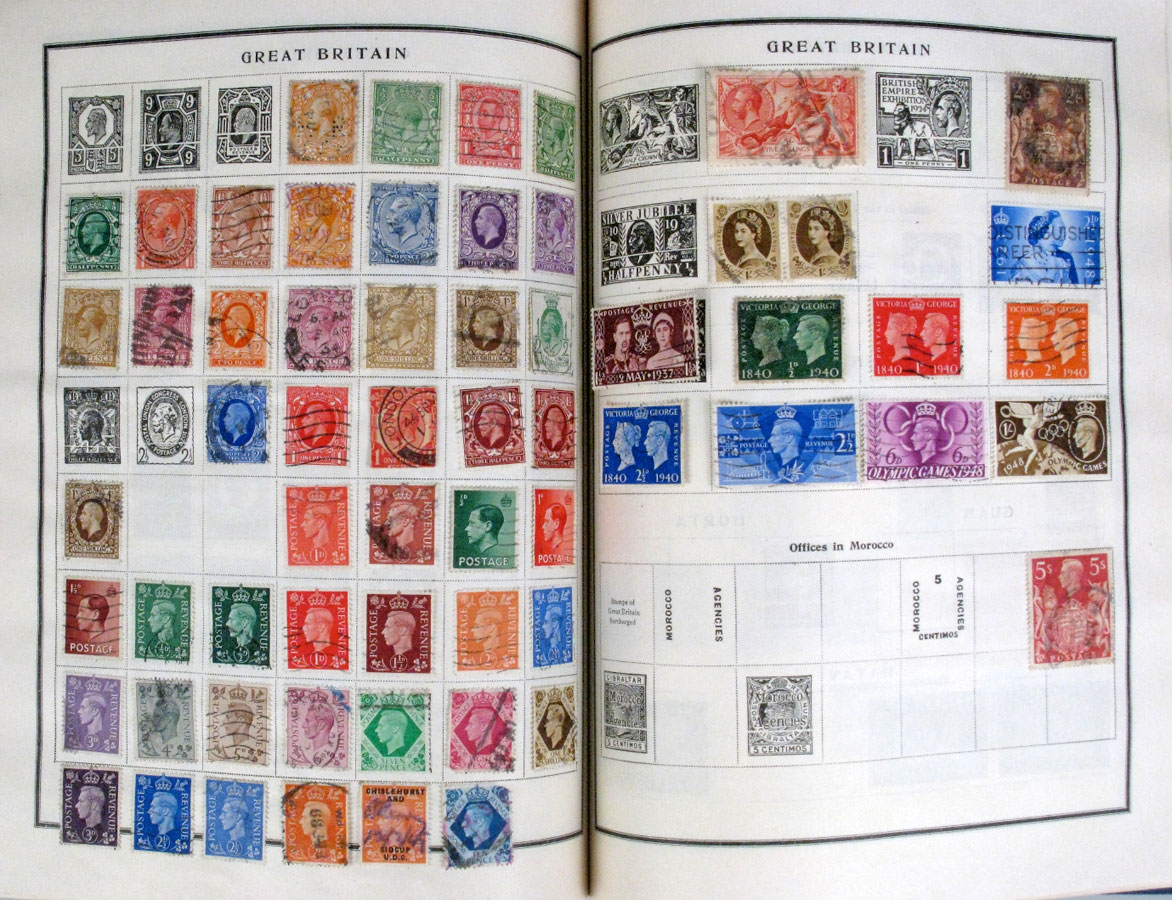
Real reference photograph: bomont57, “Postage stamp album pages – GB stamps,” via Wikimedia Commons, CC BY 2.0. Unaltered. Keep mounted material in place during a family screening.
Should I ask a stamp club or pay for an appraisal?
Start by deciding what question needs an answer. “Is this worth further investigation?” is different from “What written valuation will satisfy this court or tax requirement?” APS says a formal appraisal may not be necessary unless required for legal purposes; it also recommends asking several dealers what they would pay (APS inherited-collection guidance).
A local stamp club can be a sensible first contact for orientation. Ask whether someone familiar with the collection's countries or period can look at overview photographs, and whether a meeting or appointment is appropriate. Do not assume every club offers free appraisals, accepts unattended collections or has the right specialist available.
A paid appraisal is a separate engagement. APS quotes a possible $75–$250 per hour cost range. Treat that as published guidance, not a verified November 2026 quote from every appraiser. Before hiring anyone, request the hourly rate, minimum charge, expected time, travel or research costs, intended valuation date and written deliverable. Ask whether authentication would be a separate service.
For probate, insurance, a donation or a tax filing, explain the intended use at the start. Ask the responsible attorney, insurer or tax adviser what documentation and qualifications are required before paying for a report. An informal club opinion, a buyer's offer and a formal appraisal are not interchangeable.
If the evaluator may also buy the collection, ask how that relationship is handled. Obtain another opinion when the potential value justifies it. A written appraisal still does not guarantee a sale at the appraised amount; APS makes that limitation explicit.
Can I use old stamps as postage?
Eligible unused U.S. postage stamps issued since 1860 remain valid, subject to USPS exceptions. That is the rule in Domestic Mail Manual 604, sections 1.2–1.3. It is not permission to reuse canceled stamps or put every stamp-shaped item from an album on a letter.
The invalid categories include postage-due, special-delivery and Certified Mail stamps; foreign stamps; certain damaged or altered stamps; and nonpostage items such as hunting/conservation stamps and savings/thrift stamps. United Nations stamps have a specific mailing-location exception. Precanceled stamps have permit restrictions. Ask USPS about uncertain material rather than guessing from appearance.
As checked for this article's November 21, 2026 publication, the one-ounce domestic stamped-letter rate is $0.82 in the USPS Notice 123 effective October 4, 2026. An ordinary domestic Forever stamp carries the applicable current one-ounce stamped-letter value. Other Forever categories, including additional-ounce and Global Forever stamps, serve different price categories; read the designation.
A valid denominated five-cent stamp contributes five cents, not 82 cents. For a purely arithmetic example, sixteen five-cent stamps plus one two-cent stamp total 82 cents. That does not make them suitable for every mailpiece: weight, shape and service requirements can change postage, and USPS says stamps must not overlap so as to conceal part of another stamp.
Before using inherited sheets, obtain a quick collector review. Postage use is irreversible. And remember that postage value is a service you can use, not a promise that another person will pay face value in cash.
Where can I sell an inherited stamp collection?
Choose the channel after screening, not before. The APS-hosted disposal guide discusses different disposition routes and warns against treating a specialized collection as ordinary household-sale material. No selling company is named or reviewed here.
An estate sale can be a practical route for reviewed, common albums or mixed hobby lots already being handled with the household. Ask who will set the price, whether specialist consultation is available, how the collection will be supervised and whether lots will be discounted. Do not assume a household-sale operator can authenticate rare stamps.
A stamp dealer or a stamp-show appointment can provide a more focused buying conversation. Describe the collection in advance, bring the documentation and compare offers for the same scope. One quote for a complete collection and another for its best page are not competing bids for the same property.
A specialist auction is worth discussing when knowledgeable review identifies significant material. Request an estimate of seller costs, reserve arrangements, transport or insurance responsibilities, timing and the process for unsold lots. An impressive hammer price elsewhere does not predict your net proceeds.
Using eligible unused postage may make sense for ordinary material once collector interest has been checked. Consider whether your household actually mails enough letters to use it. A face-value total is not equivalent to money available for estate expenses tomorrow.
Donation or keeping a family selection can also be reasonable. Ask the recipient what it accepts before arriving with boxes. Do not assume a donation produces a particular tax deduction; seek tax advice if that is part of the plan. Photograph and document any sentimental pieces retained so the collection's disposition stays clear.
For a whole-home project, find an estate sale company and ask specifically how it handles collectible albums. The right answer may be “we will refer that part to a specialist.”
How should an estate sale company handle a stamp album?
Treat intake, identification, pricing and merchandising as separate tasks. Start with a receipt and overview photographs. Keep client ownership, album IDs and any hold instructions in the job record. Obtain permission before removing anything from the agreed sale scope.
The first pricing decision is whether the material belongs in an ordinary lot at all. Put uncertain specialist material on hold rather than labeling it rare or putting it in an automatic discount category. Ask the client whether any family member has claimed a particular album or whether an estate adviser needs a valuation before sale.
EstateSaleFinder's AI Appraiser can provide suggestions to start identification research. A photo-based suggestion is not authentication, a finding about gum or watermark, a formal appraisal or a guaranteed sale price. Confirm descriptions and comparisons with a knowledgeable reviewer before relying on them.
Once a lot is approved, Tag and Go can fit into the ordinary item-labeling workflow. Put the label on a protective outer container or associated tag, never on stamps, original envelopes or album pages. A faster label is useful only after the lot boundaries and price are right.
List the actual album or lot with clear photographs and descriptive words such as “stamp collection,” the visible countries and the approximate period when known. An item-level listing gives collectors something more useful to find than a room photograph. Avoid publishing private correspondence details or promising unverified rarities.
Buyers can save relevant terms in their wishlist for matching alerts. That is a discovery tool, not a guarantee that an interested buyer will attend or pay a particular amount. For pricing discipline across the rest of the sale, see pricing antiques: what sellers need to know.
What should treasure hunters look for at an estate sale?
Look for information before drama: a coherent collecting area, organized albums, notes that explain the owner's interests, and documentation that stays with the lot. These clues help you ask better questions. They do not establish authenticity or value by themselves.
Ask permission before opening albums, turning fragile pages or taking detailed photographs. Never detach a stamp to inspect its back. Ask whether certificates and loose papers are included, whether a lot has been reviewed, and whether the seller is offering the whole album or only selected contents.
Compare the asking price with what you understand, not what you hope is hidden. If you cannot identify the material confidently, decide whether the hobby enjoyment alone justifies the price. Leave room for uncertainty and any later specialist costs.
A canceled stamp is not automatically worthless. Postal use and collector demand are different questions. Equally, a stamp that looks unused is not automatically rare, and an envelope that looks ordinary should not be dismantled before someone understands it.
What about the Inverted Jenny that sold for $2 million?
That sale was real, but it is the exception, not a useful estimate for an unreviewed family album. A fine example of the Inverted Jenny sold in November 2023 for about $2 million; NPR reported the result. Contemporary reporting on the November 8 sale describes the total as including fees.
Keep the distinction clear: a famous authenticated rarity is evidence that some stamps have major value, not evidence that a similar-looking stamp is that rarity. Do not use a record result as the headline price for your album or claim an error from a photograph alone.
Questions & answers
Frequently asked questions
Are old stamps worth anything anymore?
Some are; many ordinary collections have modest resale value. APS advises evaluating the actual material rather than assuming age or album size determines the price. Preserve it first, then compare informed opinions and offers.
Are canceled stamps worth anything?
They can have collector value, but cancellation does not by itself establish a price. They cannot be reused as postage. Keep stamps on their original envelopes until a knowledgeable reviewer advises otherwise.
Can I use old stamps as postage?
Eligible unused U.S. stamps issued since 1860 remain valid subject to USPS exceptions. Ordinary domestic Forever stamps follow the current one-ounce stamped-letter rate, checked here at 82 cents. Denominated stamps retain their stated postage value; other Forever categories differ.
How do I value a stamp collection?
Inventory the albums and paperwork, take overview photographs, preserve the original arrangement, then request a preliminary specialist opinion. Compare offers for identical contents. Do not total catalog entries and call the result cash value.
Where can I sell an inherited collection?
Depending on the material, consider an estate sale, stamp dealer, stamp-show appointment or specialist auction. Review significant-looking material before accepting a bulk offer, and compare expected net proceeds rather than promotional headline prices.
Will an estate sale company sell stamps?
Ask during the walkthrough. A company may handle common albums while referring specialist pieces elsewhere. Agree on lot contents, pricing responsibility, supervision, discounts and any material excluded from the household sale.
Do I need a paid appraisal?
Not always. APS says a formal appraisal may be unnecessary unless needed for legal purposes and publishes a possible $75–$250 hourly range. Obtain a current quote and confirm documentation requirements with the relevant professional before commissioning a report.
Bottom line
Keep the collection intact, separate catalog figures from cash offers, and investigate before using stamps as postage or breaking up albums. You do not need to become a philatelist overnight. You need a clear inventory, careful handling and the right next opinion.
Sorting a sports card collection too? See are old baseball cards worth anything.
Keep exploring
Keep the album intact. Find the right help.
Ask local estate sale companies how they screen stamp collections and when they refer material to a specialist.
Find an Estate Sale CompanyAbout the author
Andy
Founder, EstateSaleFinder.net
Hi, I'm Andy — a retired commercial photographer turned developer with a five-year (and counting) obsession with estate sales. I started EstateSaleFinder.net because I knew there had to be an easier, smarter way to find and list estate sales. Now I get to chase treasure and build the tool I always wished existed.