
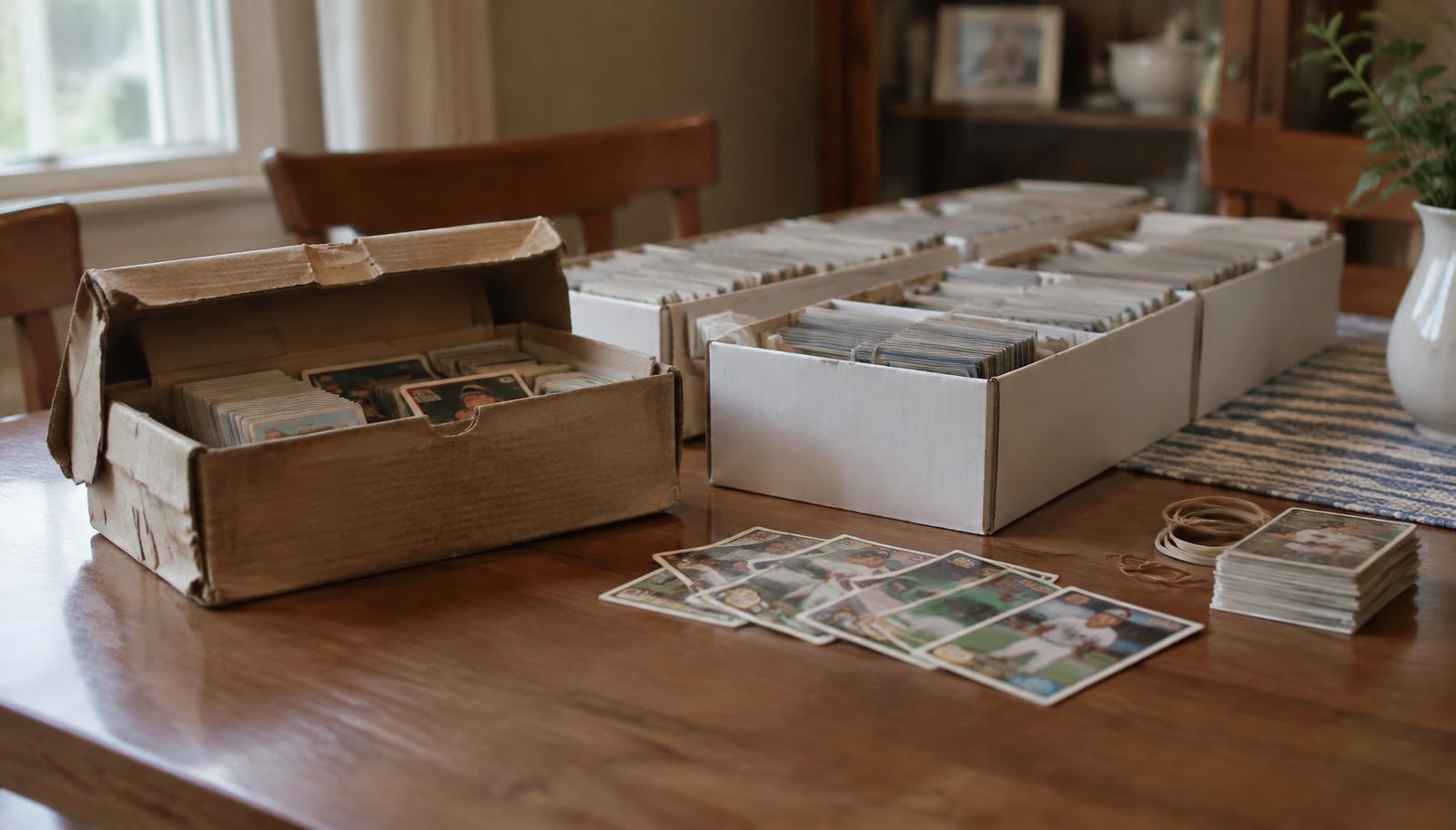
Are Old Baseball Cards Worth Anything? How to Sort an Inherited Sports Card Collection, Spot the Few Valuable Cards, and Decide What to Grade or Sell
Most old baseball cards are common, but a few deserve care. A 10-minute sorting pass, sold-price checks, when PSA grading pays, and where to sell the rest.

In this guide · 11 sectionsShow
- 01Are old baseball cards worth anything anymore?
- 02How can I tell roughly when my cards were made?
- 03What should I pull out in the first 10 minutes?
- 04How do I check what a card is actually worth?
- 05Should I get my baseball cards graded?
- 06Where can I sell an inherited baseball card collection?
- 07How should estate sale companies handle sports card boxes?
- 08What do I do with thousands of common cards?
- 09What are the common myths about old baseball cards?
- 10Frequently asked questions
- 11The bottom line
Most old baseball cards are worth very little, but a few can be worth real money. Cards from before about 1980, star rookies, true errors, autographs, serial-numbered cards and anything already graded deserve a closer look. Most 1986–1993 "junk wax" cards were printed in huge numbers and sell for pennies. Check sold prices, not asking prices, before you grade or sell.
A closet shelf of shoeboxes looks like a fortune or a chore, depending on who opens it. The truth usually sits in the middle: a handful of cards that deserve care, and thousands that are best sold as a lot. Your job is not to become a card expert overnight. It is to keep the collection intact, pull the few cards worth a second look, and pick a selling route that fits how much is actually there.
This guide is for families and executors sorting Dad's or Grandpa's boxes, treasure hunters deciding whether a card box at a sale is worth the asking price, and estate sale companies pricing collections. It is a sorting process, not an appraisal. If you already handled a coin collection or stamp album, the logic will feel familiar: preserve first, research second, sell last.
Are old baseball cards worth anything anymore?
Some are, and the age of the card matters more than how old the box looks. A 1950s or 1960s card of a star player can sell for real money even in worn condition. A 1989 card of a common player almost never does, because the late 1980s and early 1990s produced far more cards than collectors wanted.
Card historians call that stretch the "junk wax era." BaseballCardPedia places it between 1986 and 1993, with a peak around 1989–91, and notes that most cards and boxes from those years are worth less than their early-1980s counterparts. A November 2026 explainer from Common to Grail adds why: more manufacturers entered the market (Score in 1988, Upper Deck in 1989), and collectors saved cards in mint condition from day one, so high-grade copies are everywhere. It also points out that exact print runs were never published, so treat any quoted print-run number as an estimate.
That is the honest answer for most inherited boxes: the bulk is common cards, and the value, if there is any, is concentrated in a small pile.
How can I tell roughly when my cards were made?
Look at the copyright line and year on the back of the card. Then use this table as a first sort. It is a routing guide, not a price list; values swing by player, condition and current demand.
| Era (roughly) | What you'll often see | First expectation | What to do |
|---|---|---|---|
| Before 1950 | Small cards, tobacco or candy brands, sepia or tinted portraits | Can be valuable even when worn; reproductions exist | Don't clean or trim; ask a specialist or auction house |
| 1950s–1960s | Topps and Bowman, thicker gray cardboard | Stars and Hall of Famers can sell well; commons modest | Pull stars, keep sets together, check sold prices |
| 1970s | Topps, colorful borders | Mostly modest; key rookies and stars matter | Pull rookies and stars |
| 1980–1985 | Topps, Fleer, Donruss | Mostly low; a few famous rookies | Check the specific rookie cards |
| 1986–1993 ("junk wax") | Many brands, glossy Upper Deck from 1989 | Most cards sell for pennies, even in sealed boxes | Pull only star rookies, true errors, Topps Tiffany |
| 1994–present | Inserts, parallels, autographs, serial numbers ("/99") | Base cards low; numbered, autographed and rare inserts can matter | Look for serial numbers and certified autographs |
The era dates for junk wax come from BaseballCardPedia; the rest is a practical sort order. Treat the table as a "where to look first," not "what it's worth."
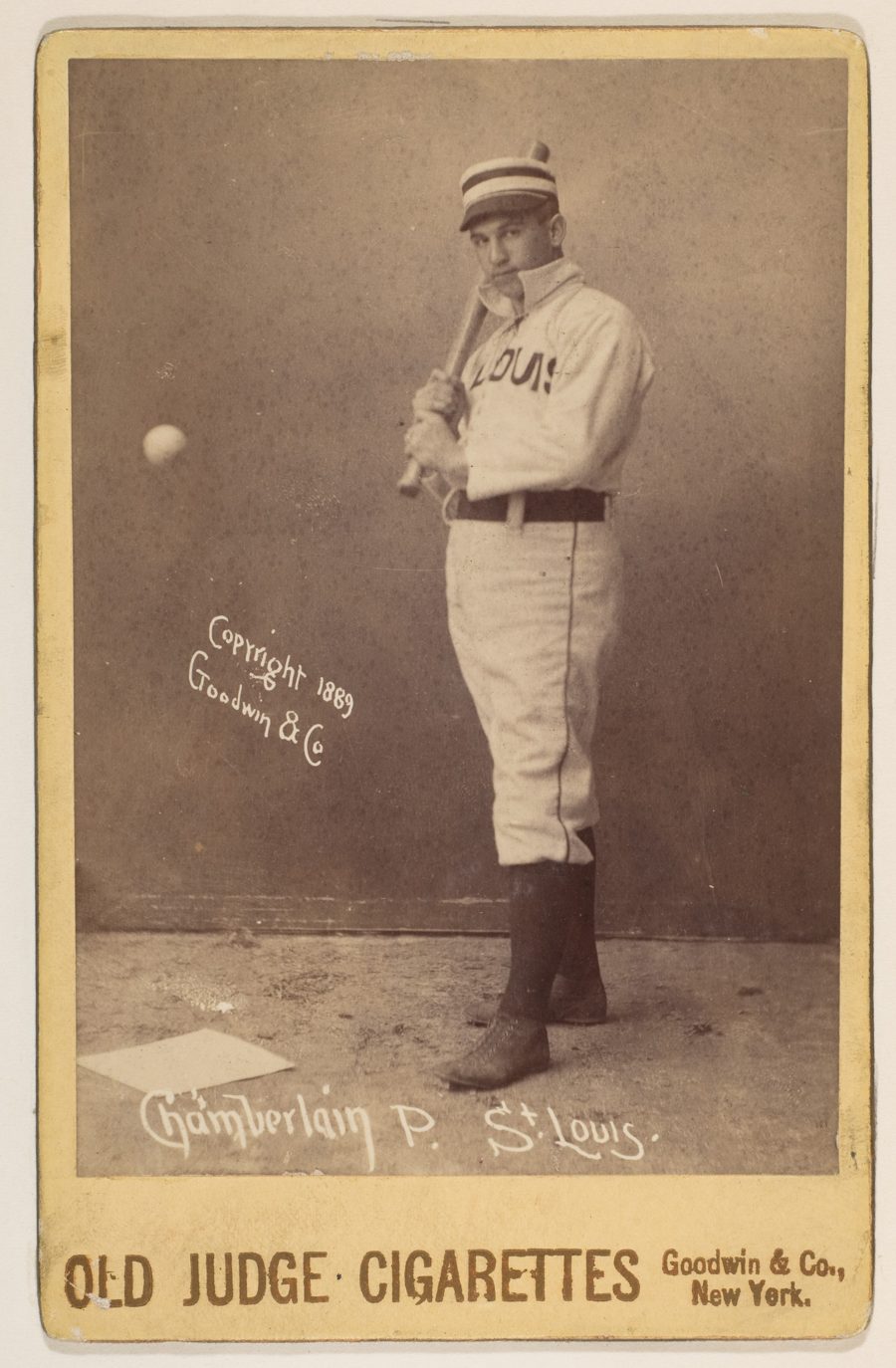
Real museum photograph: Goodwin & Company, "Ice Box" Chamberlain, Old Judge Cigarettes series, about 1888. The Metropolitan Museum of Art, CC0. Shown to illustrate what pre-1950 tobacco cards look like, not as a value example. Old tobacco cards are widely reproduced, so a card that looks like this still needs authentication.
Card table sorter · not an appraisal
Which pile does this card go in?
Check pile
Check sold prices raw and graded before deciding to grade.
What should I pull out in the first 10 minutes?
Before anyone prices anything, do a quick, gentle pass. The goal is to find the cards worth slowing down for without damaging anything or scrambling the collection.
- Keep boxes in the order you found them. Sets, team stacks and binders are often worth more together than scattered. Label each box ("Box A, hall closet") on a sticky note on the outside.
- Do not open sealed packs or boxes. Unopened wax, cello and rack packs sell as sealed product. Once opened, that premium is gone. Junk wax-era sealed boxes are often modest too, but leave the decision to a buyer.
- Handle cards by the edges. No rubber bands, tape, writing, cleaning or flattening. Corners and edges drive grades.
- Pull anything already graded. Cards in hard plastic slabs from PSA, SGC, Beckett (BGS) or CGC have a grade and a certification number you can look up.
- Pull rookie cards of stars. Many cards print "RC" or "Rookie Card." Look for Hall of Famers and famous names.
- Pull autographs and serial-numbered cards. A stamped number like "23/99" on the front or back marks a limited print. Certified autographs usually say so on the back.
- Pull known premium versions. Topps Tiffany (glossy, limited factory sets from 1984–1991), early Upper Deck stars, and cards flagged as errors in price guides.
- Note what's left as "commons." Count boxes, not cards. A 3,200-count box of 1990 commons is a lot description, not a sorting project.
That pile of pulled cards is usually small. If it is empty after a careful pass, the collection is most likely a bulk lot, and that's fine. It still sells.
If you are working through a whole house, add the card boxes to the list in what not to throw away before an estate sale, and keep the box IDs in the family's inventory so nobody "helpfully" tosses them.
How do I check what a card is actually worth?
Use sold prices, never asking prices. Anyone can list a common 1989 card for $500; what matters is what buyers paid.
- Search completed sales. On eBay, filter by "Sold items." Match the exact year, brand, card number and player. Raw (ungraded) and graded cards sell very differently, so compare like with like.
- Check the grade, not just the card. A PSA 10 and a raw, off-center copy of the same card are different products.
- Look at several sales, not one. One outlier sale proves little. Look for a pattern across recent months.
- Get a quick read with a photo. The EstateSaleFinder AI Appraiser can identify a card from a photo and point you toward comparable sales. Treat its number as a starting suggestion to check against sold listings, not a final price.
Worked example (illustration only)
a family finds 14 binders and 9 monster boxes. After the 10-minute pass, they've pulled 31 cards: a few 1960s stars, two certified autographs, and some 1990s rookies. Sold-price checks show six cards that clearly sell well raw, three that might be worth grading, and the rest modest. The remaining boxes become two or three bulk lots. That's a realistic outcome, not a disappointment.
Should I get my baseball cards graded?
Grade only the few cards where the grade will clearly add more value than the fee. For most inherited collections that is a handful of cards, or none.
PSA, the largest grading company, lists its Value service at $39.99 per card for cards valued up to $500, with an estimated turnaround of 90–100 business days, and Standard at $59.99 per card for cards up to $1,000, according to PSA's fee page and its October 2026 pricing update. Those are grading fees only; shipping, insurance and selling fees come on top, and PSA says turnaround times are estimates, not guarantees. Fees change often, so check the page the day you submit.
Other graders exist at different price points. An independent tracker, GradingTimes, listed CGC, SGC, TAG and BGS tiers in November 2026, some with card minimums. Compare total cost and how buyers in your card's category value each grading company.
A simple grading test:
| Question | If yes | If no |
|---|---|---|
| Does the card sell for well over the grading fee raw? | Keep going | Sell raw or in a lot |
| Do graded copies sell for clearly more than raw copies? | Keep going | Sell raw |
| Is the card sharp: clean corners, centered, no creases? | Consider grading | Sell raw; a low grade rarely helps |
| Can you wait several months for the card to come back? | Grade | Sell raw now |
If the answer is "no" at any step, selling raw is usually the better move.
Where can I sell an inherited baseball card collection?
Match the route to what you actually have.
- An estate sale. Good for whole collections mixed with the rest of the house. A local company can price the standout cards separately and sell commons as boxes or lots. Shoppers who follow wishlist alerts for "baseball cards" get notified when a nearby sale lists them, which helps the right buyers show up.
- A local card shop. Fast and simple. Expect an offer below retail, because the shop has to resell. Ask whether they'll quote the pulled cards separately from the bulk.
- A card show. Many dealers in one room means you can compare offers the same day. Bring the pulled cards in sleeves and top-loaders and the bulk in labeled boxes.
- An auction house or consignment auction. Best for the few truly valuable cards, especially pre-1970 stars and high-grade rookies. Ask about seller fees and timing.
- Online marketplaces. Highest effort: photos, listings, shipping and returns. Works well for mid-value singles if someone in the family wants to do it.
Get at least two offers on anything that matters, and make sure each buyer quotes the same set of cards.
How should estate sale companies handle sports card boxes?
Card boxes are a common sale-day headache: shoppers dig through them, mix sets, and pocket the one good card. A few habits help.
- Screen before you price. Do the 10-minute pass above before the sale. Pull graded, autographed, numbered and star rookie cards into a showcase or the checkout area.
- Price commons as lots. Sell by the box or by the bag with a clear count. Don't tag single commons.
- Photograph the good cards for the listing. Card buyers decide which sales to visit from photos. On EstateSaleFinder, companies use Tag and Go to photograph and tag items as they work, and the listing updates without a separate upload step.
- Use pre-offers for standouts. Letting serious buyers make offers before the sale on the pulled cards can bring better prices than first-come, first-served.
- Tell the family what you found. Note which cards went to a specialist route and why, so nobody wonders later.
Across EstateSaleFinder, 61 sale listings in the past year mentioned baseball or sports cards in their title or description. That's a small but steady share, which is why a clean sports-card photo in the listing stands out.
What do I do with thousands of common cards?
Most families end up here, and it is a normal ending.
- Sell as a bulk lot. Card shops, shows and estate sales all move bulk, usually priced by the box or by weight.
- Give some to young fans. Kids' teams, a grandchild who's just starting, or a local youth league.
- Donate. Some charities, hospitals and youth programs accept cards. Call first.
- Keep a few for the story. A favorite player, a hometown team. That's worth more than the market price.
What not to do: throw boxes away before someone has done the 10-minute pass. The one rookie card hiding in a box of commons is the whole reason to look.
What are the common myths about old baseball cards?
"They're old, so they must be valuable." Age helps only when it comes with scarcity. A card from 1990 is over 35 years old and still usually common.
"Sealed boxes from the '80s are a jackpot." Some sealed product sells well, but many junk wax-era boxes are modest because so many were saved. Check sold prices before opening or selling.
"The price guide says it's worth $50." Guides and asking prices are not sales. What a buyer actually paid, recently, is the number that counts.
"Grading always adds value." A low grade can make a card harder to sell than a clean raw copy, and fees add up fast.
"I should clean or press the cards first." Don't. Cleaning, trimming and pressing can be detected and can lower value or cause a card to be rejected.
Questions & answers
Frequently asked questions
Are 80s and 90s baseball cards worth money?
Most are worth very little because of heavy production in the late 1980s and early 1990s, the period BaseballCardPedia dates to 1986–1993. Exceptions include star rookies in top condition, certain errors, Topps Tiffany sets, and later serial-numbered or autographed cards.
How do I know if my baseball cards are worth anything?
Check the year, brand, card number and player, then search sold listings for the same card in similar condition. Pull pre-1970 stars, rookies, autographs, serial-numbered and graded cards first. A photo through the AI Appraiser can give you a quick starting suggestion to verify against real sales.
Should I get my old baseball cards graded?
Only if the card already sells for well over the fee raw, graded copies sell for clearly more, and your card is in sharp condition. For most inherited boxes, that's a few cards at most.
How much does it cost to grade a baseball card?
PSA's Value tier is $39.99 per card for cards valued up to $500, and Standard is $59.99 for cards up to $1,000, per PSA's fee page as of November 2026. Shipping, insurance and selling fees are extra. Check current fees before submitting.
Where can I sell an old baseball card collection?
An estate sale, a local card shop, a card show, an auction house for top cards, or online marketplaces. Get at least two offers on the cards that matter, and make sure each buyer is quoting the same cards.
Will an estate sale company sell sports cards?
Many will, especially as part of a full household sale. Ask how they screen card boxes, whether they pull standout cards for separate pricing, and how they sell commons. You can find estate sale companies near you and ask before you sign.
The bottom line
Keep the boxes together, do one careful 10-minute pass, check sold prices for the small pile you pull, grade only the few cards that clearly justify the fee, and sell the rest as lots. If you're a shopper, save "baseball cards" to your wishlist so you hear about nearby sales that list them, and use the route planner to hit several on the same Saturday.
Related reading: Pokémon cards at estate sales, what Beanie Babies and junk wax taught resellers, vintage toys worth money, inherited coin collections and old stamp collections.
Keep exploring
Snap a card. Get a starting point.
The AI Appraiser identifies a card from a photo and suggests comparable sales to check. Treat it as a suggestion, then confirm with sold prices.
Try the AI AppraiserAbout the author
Andy
Founder, EstateSaleFinder.net
Hi, I'm Andy — a retired commercial photographer turned developer with a five-year (and counting) obsession with estate sales. I started EstateSaleFinder.net because I knew there had to be an easier, smarter way to find and list estate sales. Now I get to chase treasure and build the tool I always wished existed.