
Is My Furniture Mid-Century Modern? How to Identify Real MCM at Estate Sales (Labels, Date Codes, and Fakes)
A five-minute check for estate sales, where maker's marks hide, a makers cheat sheet, how to read a Lane date code, signs of a reproduction and what MCM is worth. Free printable field sheet.

In this guide · 11 sectionsShow
- 01Quick summary
- 02What years are considered mid-century furniture?
- 03What defines mid-century furniture?
- 04How to identify mid-century modern furniture in five minutes
- 05Mid-century modern furniture makers: a cheat sheet
- 06How do I spot fake or reproduction mid-century furniture?
- 07How much is my mid-century modern furniture worth?
- 08Where can I buy mid-century furniture cheap?
- 09FAQ
- 10Related guides
- 11Sources
To tell if furniture is mid-century modern, check three things: the look, the mark and how it's built. Real MCM usually dates from about 1945 to 1969, with clean lines, tapered legs and walnut or teak. Look for a maker's label inside drawers, on the back or underneath. Then check the build: dovetailed drawers and solid wood point to the period; staples and particleboard mean it's newer.
Quick summary
- The years: the core mid-century period runs from about 1945 to 1969. The Museum of Arts and Design calls "the period between 1945 and 1969" a key era for American craft and design (Museum of Arts and Design).
- Find a mark. Labels, ink stamps and metal tags usually hide inside drawers, on the back panel or underneath. Hold a flashlight low and sideways to read faint stamps.
- Herman Miller labels help date a piece. The company was the Herman Miller Furniture Company from 1923 and Herman Miller, Inc. from 1960 (Saint Louis Art Museum).
- Lane serials read backward. Lane's own FAQ says to read the serial "BACKWARDS," so 753150 means 05/13/57 (Lane).
- A label names the maker, not always the designer. And "the label dates the label. It does not date the chair" (Mid Century Form).
- Our own data: in EstateSaleFinder listings, 1,738 item titles mention "mid-century" or "MCM," 257 mention Lane, 144 teak, 35 Danish and 31 Broyhill. That's out of about 214,000 items.
- Free download: a Mid-Century Modern 5-Minute Check, below.
What years are considered mid-century furniture?
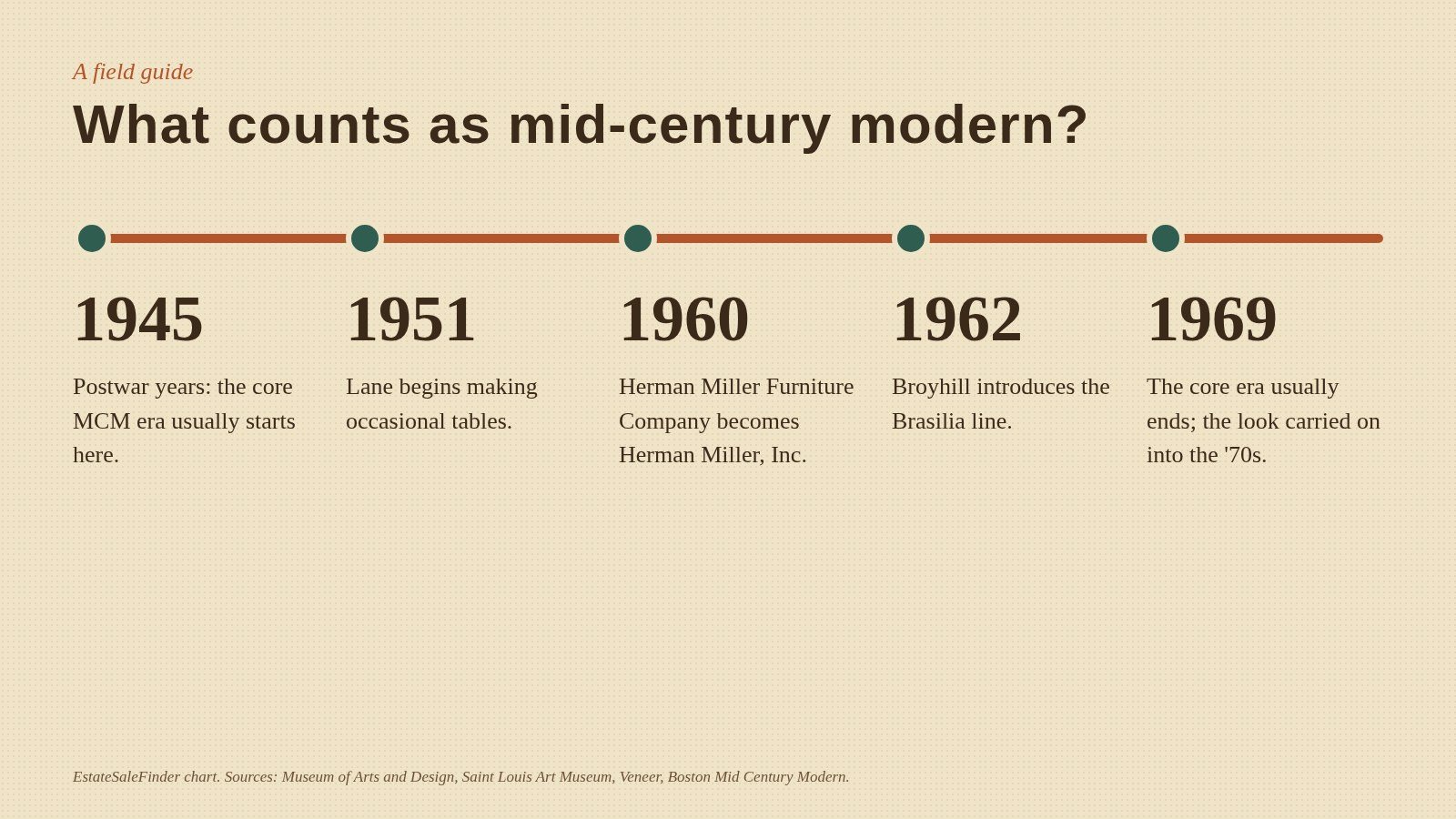
Most dealers and museums use about 1945 to 1969 for the core period, starting after World War II. Some use a wider range. A research guide at Appalachian State University notes the term is often stretched from the early 1930s to the mid-1970s (Appalachian State University Libraries). For shopping, think of 1945 to 1969 as the heart of it and the early 1970s as the tail.
What defines mid-century furniture?
Mid-century modern is a look built on simple shapes and honest materials. In 1950 the Museum of Modern Art published Edgar Kaufmann Jr.'s "Twelve Precepts of Modern Design," which said modern design should "be simple, its structure evident in its appearance" and "express the qualities and beauties of the materials used" (Appalachian State University Libraries).
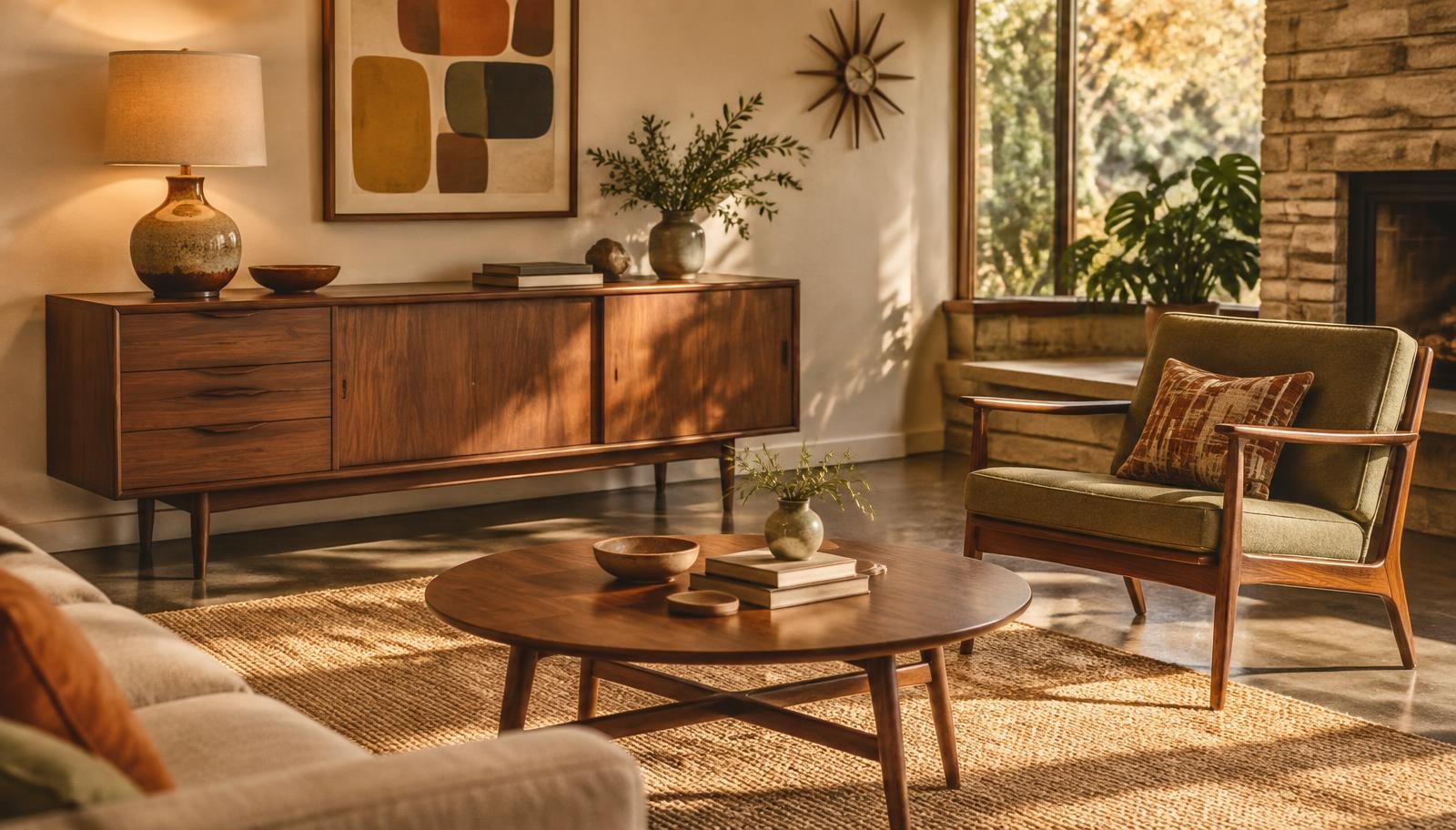
In a house full of furniture, MCM usually stands out by:
- Low, long shapes, such as credenzas, lowboy dressers and platform beds.
- Tapered or splayed legs, often angled outward.
- Warm woods and veneers, especially walnut, teak and rosewood, plus molded plywood, fiberglass and metal.
- Little decoration. Pulls are often carved into the drawer edge or are simple bars.
The look alone isn't proof. Companies have copied it for decades, so the next two checks matter more.
How to identify mid-century modern furniture in five minutes
You don't need tools beyond your phone's flashlight. Work in this order.
Minute 1: the look
Check the shape, legs and wood against the list above. If it has heavy carving, claw feet or ornate brass, it's probably another style.
Minute 2: find a mark
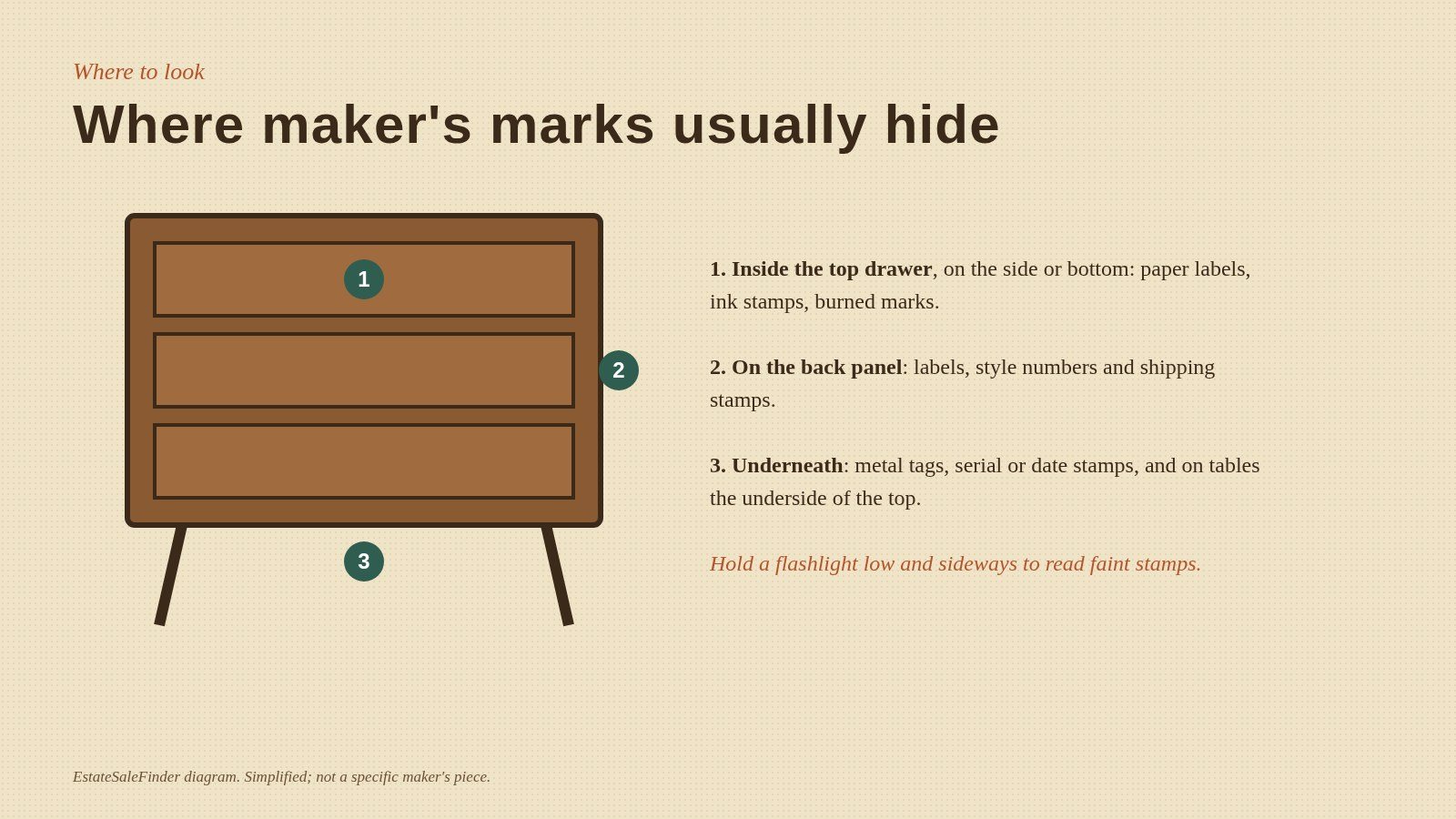
Pull out the top drawer and check its sides and bottom. Then look at the back panel and underneath. On tables, look at the underside of the top. Veneer, an app for dating furniture, gives the same advice for Lane: "On tables, look on the underside of the top" (Veneer). Hold your flashlight low and sideways. Raking light makes faint ink stamps and burned marks readable.
Minute 3: how it's built
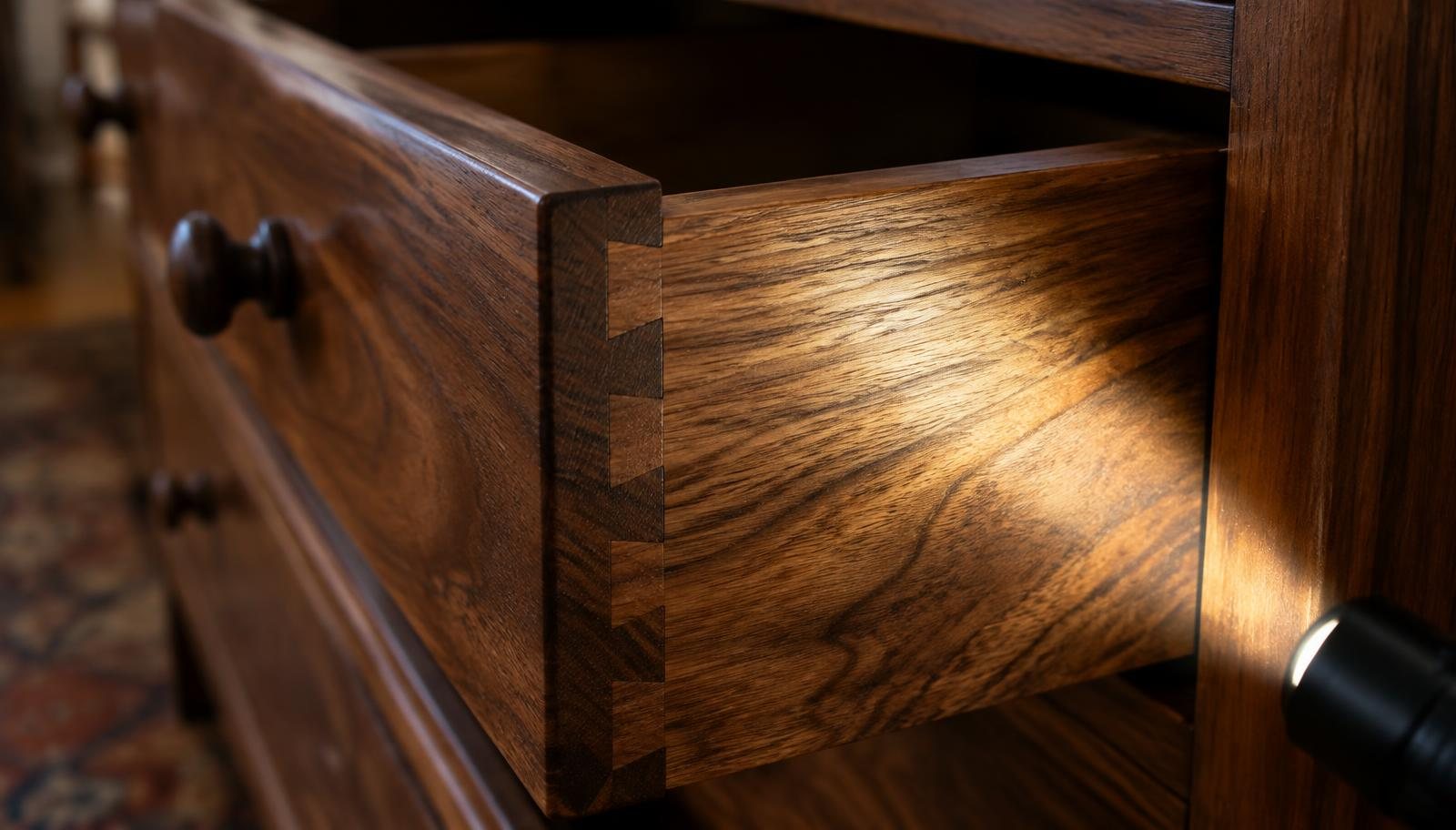
Labels fall off, so the build matters. Dovetailed drawers and solid wood, or veneer over a solid core, fit the period. Staples holding drawers together, particleboard edges and modern screws mean it's newer or has been heavily repaired.
Minute 4: condition
Look for lifting veneer, chips, water rings, a paint job or a heavy refinish, and wobbly or replaced legs. These lower value even on a genuine piece.
Minute 5: decide
Check sold prices for the same maker and line before you pay. Asking prices tell you little.
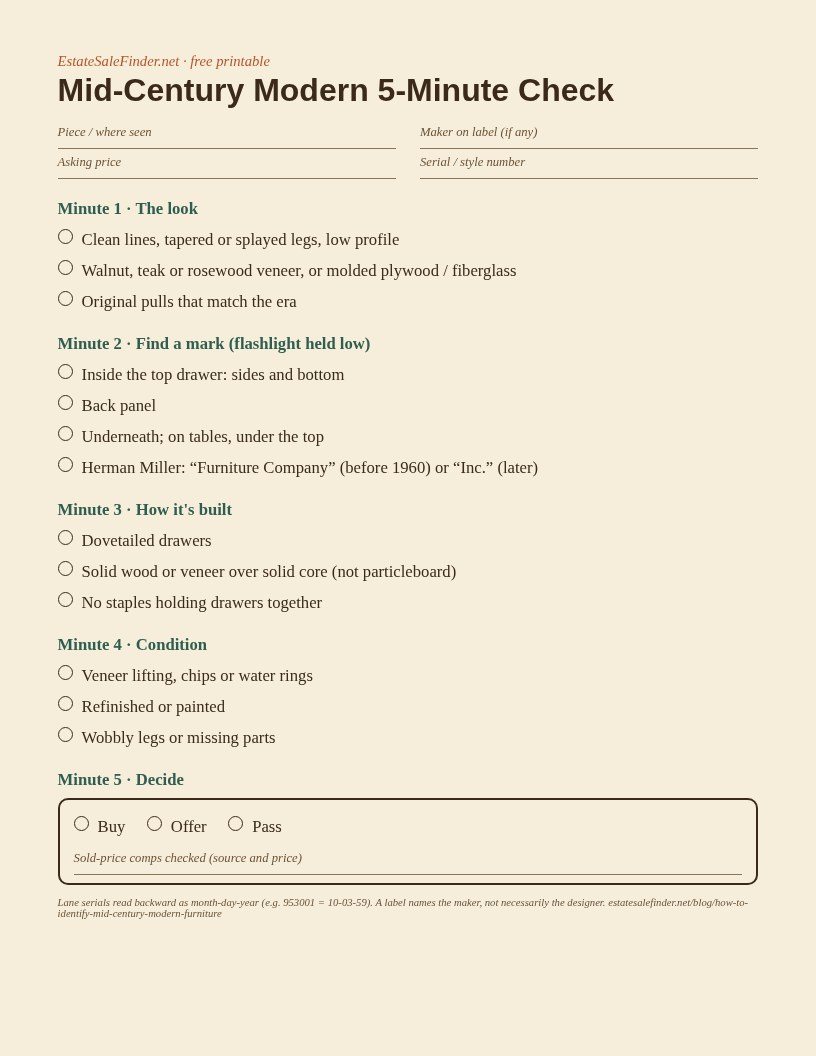
Free printable: Mid-Century Modern 5-Minute Check
A full 8.5 x 11 page to take to estate sales: the look, the mark, the build, condition and a buy, offer or pass decision.
Mid-century modern furniture makers: a cheat sheet
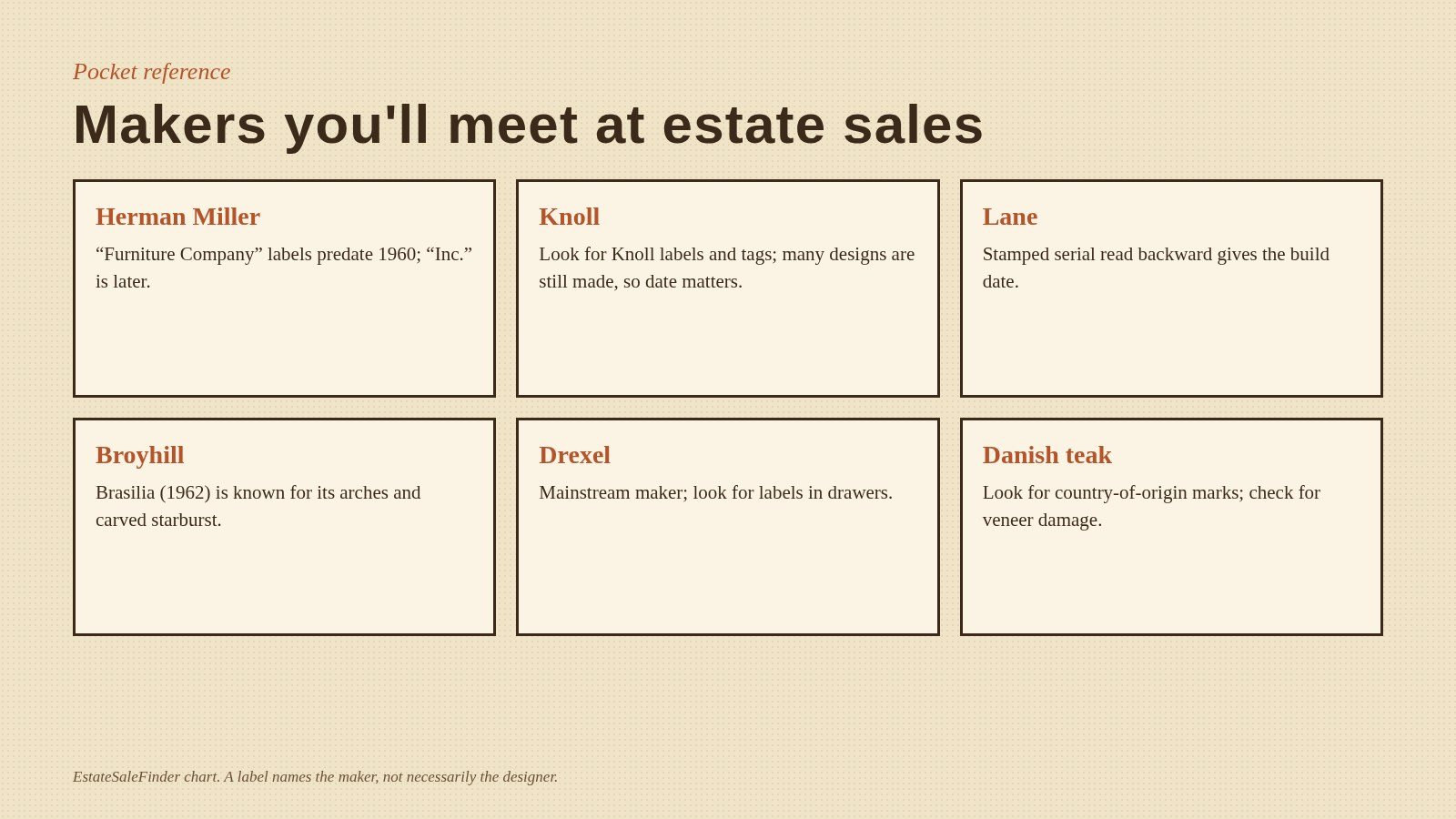
| Maker | What to look for | Dating clue |
|---|---|---|
| Herman Miller | Paper labels, foil labels and stamps under seats and inside cases | "Herman Miller Furniture Company" before 1960; "Herman Miller, Inc." from 1960 |
| Lane | Stamped style number and serial, often on the back or bottom | Read the serial backward: month, day, two-digit year |
| Broyhill Brasilia | Arched door fronts and a carved starburst motif on walnut case pieces | Introduced in 1962 |
| Knoll | Knoll labels and tags | Many designs are still made, so date the label, not just the design |
| Danish teak | Country-of-origin marks such as "Made in Denmark" | Check veneer edges for chips and lifting |
Sources for the table: Saint Louis Art Museum, Mid Century Form, Lane, Veneer, Boston Mid Century Modern and Mod City Madness.
Herman Miller: the label dates the label
Mid Century Form, a site devoted to dating Herman Miller, says the company "changed its labels a dozen times between 1946 and 1984," and that each change narrows the date. It adds an important warning: "The label dates the label. It does not date the chair." On Eames chairs, shells, bases and glides were often swapped over the years, so a 1954 label on a shell says nothing about the base bolted to it (Mid Century Form). The simple split shoppers can use: "Herman Miller Furniture Company" on a label points to before 1960, and "Herman Miller, Inc." to 1960 or later (Saint Louis Art Museum).
How do I read a Lane date code?
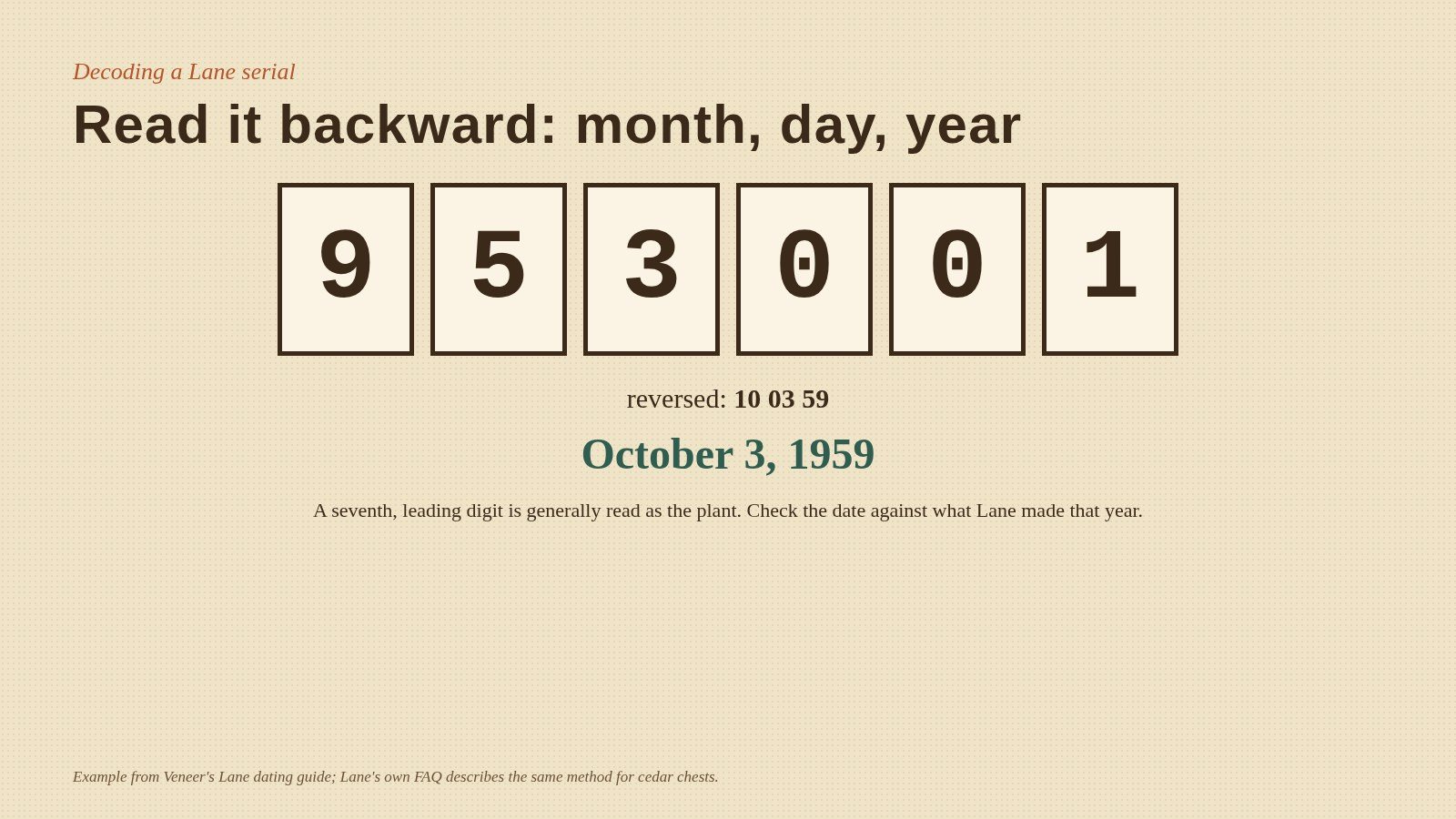
Read the six-digit serial right to left. It splits into month, day and two-digit year. Veneer's example: "953001 reads as 10-03-59, October 3, 1959," and a seventh leading digit "is generally read as the plant" (Veneer). Lane's own FAQ uses the same method for cedar chests: 753150 means 05/13/57 (Lane).
Sanity-check the date. Veneer notes that "Lane used more than one numbering system over the decades," and that Lane began making occasional tables in 1951, so "a Lane coffee table can't predate the tables" (Veneer).
Safety note for cedar chests
Veneer advises that on a Lane cedar chest made between 1912 and 1987, you should "take the old lock off" (Veneer). The old latch locks automatically and has trapped children. If you resell one, remove or disable the lock.
Is Broyhill mid-century modern?
Yes, some of it. Broyhill made many styles, but its Brasilia line, introduced in 1962, is one of the best-known American MCM lines. Boston Mid Century Modern says the line was inspired by the architecture of Brazil's new capital city (Boston Mid Century Modern). Mod City Madness calls the carved starburst "the one that makes it instantly identifiable" (Mod City Madness). Sources disagree on who designed it: Boston Mid Century Modern credits Melbourne Smith, while Mod City Madness credits Chet Beardsley. It's a good reminder that a maker's name is easier to prove than a designer's.
How do I spot fake or reproduction mid-century furniture?
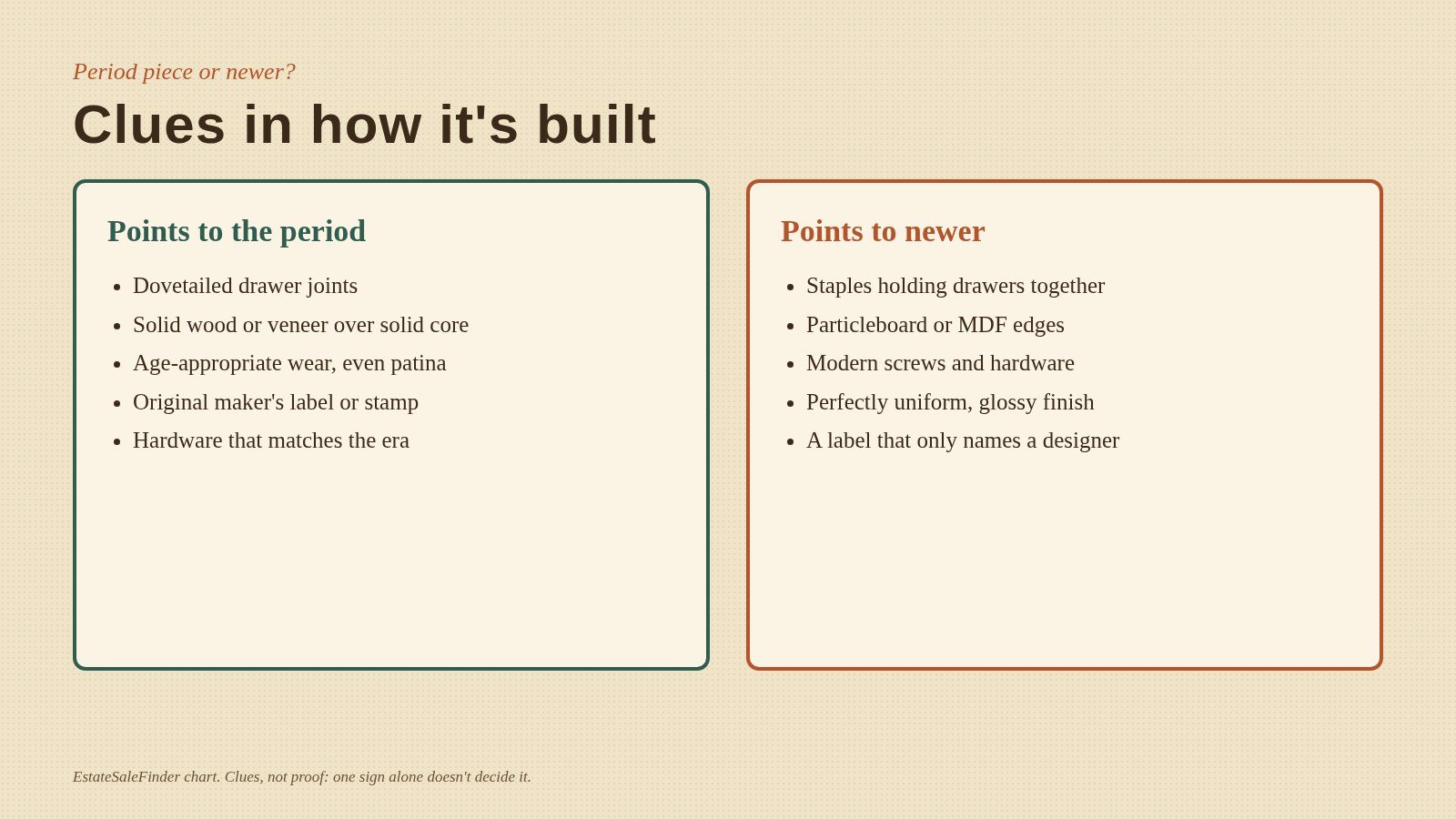
Mod City Madness warns that even well-known lines have "fakes and lookalikes" (Mod City Madness). No single clue settles it, but together they tell a story:
| Points to the period | Points to newer |
|---|---|
| Dovetailed drawer joints | Staples holding drawers together |
| Solid wood, or veneer over a solid core | Particleboard or MDF edges |
| Even wear and patina where hands touch | A perfectly uniform, glossy finish |
| An original maker's label or stamp | A label that only names a famous designer |
| Hardware that matches the era | Modern screws, hinges and drawer slides |
Watch for "MCM style." Sellers often use "mid-century" to describe a look, not an age. That's fine if the price fits, but don't pay a vintage price for a new piece.
How much is my mid-century modern furniture worth?
It depends far more on the maker and condition than on the look. Designer pieces from makers such as Herman Miller and Knoll can sell well. Mass-produced pieces from department-store lines usually sell for much less, though named lines like Broyhill Brasilia have a strong following.
To price a piece:
- Identify the maker and line from the label or stamp.
- Search sold listings, not asking prices, for the same maker, line and piece.
- Adjust for condition. Veneer damage, refinishing and replaced parts lower value.
- Use the AI Appraiser to research comparable items. Its prices are suggestions, not appraisals.
Our guide to what furniture buyers want at estate sales explains why designer names sell, and is brown furniture coming back? covers which wood furniture is selling in 2026.
Where can I buy mid-century furniture cheap?
Estate sales are one of the best places, because whole houses furnished in the 1950s and 1960s still come up. A few tips:
- Search by keyword. Use browse estate sales and search for "mid-century," "teak," "Lane" or "Danish."
- Set a wishlist alert. Add those words to your wishlist and get notified when a matching item is listed. Our wishlist alerts guide shows how.
- Go on the last day. Furniture that didn't sell is often discounted.
- Bring a tape measure and your flashlight. Measure your car and the door before you buy.
Tips for booth dealers
- Buy the line, not just the piece. A matching set or a recognized line sells faster.
- Photograph the label. Buyers trust a clear photo of the maker's mark.
- Write honest listings. Say "MCM style" when you can't confirm the maker.
- Clean gently. See how to clean antiques without ruining them before you touch an old finish.
More sourcing advice is in our booth seller sourcing guide.
FAQ
How can I tell if furniture is mid-century modern?
Check the look (clean lines, tapered legs, walnut or teak), find a maker's mark inside drawers, on the back or underneath, and check the build. Dovetailed drawers and solid wood point to the period; staples and particleboard mean it's newer.
What years count as mid-century?
The core period is about 1945 to 1969. Some sources use a wider range, from the 1930s into the mid-1970s.
How much is my mid-century furniture worth?
It depends on the maker, line and condition. Designer pieces can sell well; mass-produced pieces usually sell for less. Search sold listings for the same maker and piece.
Is Broyhill mid-century modern?
Some Broyhill is. Its Brasilia line, introduced in 1962, is a well-known American MCM line, recognized by its arches and carved starburst.
How do I read a Lane date code?
Read the six-digit serial backward. It gives month, day and two-digit year: 953001 means October 3, 1959. A seventh leading digit is generally the plant.
How do I spot fakes?
Look for staples, particleboard, modern hardware and a too-perfect finish. A label that names only a famous designer is a warning sign. Weigh the clues together.
Where can I buy mid-century furniture cheap?
Estate sales, especially on the last day. Search listings for "mid-century," "teak" or "Lane," and set a wishlist alert for those words.
Related guides
Sources
- Museum of Arts and Design: Crafting Modernism exhibition
- Appalachian State University Libraries: Mid-Century Modern Design
- Saint Louis Art Museum: Herman Miller Furniture Company
- Mid Century Form: How to date Herman Miller furniture by its label
- Lane Furnishings: FAQ
- Veneer: How to date Lane furniture
- Boston Mid Century Modern: Broyhill Brasilia
- Mod City Madness: Broyhill Brasilia collector's guide
Sources checked November 10, 2026. Photos are AI-generated illustrations and show no real maker's piece; charts are EstateSaleFinder diagrams built from the sources above. This guide helps you screen furniture; it isn't an appraisal.
Bought it? Here's what to bring and how long you have to pick it up.
Keep exploring
Ready to start your own treasure hunt?
Discover estate sales near you and find incredible deals.
Explore Sales Near MeAbout the author
Andy
Founder, EstateSaleFinder.net
Hi, I'm Andy — a retired commercial photographer turned developer with a five-year (and counting) obsession with estate sales. I started EstateSaleFinder.net because I knew there had to be an easier, smarter way to find and list estate sales. Now I get to chase treasure and build the tool I always wished existed.