
Can You Sell Ivory at an Estate Sale? Ivory, Taxidermy, Feathers and Tortoiseshell Rules for Families and Companies (2026)
Sometimes — but the rules are stricter than most families expect. The federal tests, the state bans, and what to do when you find ivory, mounts or feathers in a loved one's home.
Sometimes — but far less often than families hope. An estate sale is still a sale in the eyes of the law, and "it belonged to Grandma" is not a legal defense. Small amounts of ivory can be sold federally only if the item passes every one of five tests, and states like California, New York, New Jersey and Hawaii are stricter. Eagle feathers and mounted migratory birds are almost never legal to sell. When in doubt, pull the item from the sale and ask a qualified appraiser or attorney before it has a price tag.
Quick summary
- Federal ivory rule: since July 6, 2016, commercial trade in African elephant ivory is banned unless the item passes ALL five de minimis tests (details below).
- State laws can be stricter: California, New York, New Jersey and Hawaii have their own bans or permit systems. Federal approval does not override them.
- Eagle feathers and mounts: effectively never legal to sell. First offense can mean a $100,000 fine for an individual.
- Migratory bird mounts and feathers: generally illegal to sell, even found feathers.
- Deer mounts and ordinary taxidermy: usually fine if legally hunted, but state wildlife rules apply.
- Tortoiseshell: from hawksbill sea turtles; heavily restricted under the Endangered Species Act and CITES.
- eBay and Facebook: ban ivory and most animal products outright, even where the law might allow them.
Can I sell it? A quick table
These are general patterns, not legal rulings. Every item depends on its species, age, paperwork and the state where the sale happens.
| Item found in the estate | Usually OK to sell? | Why |
|---|---|---|
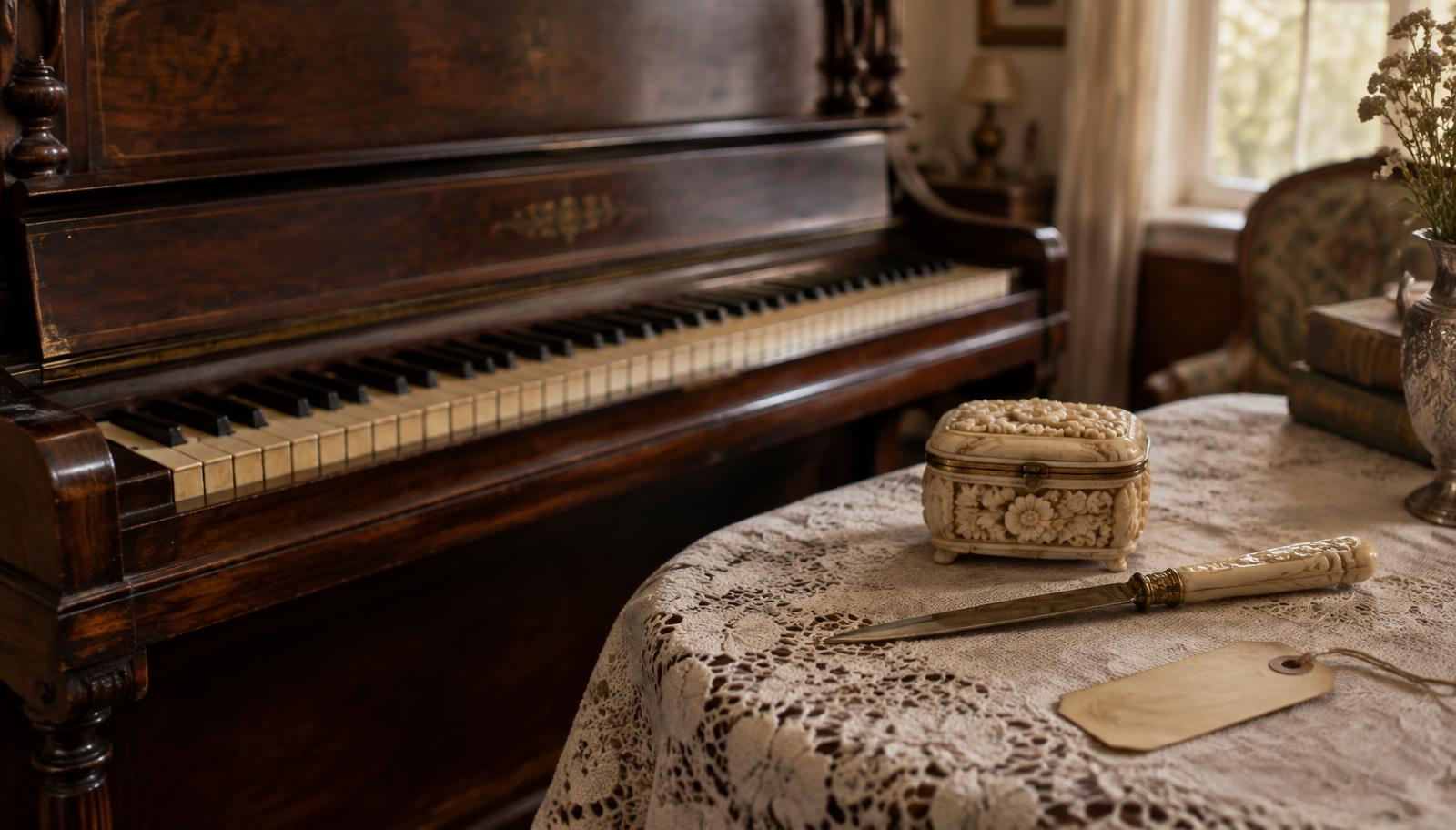
| Piano with ivory keys | Often yes | Can pass the federal tests if old enough and ivory is a small part of the whole |
| Ivory-handled knife or letter opener | Often yes | Same tests: under 200g of ivory, less than half the value and volume |
| Furniture with ivory inlay | Often yes | Ivory is a small fixed component of a larger piece |
| Solid ivory carving or figurine | Usually no | Ivory IS the item, so it fails the "small component" tests |
| Ivory chess set | Usually no | Same problem: mostly or entirely ivory |
| Ivory jewelry (brooch, beads, bangle) | Usually no | Typically fails the component and value tests |
| Mammoth ivory | Depends on state | Legal federally, but CA, NY, NJ and HI restrict it |
| Mounted deer head | Usually yes | Legal if lawfully hunted; check state wildlife rules |
| Mounted duck, goose or other migratory bird | Usually no | Migratory Bird Treaty Act; wild-taken birds may not be sold |
| Bald or golden eagle anything | No | Feathers, mounts, nests, eggs — all illegal to sell |
| Songbird or hawk feathers (even found ones) | No | Possession without a permit is generally prohibited |
| Tortoiseshell comb, box or jewelry | Usually no | Hawksbill sea turtle; ESA and CITES restrictions |
The federal ivory rule in plain English
On July 6, 2016, a near-total federal ban on commercial trade in African elephant ivory took effect. There is a "de minimis" exception for items with a small amount of ivory, but an item must pass every one of these five tests (50 CFR § 17.40):
- The ivory was imported into the U.S. before January 18, 1990 (or came in under a CITES pre-Convention certificate with no commercial-use limit).
- The ivory is a fixed or integral part of a larger manufactured or handcrafted item — not raw ivory, and not a stand-alone ivory object.
- The ivory weighs less than 200 grams (about 7 ounces).
- The item was made before July 6, 2016.
- The ivory is less than 50% of the item's volume AND less than 50% of its value — both, not either.
This is why the old upright piano with ivory key tops usually qualifies: the keys are a small, fixed part of a much larger, much older item. And it's why the carved ivory figurine on the mantel usually doesn't: the ivory is the whole item.
One honest warning: the U.S. Fish and Wildlife Service publishes the tests, not a master list of which household items pass. Piano keys, knife handles and inlaid furniture are the classic examples of items that can qualify; carvings, chess sets and jewelry are the classic examples that usually can't. But each piece stands on its own facts. The USFWS guide "What Can I Do With My Ivory?" is the best starting point.
State laws are often stricter
Passing the federal tests is not the finish line. Several states run their own bans, and a sale that's fine federally can still be illegal where the estate sale happens.
| State | What to know |
|---|---|
| California | General ban. The antique exception requires the item to be at least 100 years old with ivory under 5% by volume, backed by provenance documents. California's definition of "ivory" includes mammoth (Fish & Game Code § 2022). |
| New York | General ban with a DEC license system. The antique exception requires 100+ years old and ivory under 20% by volume with documentation. The sale license lasts one year and has no fee (NYSDEC). |
| New Jersey | Broad ban on selling ivory and rhino horn. The law lets you pass ivory to lawful estate beneficiaries — but inheriting it is not permission to resell it at the estate sale (P.L. 2014, c. 22). |
| Hawaii | Bans sales of listed animal products including elephant and mammoth ivory, plus sea turtle products (HRS § 183D-66). |
Other states have their own rules, and they change. Check the law in the state where the sale is held — and if you ship to a buyer, the destination state too.
Feathers, eagles and mounted birds
This is the one that surprises families most.
- Bald and golden eagles: the Bald and Golden Eagle Protection Act makes it illegal to sell, buy, barter or even possess eagle parts — feathers, mounts, nests, eggs — without authorization. USFWS says a first offense can bring a $100,000 fine for an individual ($200,000 for an organization), up to a year in prison, or both. A second offense is a felony (USFWS).
- Migratory birds: the Migratory Bird Treaty Act protects most native wild birds. USFWS says possessing their feathers without a permit is generally prohibited — even molted feathers you find on the ground (USFWS Feather Atlas). Wild-taken migratory bird mounts may not be sold, period.
- Ordinary taxidermy: a mounted deer head from a legal hunt is generally fine to sell, though state wildlife rules vary. There is no blanket "old taxidermy is legal" rule — age alone doesn't settle eagle, migratory bird or endangered species questions.
Tortoiseshell
"Tortoiseshell" combs, boxes and jewelry almost always come from the hawksbill sea turtle, which is protected under the Endangered Species Act and listed on CITES Appendix I — the strictest international category. Don't assume an old piece is exempt; the ESA antique exception has its own strict conditions (generally 100+ years old), and state law may add more (USFWS hawksbill page).
Is it really ivory? A 60-second check
Before anyone worries about the law, make sure it's ivory at all. Plenty of "ivory" in estate sales is bone or plastic.
- Look for Schreger lines: real elephant ivory shows cross-hatched lines (like wood grain meeting at angles) on broken or cut surfaces, visible under a magnifying glass. Bone shows tiny pits or channels instead. Plastic shows mold seams or a perfectly uniform look.
- The hot-pin test: a heated pin pressed into an hidden spot melts plastic (chemical smell) but not ivory or bone. This leaves a mark on plastic, so use it carefully — and never on a piece you might keep.
- Weight and feel: ivory is dense and smooth; plastic feels lighter and warmer.
When the answer matters for money or legality, a qualified appraiser is worth the fee.
What families can legally do with ivory they can't sell
Finding out you can't sell Grandma's carving doesn't mean you're stuck with a problem.
- Keep it. Owning inherited ivory is generally legal; the bans target selling, not possession.
- Gift it or pass it down. Non-commercial transfer within the family is generally allowed federally (check your state).
- Donate it. Museums and the U.S. Fish and Wildlife Service accept ivory donations.
- Document it. Write down what you know: when and where it was bought, family history, old photos. That paperwork is what separates "sellable antique" from "unsellable question mark" later.
What estate sale companies should do
If you run sales, build a policy before you need it:
- Pull it from the sale the moment you spot possible ivory, eagle items, migratory bird mounts or tortoiseshell during the walkthrough.
- Label it "not for sale" and tell the family why, in writing if possible.
- Don't ship across state lines — interstate sales add federal exposure on top of state law.
- Don't list it online to "test the waters." eBay and Meta ban these items anyway (more below).
- Know your state law and keep the USFWS ivory guide bookmarked.
- Put it in your contract. A clause covering legally restricted items protects you and the family. Our estate sale contract checklist covers what else belongs in there.
If you're weighing whether to run the sale yourself or hire help, see whether you need a license to run an estate sale. And for the other sensitive category families ask about, here's what to do with guns when someone dies.
eBay and Facebook are stricter than the law
Even where a sale might be legal, the big marketplaces won't touch it:
- eBay bans ivory and products from elephant, walrus and hippo, plus migratory birds and their feathers, protected turtles and tortoises, and CITES Appendix I species (eBay animal products policy).
- Facebook and Instagram (Meta Commerce) ban animal products entirely, expressly listing ivory, animal parts and taxidermy (Meta Commerce policy).
So "I'll just sell it online" is usually not a workaround — it's a faster way to get flagged.
What happens if you get it wrong?
Penalties depend on the law broken, the state and whether the sale crossed state lines:
- Lacey Act: selling or transporting wildlife in violation of an underlying federal, state, tribal or foreign law can trigger federal penalties — civil penalties up to $10,000 per violation, with criminal penalties for knowing violations (16 U.S.C. § 3372, § 3373).
- Eagle violations: up to $100,000 for an individual on a first offense, and a felony on the second.
- State penalties apply on top, and vary.
The pattern in enforcement cases is almost never "family didn't know." It's "seller shipped restricted items across state lines after being told." When in doubt, don't ship.
Medals and ribbons are another item families often can't sell. Here's what the law says about selling military medals.
FAQ
Can I sell Grandma's ivory piano keys?
Usually yes, if the piano itself is old enough. The keys are a small fixed part of a much larger item, so an antique piano can pass all five federal tests. Check your state first — California's antique exception, for example, requires the piece to be at least 100 years old with documentation. If you're deciding whether the piano is worth keeping at all, see Is my old piano worth anything?.
Is mammoth ivory legal?
Federally, yes — mammoths aren't endangered, they're extinct. But California, New York, New Jersey and Hawaii all restrict mammoth ivory alongside elephant ivory. "It's mammoth" is not a magic phrase.
Can I sell a mounted deer head?
Generally yes, if the deer was legally hunted and your state's wildlife rules allow the sale. Deer aren't migratory birds or eagles, so the strict federal bird laws don't apply.
I found an eagle feather in the attic. What do I do?
Don't sell it, and don't put it in the sale. Native Americans enrolled in federally recognized tribes can apply for eagle feathers through the USFWS National Eagle Repository; everyone else should contact USFWS about turning it in.
Can I donate ivory instead of selling it?
Yes. Museums and the U.S. Fish and Wildlife Service accept donations, and donating avoids the sale restrictions entirely.
Does "antique" mean it's automatically legal?
No. Federal ivory law has no general antique exemption for elephant ivory — only the five-part de minimis test. The Endangered Species Act's antique provision generally requires 100+ years old and has its own conditions. Age helps, but it never settles the question by itself.
Sources
- Federal Register: Revision of the Section 4(d) Rule for the African Elephant (2016)
- eCFR: 50 CFR § 17.40
- USFWS: Elephant Ivory FAQs
- USFWS: What Can I Do With My Ivory? (PDF)
- California Fish & Game Code § 2022
- NYSDEC: Sale of Elephant, Mammoth Ivory and Rhinoceros Horn license
- New Jersey P.L. 2014, c. 22
- Hawaii HRS § 183D-66
- USFWS: Bald and Golden Eagle Protection Act
- USFWS Feather Atlas: Feathers and the Law
- USFWS: Hawksbill Sea Turtle
- eBay: Animal Products Policy
- Meta Commerce Policy: Animals and Animal Products
- 16 U.S.C. § 3372 and § 3373 (Lacey Act)
Laws and platform policies checked November 4, 2026. This is general information, not legal advice. For a specific item, talk to a qualified appraiser or attorney in your state.
Keep exploring
Ready to start your own treasure hunt?
Discover estate sales near you and find incredible deals.
Explore Sales Near Me
About the author
Andy
Founder, EstateSaleFinder.net
Hi, I'm Andy — a retired commercial photographer turned developer with a five-year (and counting) obsession with estate sales. I started EstateSaleFinder.net because I knew there had to be an easier, smarter way to find and list estate sales. Now I get to chase treasure and build the tool I always wished existed.