
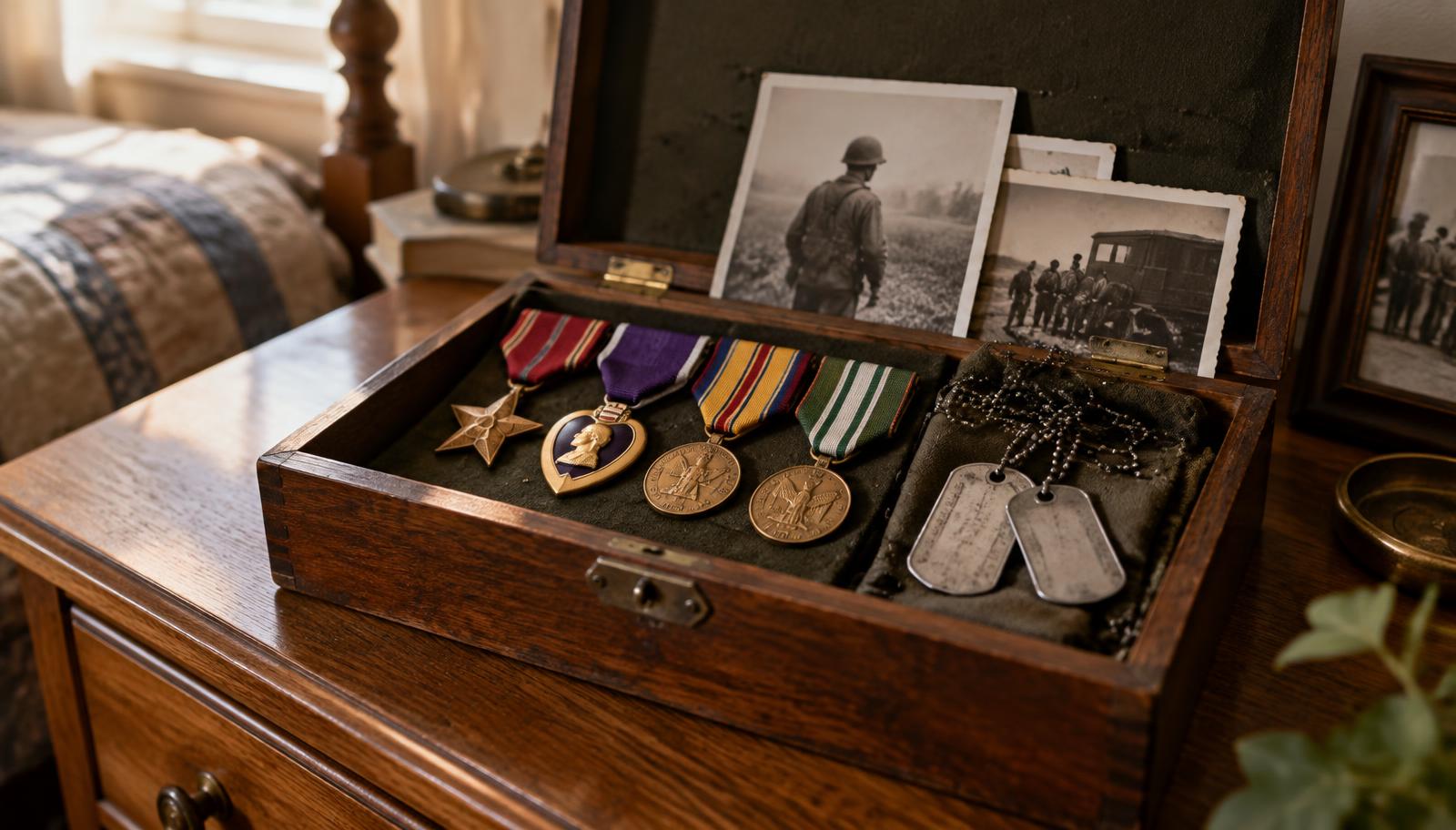
Can You Sell Military Medals? What Families, Estate Sale Companies & Collectors Need to Know About Inherited Medals, Purple Hearts and Militaria (2026)
Usually no. Federal law bans selling U.S. military medals and their ribbons. Here's what families can do instead: keep, frame, replace or return them, plus what companies and box-lot buyers should know.
Usually no. Under federal law, 18 U.S.C. § 704, it is a crime to knowingly sell, buy, trade or advertise U.S. military medals and decorations authorized by Congress, including their ribbons, unless federal regulations specifically allow it. The penalty is up to six months in prison, and up to one year for the Medal of Honor, Purple Heart, Silver Star and the service crosses. Families can keep, pass down, display or donate medals. They just shouldn't sell them.
Quick summary
- The law: 18 U.S.C. § 704(a) makes it a federal crime to sell, buy, trade, barter or advertise U.S. military decorations and service medals, plus their ribbons, buttons and rosettes, "except when authorized under regulations made pursuant to law."
- Higher penalties: up to 1 year for the Medal of Honor, and up to 1 year for the Distinguished Service Cross, Navy Cross, Air Force Cross, Silver Star, Purple Heart and combat badges. Other medals carry up to 6 months.
- No age exception: the statute doesn't exempt old medals. A World War II Purple Heart is covered the same way as a recent one.
- Usually fine to sell: uniforms, patches, field gear, footlockers and most militaria that isn't a medal, badge or ribbon. (Firearms and ordnance follow their own rules.)
- Foreign medals: § 704 covers U.S. medals. Foreign decorations aren't named in it, but check the platform and any state rules.
- What families can do: keep them, pass them down, frame them, donate them, request free replacements, or return found medals through Purple Hearts Reunited.
- Paperwork: discharge papers (DD-214) often carry a Social Security number. Never put them out for sale. Shred or redact them.
This is general information, not legal advice. A lawyer hasn't reviewed it. For a specific item or situation, talk to an attorney.
What the law actually says
Here's the operative part of the statute, quoted word for word:
18 U.S.C. § 704(a): "Whoever knowingly purchases, attempts to purchase, solicits for purchase, mails, ships, imports, exports, produces blank certificates of receipt for, manufactures, sells, attempts to sell, advertises for sale, trades, barters, or exchanges for anything of value any decoration or medal authorized by Congress for the armed forces of the United States, or any of the service medals or badges awarded to the members of such forces, or the ribbon, button, or rosette of any such badge, decoration or medal, or any colorable imitation thereof, except when authorized under regulations made pursuant to law, shall be fined under this title or imprisoned not more than six months, or both." (Cornell LII)
Three phrases matter most to an estate sale:
- "Sells, attempts to sell, advertises for sale." Putting a price tag on a medal, listing it in your sale photos, or posting it on Facebook Marketplace all fit this wording.
- "Purchases." The law covers the buyer too. That matters to resellers who buy box lots.
- "Ribbon, button, or rosette." Ribbon bars and lapel pins are covered, not just the medal itself.
Subsections (c) and (d) raise the maximum to one year when the item is a Medal of Honor, Distinguished Service Cross, Navy Cross, Air Force Cross, Silver Star, Purple Heart, combat badge, or a replacement or duplicate of one.
What about the Stolen Valor Act?
The 2013 Stolen Valor Act rewrote subsection (b), which makes it a crime to pretend to have earned certain medals in order to get money or benefits. It didn't remove subsection (a), the ban on buying and selling. Many older blog posts mix the two up. That's one reason you'll find so much contradictory advice online.
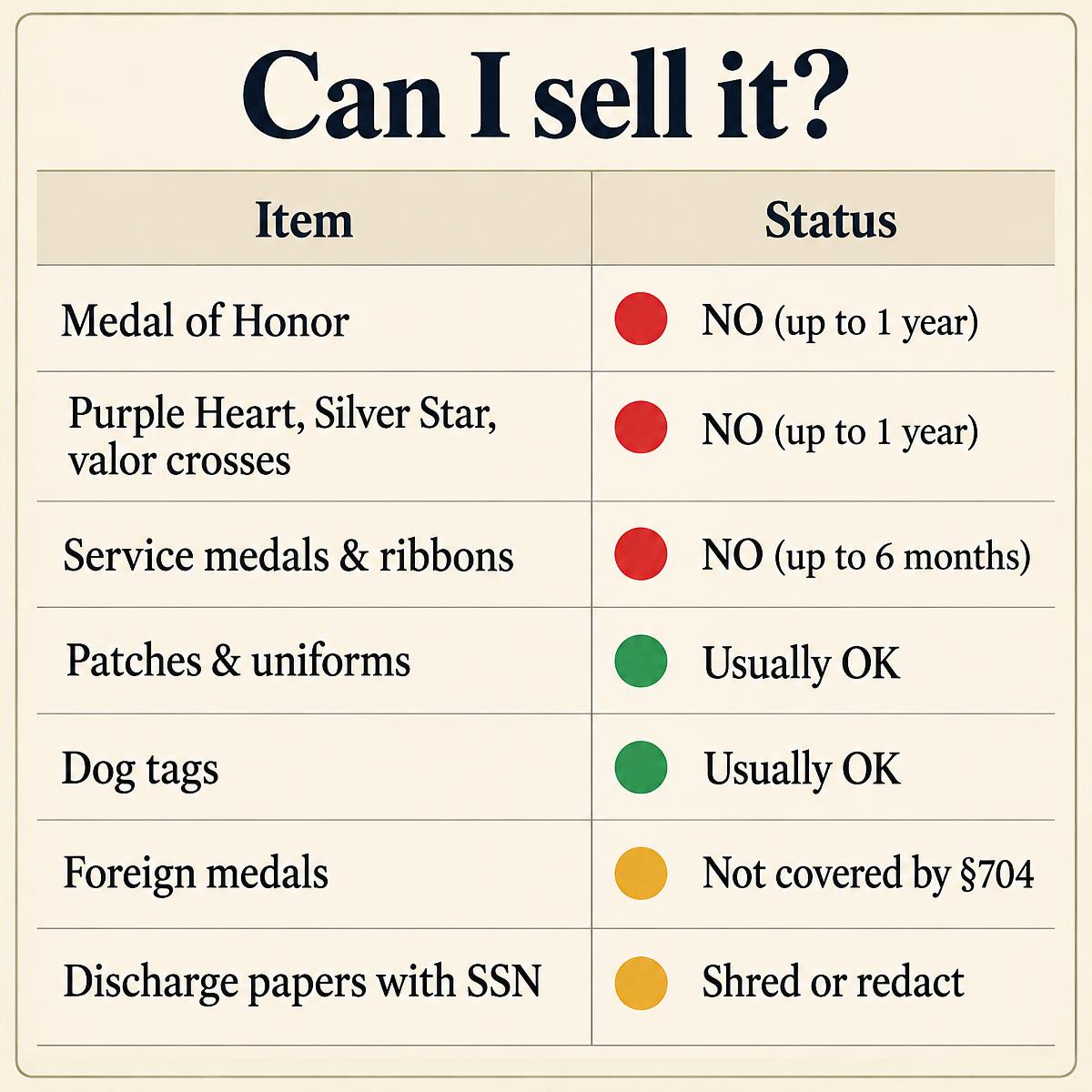
Can I sell it? The quick table
These are general patterns based on the text of § 704 and marketplace rules. They aren't legal rulings.
| Item found in the estate | Sell it at the sale? | Why |
|---|---|---|
| Medal of Honor | No | § 704(c): up to 1 year. It's also extremely rare, so if you think you've found one, call a museum or the branch historian. |
| Purple Heart | No | § 704(d): up to 1 year |
| Silver Star, Distinguished Service Cross, Navy Cross, Air Force Cross | No | § 704(d): up to 1 year |
| Combat badges (for example, Combat Infantryman Badge) | No | § 704(d) names "a combat badge" |
| Bronze Star, Good Conduct, campaign and service medals | No | § 704(a) covers "service medals or badges": up to 6 months |
| Ribbon bars, lapel buttons, rosettes | No | Named in § 704(a) |
| Uniforms, jackets, hats, insignia patches | Usually yes | Not medals or decorations |
| Dog tags | Usually yes | Not decorations, but they carry a name, and sometimes a service number or SSN (see below) |
| Footlockers, canteens, field gear, mess kits | Usually yes | Ordinary surplus |
| Foreign medals (German, British, Japanese, etc.) | Not covered by § 704 | The statute covers U.S. medals. Check the platform's rules, and be careful with Nazi items on marketplaces. |
| Discharge papers (DD-214), orders, pay records | Don't sell | Privacy and identity-theft risk. Give them to the family or shred them. |
| Firearms, bayonets, grenades (even "inert") | Separate rules | See what to do with guns when someone dies. Inert ordnance is banned on eBay. |
Not sure what a medal is? Snap a photo with the EstateSaleFinder Ai Appraiser. It can usually tell a campaign medal from a valor decoration in seconds. Treat it as a suggestion, though, and double-check with a branch reference before you decide.
So why are medals for sale everywhere?
Search "Purple Heart for sale" and you'll find listings. That's the source of most of the confusion. A few reasons:
- Enforcement is rare. A law that's seldom prosecuted is still a law. The listings you see are evidence that people take the risk, not that it's legal.
- "Authorized under regulations." The statute allows exceptions under federal regulations, and some sellers read that as a broad loophole. We couldn't find a published regulation that authorizes private resale of awarded U.S. medals at an estate sale, so we don't recommend relying on it.
- Older and contradictory advice. Some legal blogs and forum threads say selling medals is fine, often by mixing up the 2013 change to subsection (b) with the ban in subsection (a). Collectors on the U.S. Militaria Forum have described eBay removing medal and ribbon listings, while others report seeing them stay up. That's anecdote, not policy, and it shows how inconsistent enforcement is.
- Marketplaces enforce unevenly. In a 2018 eBay Community thread, the accepted answer quoted eBay's rule: "Not allowed. Government-issued medals and certificates for medals, including the Air Force Cross, Congressional Medal of Honor, Distinguished Service Cross, Navy Cross, Purple Heart, or Silver Star." eBay's current military items policy focuses on ordnance, armor and military-use items. Either way, an eBay listing that stays up doesn't make a sale legal under § 704.
The safe conclusion for an estate sale is simple: don't price them, don't photograph them for the listing, and don't sell them.
What families should do first
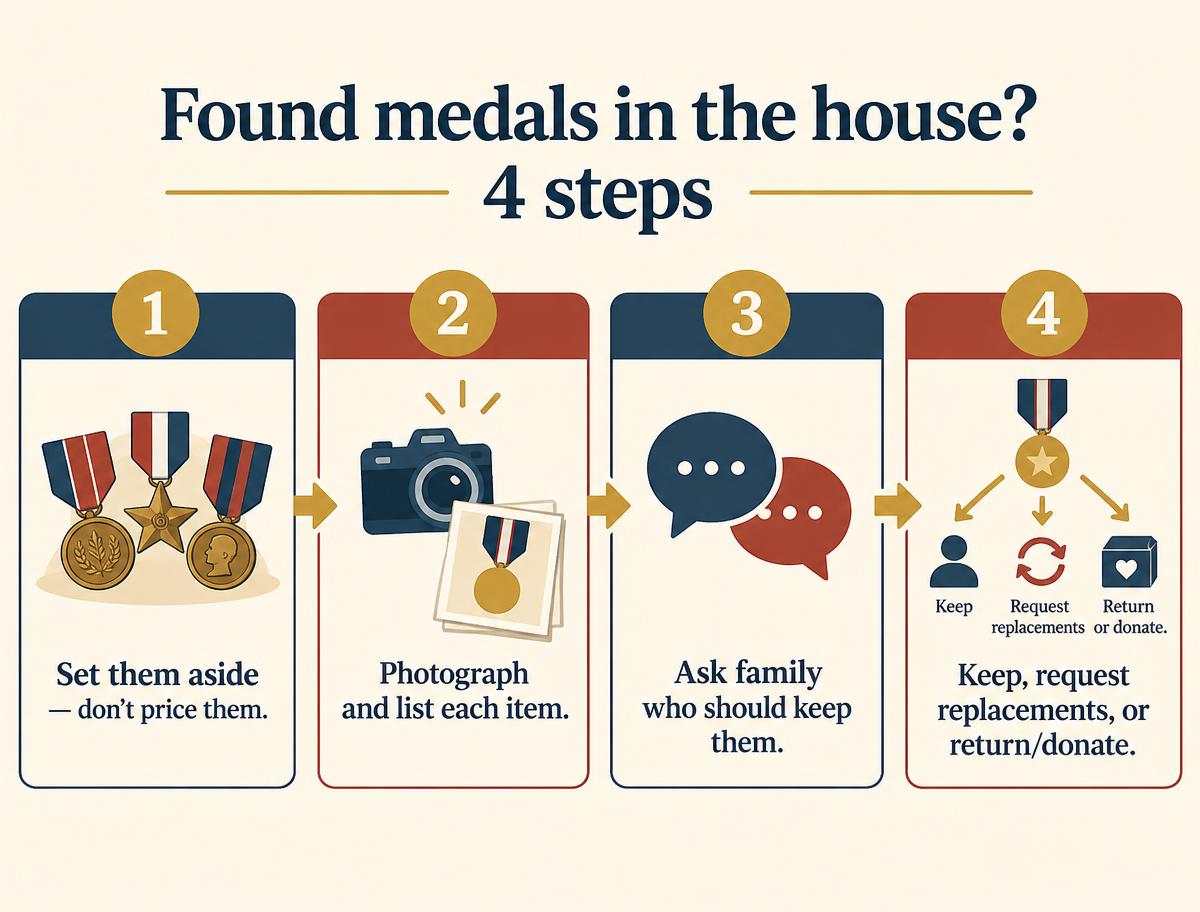
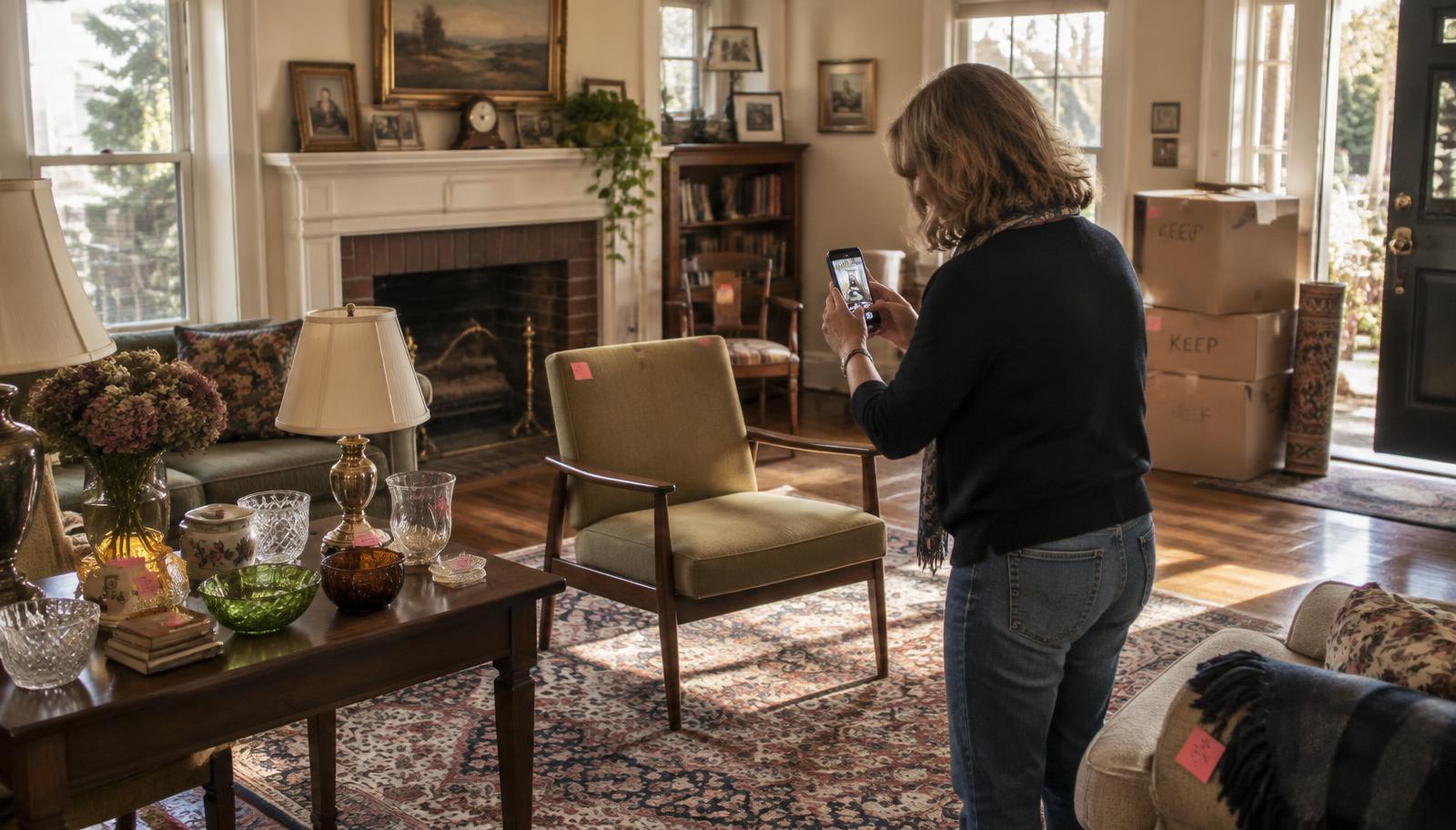
- Set them aside before the estate sale company arrives. Put medals, ribbon bars, certificates, citations, photos and discharge papers in one labeled box. Tell your company it's off-limits. Good companies will ask about it during the walkthrough anyway.
- Photograph and list each item. Note what's engraved on the back of each medal. Purple Hearts and some older medals are often engraved with the recipient's name. Those details matter for the family history and for any future return.
- Ask the family who should keep them. Medals are often the most emotional items in the house. Decide this before the sale, not during it. Our guide to dividing heirlooms has more on keeping restricted and sentimental items out of the sale.
- Choose what happens next: keep, frame, request replacements so every branch of the family can have a set, or donate.
Protect the paperwork
Many veterans' discharge papers (the DD-214) list a Social Security number, and for older veterans the service number was often the SSN. Identity thieves target the records of people who have died. Never put these papers in a sale. Keep the original with the estate files, because the family may need it for VA burial benefits or a headstone, and shred any copies.
How to get free replacement medals
If medals are missing, or if several grandchildren each want a set, the military will often replace them. Here's what the National Archives says:
- Veterans: "the military services will work replacement medal requests for the veteran at no cost." Family members can apply with the veteran's signed authorization.
- Next of kin of a deceased veteran: the process "and cost" differs by branch and depends on who's asking, especially when the record is archival (generally 62+ years after the veteran left the service).
- How to apply: submit a Standard Form 180, or order online through eVetRecs at vetrecs.archives.gov. On the SF-180, mark "Other" in Section II, Items 1 and 2, and write in "Medal Replacement."
- Where it goes: the National Personnel Records Center in St. Louis verifies the record and then passes the request to the right branch.
- General public: if the veteran left the service 62 or more years ago, anyone can buy a copy of the personnel file to see which awards were earned. Medals can then come from a commercial source.
Expect it to take months, not weeks. Ordering replacements is also a good way to confirm which medals the veteran actually earned. That matters more than you'd think when a box holds medals from two or three relatives.
How to return medals you find
Estate sale companies and box-lot buyers sometimes find medals that belong to someone outside the family. Maybe it's a stranger's Purple Heart in a jewelry box bought at auction decades ago. Here are some good options:
- Purple Hearts Reunited is a 501(c)(3) nonprofit founded in Vermont in 2012. It says it returns lost or stolen medals to veterans and families at no cost and has returned the medals of more than 1,000 veterans. Despite the name, it handles other valor medals and military artifacts too.
- VFW, American Legion and Military Order of the Purple Heart posts often help track down families locally, and can point you to the right state veterans' office.
- Museums. Branch museums, state military museums and local history museums accept donations when no family can be found. Call first. Most want to know the medal's history.
Displaying medals at home
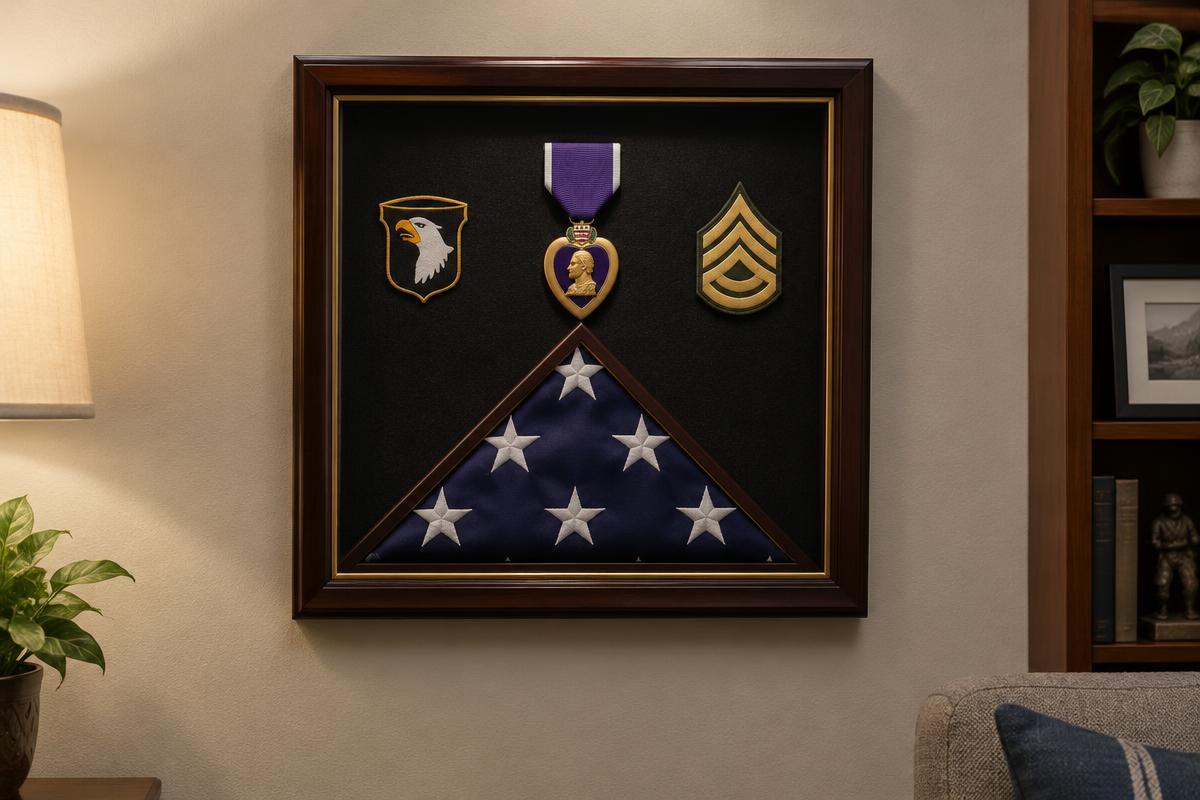
If the family keeps the medals, a shadow box is the classic choice. It holds the medals, ribbon bar, patches, the folded burial flag and a photo, so the whole story stays together. Frame shops and veterans' groups can help you arrange them in the correct order of precedence. Keep a copy of the citations and orders with the box, so the next generation knows what each medal was for.
For estate sale companies: a medal policy
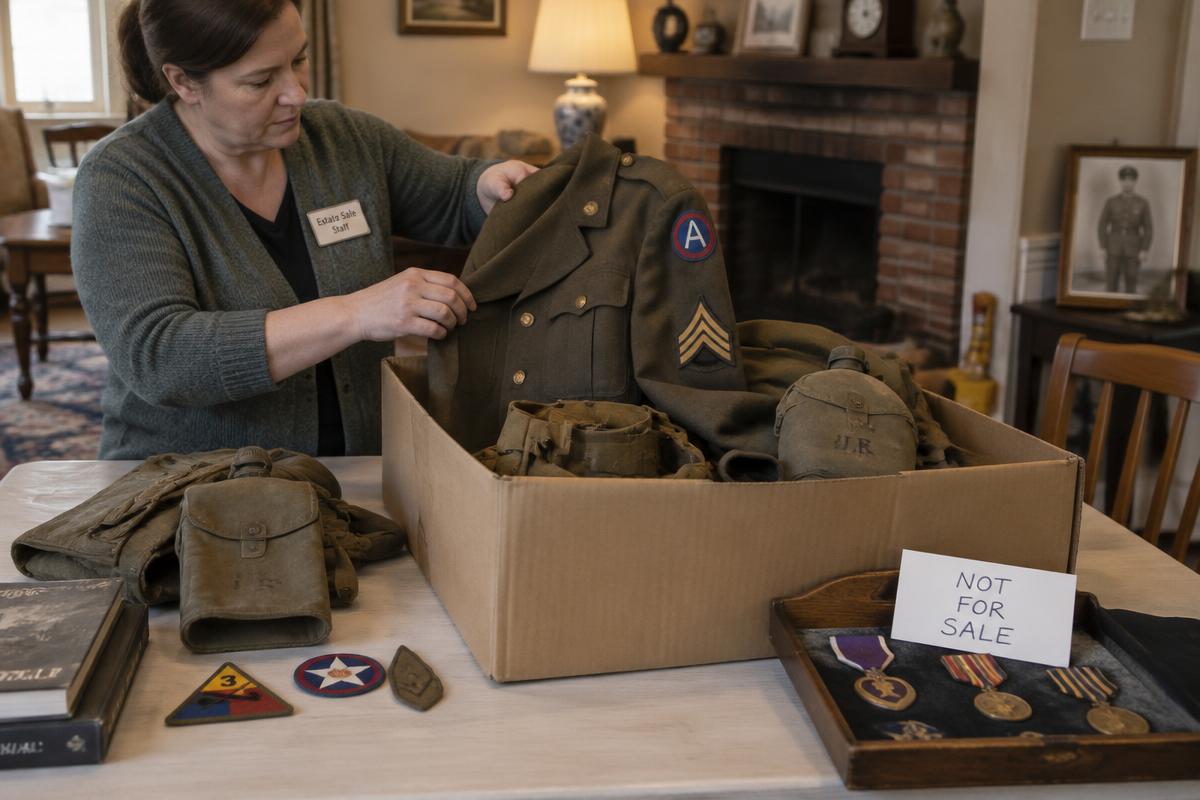
If you run sales, put a written policy in place before Veterans Day brings it up:
- Ask about medals at the walkthrough. Add "military medals, ribbons, discharge papers" to your restricted-items checklist next to firearms, ivory and prescription drugs. See can you sell ivory at an estate sale? for the wildlife side.
- Pull them from the floor. Even if the family says "just sell it," explain § 704 in plain words and hand the items back.
- Keep them out of photos and listings. "Advertises for sale" is in the statute. Crop medals out of shelf shots in your listing photos.
- Sell the uniform, not the ribbons. A uniform jacket with medals or ribbon bars still pinned on should have them removed and returned to the family before it's priced.
- Put it in the contract. A clause on legally restricted items protects the company and the family. Our estate sale contract checklist covers what else belongs there.
- Have a return path ready. Keep a contact at Purple Hearts Reunited or a local VFW post for medals that turn up in old, unrelated box lots.
Companies listing on EstateSaleFinder can add a "military memorabilia" note to the sale's terms. Buyers then know up front that medals aren't included, and you won't get calls asking about them. See how EstateSaleFinder works for companies.
For resellers and box-lot buyers
- Remember that buying is covered too. § 704(a) starts with "purchases." If you spot a medal in a box lot, set it aside. Don't flip it.
- Don't relist it. The same rule applies on eBay, Facebook and at flea markets.
- Patches, uniforms and gear are your inventory. WWII and Vietnam-era uniforms, unit patches, canteens and footlockers have real collector demand and aren't covered by § 704.
- Foreign medals are a different category. § 704 covers U.S. medals. Before listing one, check the marketplace's rules, especially for Nazi-era items, which many platforms restrict.
If you're looking for militaria at sales near you, search estate sales on EstateSaleFinder and follow companies that often handle veterans' estates. You'll get an alert when they list a new sale.
FAQ
Is it legal to sell military medals?
U.S. military medals and decorations, generally, no. 18 U.S.C. § 704(a) bans knowingly selling, buying, trading or advertising them, and their ribbons, unless federal regulations specifically authorize it. Penalties run up to 6 months, or up to 1 year for the Medal of Honor, Purple Heart, Silver Star, service crosses and combat badges.
Can you sell military medals on eBay?
You shouldn't. In a 2018 community thread, eBay's posted rule said government-issued valor medals such as the Purple Heart and Silver Star are "not allowed," including their ribbons and rosettes. Federal law applies whatever any platform allows. Seeing listings on eBay doesn't make a sale legal.
Can I sell my grandfather's Purple Heart?
No. The Purple Heart is one of the medals named for the higher penalty, up to one year, in § 704(d). The statute has no age exemption. You can keep it, frame it, give it to a relative, donate it to a museum, or, if it isn't your family's, return it through Purple Hearts Reunited.
What should I do with military medals after a death?
Set them aside before the estate sale, photograph them, and decide as a family who keeps them. The next of kin can request replacement medals through the National Archives (SF-180), so more than one relative can have a set. Keep the discharge papers with the estate files, and shred any copies that aren't needed.
Is it legal to own or inherit military medals?
Yes. § 704 bans buying, selling and trading them, along with the other listed acts. It doesn't ban owning or inheriting them. Passing medals down within the family as a gift is fine.
Are WWII medals exempt because they're old?
No. The statute has no exemption based on age.
Can I sell the uniform?
Usually yes, once the medals, ribbon bars and badges are taken off. Uniforms, patches and field gear aren't decorations under § 704.
Who buys military memorabilia near me?
For uniforms, patches and gear: local militaria dealers, gun-and-military shows, auction houses and estate sale shoppers. For medals, the honest answer is that no one should be buying them. Donate or return them instead.
Related reading
Sources
- 18 U.S.C. § 704, Military medals or decorations (Cornell Legal Information Institute)
- 18 U.S.C. § 704 (FindLaw)
- National Archives: Military Awards and Decorations
- National Archives: Standard Form 180
- Purple Hearts Reunited: History and Mission
- eBay: Military Items Policy
- eBay Community: "Selling Purple Heart and Silver Star Medals on eBay" (2018, user thread)
- U.S. Militaria Forum: "Ebay Removing Medals and Ribbons" (2018, anecdote)
Statute and sources checked November 5, 2026. This is general information, not legal advice, and a lawyer hasn't reviewed it. For a specific item, talk to an attorney.
Keep exploring
Ready to start your own treasure hunt?
Discover estate sales near you and find incredible deals.
Explore Sales Near Me
About the author
Andy
Founder, EstateSaleFinder.net
Hi, I'm Andy — a retired commercial photographer turned developer with a five-year (and counting) obsession with estate sales. I started EstateSaleFinder.net because I knew there had to be an easier, smarter way to find and list estate sales. Now I get to chase treasure and build the tool I always wished existed.