

Estate Sale Contract Checklist: 21 Clauses to Read Before You Sign (and the Red Flags That Cost Families Money)
Commission, fees, payout dates, leftovers, access, insurance and cancellation: the 21 clauses to check, red flags rewritten, and a printable checklist.
An estate sale contract should spell out, in writing, the commission and any minimum fee, every extra charge, when and how you get paid, what's excluded from the sale, what happens to leftovers, who pays for cleanout, and the company's insurance and cancellation terms. Read all 21 clauses below before you sign, and never start a sale without a signed copy in hand.
Hiring an estate sale company usually happens during a hard stretch: a parent has died, moved into care, or the house needs to sell. That's exactly when families sign agreements they haven't fully read. EstateSales.NET's own guidance for families is blunt: get a contract, don't hold a sale without one, ask about anything you don't understand, and keep a copy (EstateSales.NET).
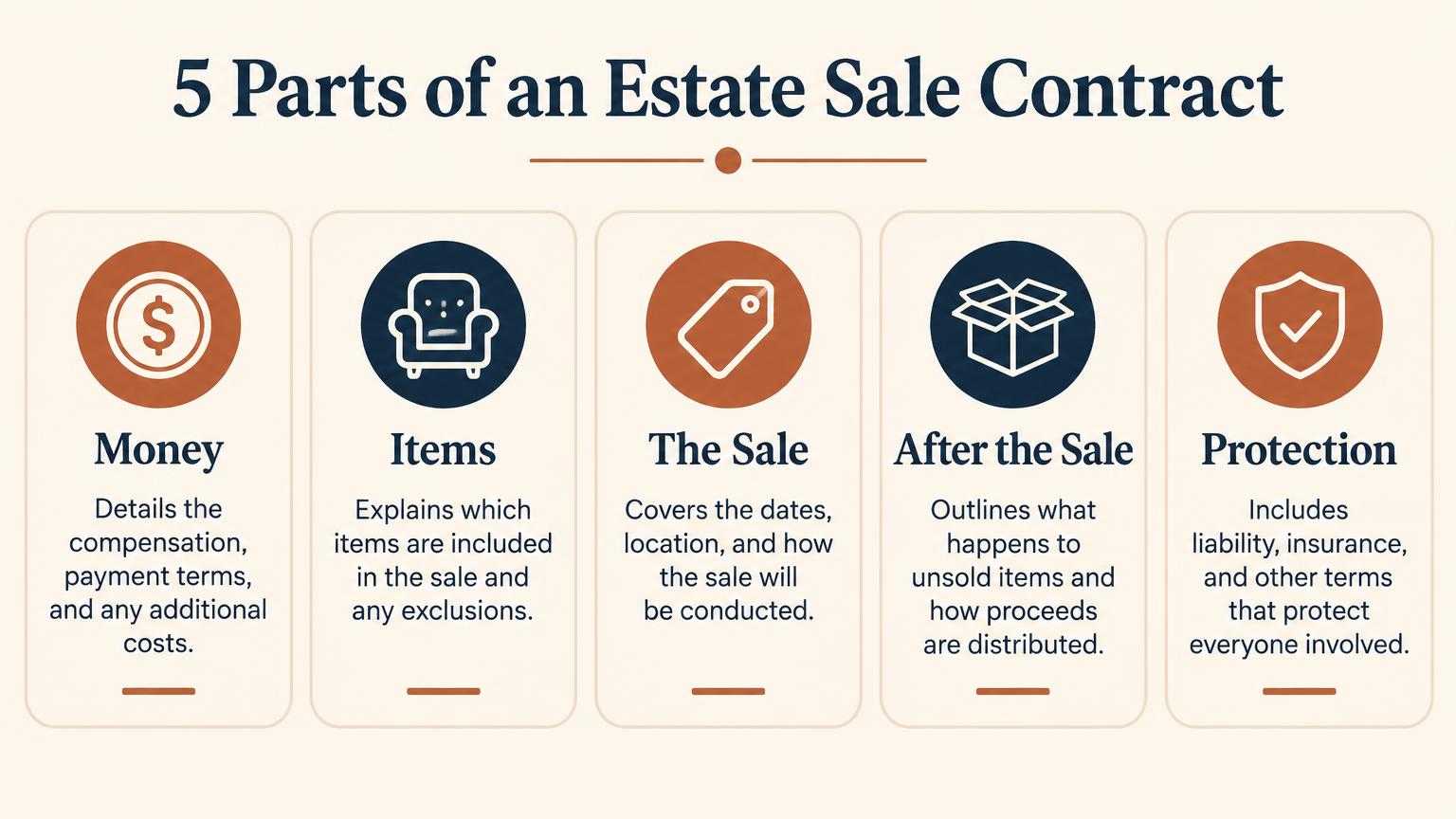
This checklist walks through the 21 clauses that matter most, grouped into five parts, with red-flag wording rewritten in plain English, questions to ask, and a printable checklist at the end.
Quick summary
- Money: commission, minimum fee, extra fees, payout date, card chargebacks.
- Items: what's excluded, the family's deadline to remove things, staff buying before the sale.
- The sale: dates, advertising, pricing and discounts, theft and breakage.
- After the sale: who keeps leftovers, haul-away, broom-clean condition.
- Protection: insurance, cancellation and who can sign.
Who can sign an estate sale contract?
Only someone with legal authority over the belongings should sign. That's usually:
- The owner, if they're living and able to make decisions.
- An agent under a power of attorney, while the owner is alive. A power of attorney generally ends at death.
- The executor or personal representative, after death, once appointed by the court.
- A trustee, if the belongings are held in a trust.
If the estate is in probate, the executor may need court permission before selling. See can you have an estate sale during probate. A sibling who simply has the house key isn't authorized to sign. When more than one person must agree (co-executors, for example), get every required signature on the same contract.
Part 1: Money (clauses 1–5)
1. Commission
The percentage of gross sales the company keeps. Make sure it says gross or net, and whether the rate changes by sales total (some companies use tiers). Our guide to estate sale company fees explains how commissions are usually structured.
2. Minimum fee
Many companies charge a minimum if sales come in low. The contract should state the dollar amount and exactly when it applies.
3. Extra fees
Look for labor, cleaning, staging, advertising, credit card processing, security, dumpster and trash fees. Every fee should be listed with a dollar amount or a cap. "Additional charges as needed" is too open-ended.
4. Payout date and paperwork
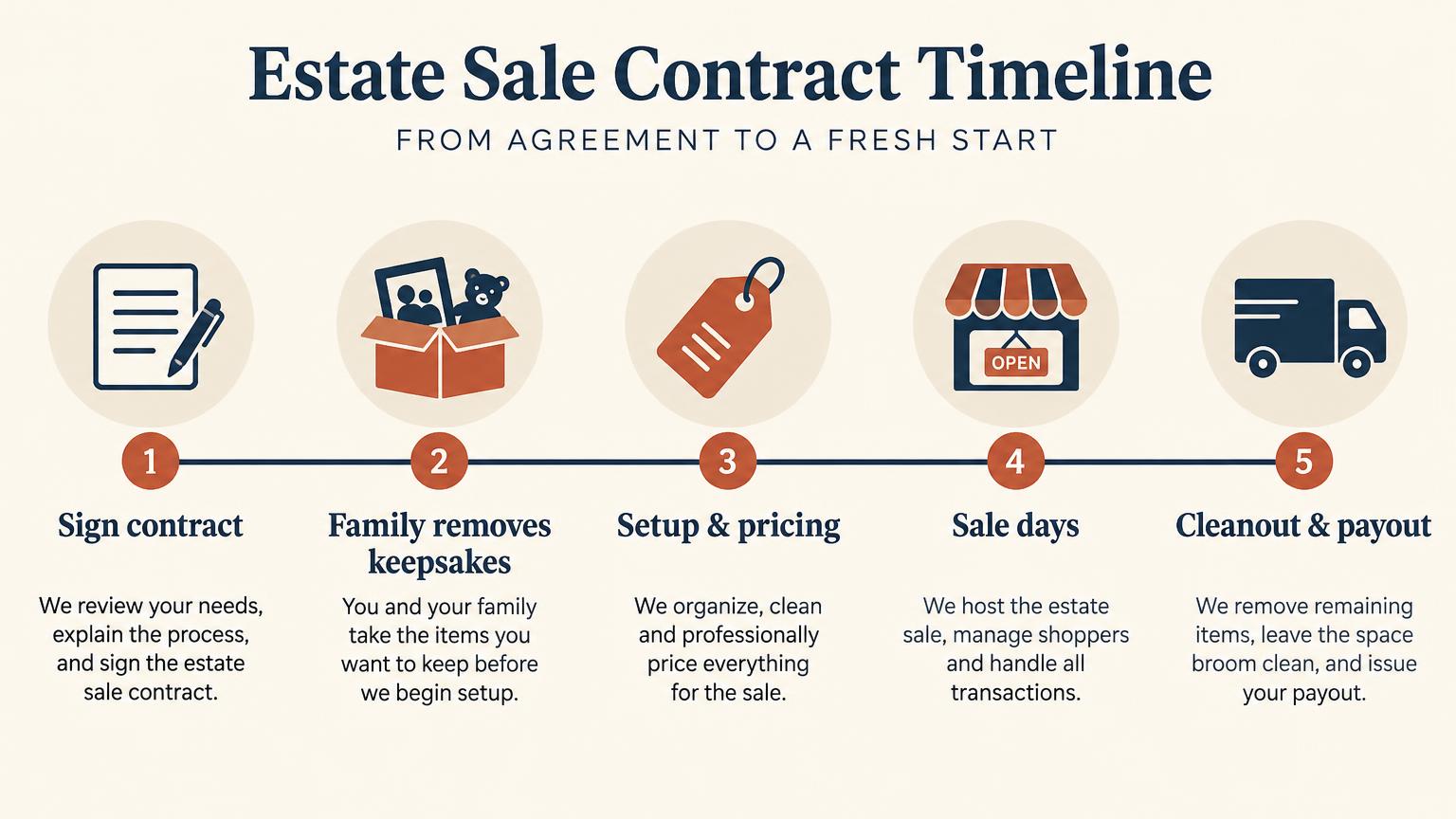
When will you be paid, how (check, transfer), and what accounting will you get? A fair contract names a set number of days after the last sale day and promises an itemized settlement statement.
5. Card chargebacks and returns
If a buyer disputes a card payment after the sale, who absorbs it? Ask how long the company holds back any money for this, and get it in writing.
Part 2: Items (clauses 6–9)
6. Excluded items
List everything the family is keeping, or mark it clearly in the house. EstateSales.NET specifically says exceptions to what will be sold need to be made clear in the contract (EstateSales.NET).
7. Family removal deadline
Most companies need the family to take keepsakes before setup starts. Agree on a date. If you're still dividing things, see how to divide your parents' belongings among siblings.
8. Access to the house during setup
Many contracts limit family entry once setup begins. On Reddit, one executor's family asked whether a contract barring them from the house for six weeks, with a fine, was normal. A company owner replied that restricting entry is an industry norm, and that their own contract uses supervised entry with advance notice (r/estatesales, Sept. 2025; one owner's view, not a rule). If you have to maintain the home, write in supervised access.
9. Staff and early buyers
Can company staff, friends or dealers buy before the public sale? A fair contract says no, or requires that any early sale be at the posted price and listed on your settlement.

Part 3: The sale itself (clauses 10–14)
10. Sale dates and hours
Dates, hours, and whether there's a preview or online pre-sale. What happens if the sale has to move?
11. Advertising
Where the sale will be listed (sites, email lists, social media, signs). Ask to see a past listing. See where estate sales are advertised.
12. Pricing, discounts and offers
Who sets prices, when discounts start (many go to 50% off on the last day), and whether offers are accepted. If you want approval on high-value items, write in a dollar threshold.
13. Valuables and outside experts
Who decides when jewelry, art, coins or guns need a specialist, and who pays for it?
14. Theft, breakage and security
Who's responsible if something is stolen or broken during setup or the sale? How does the company secure small valuables?
Part 4: After the sale (clauses 15–18)
15. Who keeps unsold items?
This is the clause families most often regret. Options include donation (with receipts), buyout by the company at an agreed price, consignment, return to the family, or haul-away. Get the option in writing. A Reddit poster said the family agreed to "give away" leftovers from a large antique sale, then saw some of those items in the same company's later sale a year on (r/estatesales, Nov. 2025; one family's account). Whether or not that was allowed, a clear clause avoids the surprise. More options in what happens to unsold items after an estate sale.
16. Haul-away and cleanout
Is cleanout included? If not, what's the price or cap, and who's hauling?
17. Condition of the house
"Broom-clean" should be defined, along with a date the keys come back.
18. Final accounting
An itemized list of high-value sales, all fees, and the net payout. Some state attorneys general have taken action against companies over unpaid proceeds and unsold property. In one 2007 case, Washington's AG sued an estate consignment business that allegedly kept customers' unsold property and didn't fully pay them (Washington AG).
Part 5: Protection (clauses 19–21)
19. Insurance
Ask for proof of general liability insurance (for shopper injuries) and whether the company is bonded. Ask the home insurer how an estate sale affects coverage, too.
20. Cancellation
What happens if you cancel, the house sells first, or the company cancels? Look for a stated fee instead of "full estimated commission."
21. Signatures, dates and copies
Every required signer, the date, and a signed copy for you.
Red-flag clauses, rewritten in plain English
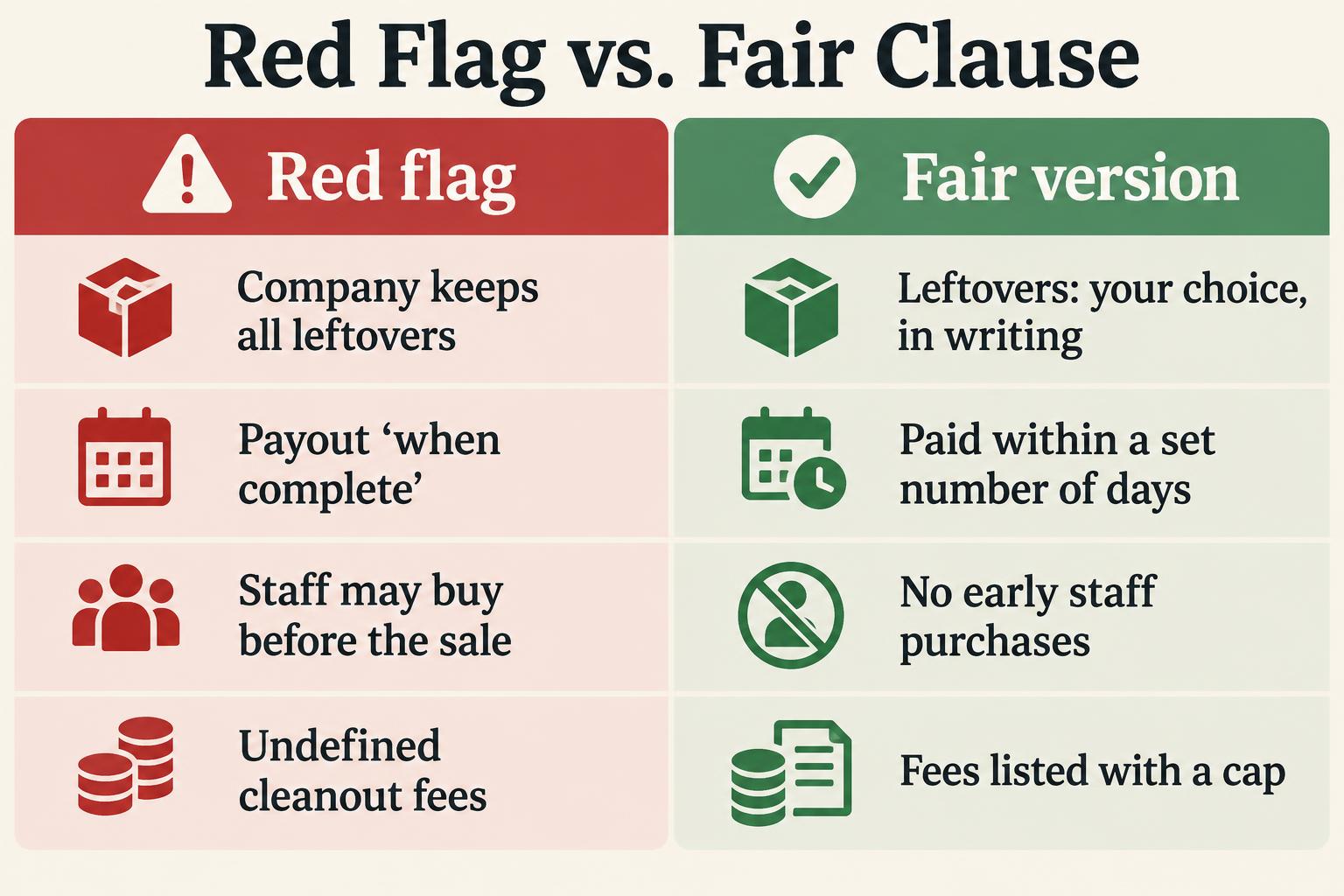
| Red-flag wording | What it can mean | Ask for instead |
|---|---|---|
| "Company retains all remaining items" | You lose leftovers, even valuable ones | Your choice of donation, buyout at a set price, or return |
| "Payment upon completion" | No real deadline | Paid within a set number of days after the last sale day |
| "Additional fees as needed" | Open-ended charges | Every fee listed, with a cap |
| "Staff may purchase items" | Best pieces sold before the public sees them | No early staff purchases, or at posted price and itemized |
| "Client may not enter the premises" | No access to a home you're responsible for | Supervised entry with advance notice |
| "Cancellation: full estimated commission" | Paying for a sale that never happens | A flat, stated cancellation fee |
Questions to ask before you sign
- Can I see a sample settlement statement from a past sale?
- What exactly happens to leftovers, and is that in the contract?
- How many days after the sale do I get paid?
- What fees could come up that aren't on this page?
- Are you insured, and can I see the certificate?
- Do staff or dealers ever buy before the sale opens?
- Can I sign online and get a signed copy right away?
For more interview questions, see how to find an estate sale company.
Signing online: what to expect
Many companies now send contracts to sign online instead of meeting in person, which helps when family members live in different states. Companies on EstateSaleFinder, for example, can send their own contract straight from their client tools. The family opens it on a phone or computer, confirms it's them with a code sent by email, signs, and everyone gets a fully signed copy by email. When several people need to sign, such as co-executors, each one signs in turn.

Whatever tool your company uses, the rule is the same: read the full contract before you sign, and keep the signed copy.
For estate sale companies: tighten your own contract
Clear contracts protect companies too. Fewer surprises means fewer disputes, refunds and bad reviews. A few habits help:
- Name every fee and when it applies.
- Write the leftovers option in the contract, with a checkbox for the family's choice.
- Set a payout deadline and send an itemized settlement.
- Spell out house access during setup.
- Get every required signature, including co-executors.
On EstateSaleFinder, companies can upload their existing contract as a PDF, send it to a client to sign online, and keep the signed copy with that client's record, so the paperwork lives next to the sale itself. New companies can also read how to start an estate sale company.
Printable estate sale contract checklist
Print this or copy it into a document. Check each box only when the answer is in the written contract.
- 1. Commission rate (gross or net, any tiers)
- 2. Minimum fee and when it applies
- 3. Every extra fee, with a dollar amount or cap
- 4. Payout date, method and itemized statement
- 5. Who covers card chargebacks and returns
- 6. List of excluded items
- 7. Family removal deadline
- 8. House access during setup
- 9. No early staff or dealer purchases
- 10. Sale dates and hours
- 11. Where the sale is advertised
- 12. Pricing, discount schedule and offers
- 13. Specialists for valuables, and who pays
- 14. Theft, breakage and security
- 15. Leftovers option chosen
- 16. Haul-away and cleanout price
- 17. Broom-clean definition and key return date
- 18. Final accounting
- 19. Proof of insurance
- 20. Cancellation terms for both sides
- 21. All required signatures, dated, with copies
FAQ
Who keeps unsold items after an estate sale?
Whatever the contract says. Common options are donation, a company buyout at an agreed price, return to the family, or haul-away. If the contract doesn't say, ask before you sign.
When do I get paid after an estate sale?
It depends on the company. Look for a specific number of days after the last sale day and an itemized statement. "Upon completion" is too vague.
Is there a free estate sale contract template?
Templates exist online, but every company uses its own agreement, and state rules vary. Use the checklist above to review whatever contract you're given, and have an attorney review it if the estate is large or in probate.
Can I negotiate an estate sale contract?
Yes. Fees, leftovers, payout timing and access are commonly negotiated. Ask for changes in writing before you sign.
Do I need a lawyer to review the contract?
Not always, but it's wise for large estates, probate sales, or anything you don't understand. A probate attorney can review it quickly.
Can I sign an estate sale contract online?
Yes, if the company offers it. Make sure you get a fully signed copy for your records.
Sources:
- EstateSales.NET: What to expect when you hire an estate sale company
- Washington State Attorney General: lawsuit against an estate consignment business (April 2007)
- r/estatesales: Estate sale contract regarding entering property during setup (Sept. 2025, anecdote)
- r/estatesales: Leftovers from sale (Nov. 2025, anecdote)
Signing as an agent? See can a power of attorney hold an estate sale?
Sources checked November 2, 2026. General information, not legal advice. Talk to a probate attorney in your state.
Keep exploring
Ready to start your own treasure hunt?
Discover estate sales near you and find incredible deals.
Explore Sales Near Me
About the author
Andy
Founder, EstateSaleFinder.net
Hi, I'm Andy — a retired commercial photographer turned developer with a five-year (and counting) obsession with estate sales. I started EstateSaleFinder.net because I knew there had to be an easier, smarter way to find and list estate sales. Now I get to chase treasure and build the tool I always wished existed.