

Can a Power of Attorney Sell a Parent's Belongings or Hold an Estate Sale? POA vs. Executor vs. Trustee, Explained (Plus the Assisted-Living and Medicaid Traps)
A who-can-sell table, what to check in the power of attorney, signing the estate sale contract as agent, where the money goes, gifts to siblings, the Medicaid trap, and what changes at death.
A power of attorney can usually sell a living parent's belongings, including through an estate sale, if the document gives that power. The authority ends when the parent dies. After that, only the executor, or a trustee for trust property, can sell. Keep the money in the parent's name, keep records, and talk to an elder-law attorney first if Medicaid might be involved.
This guide is general information, not legal advice. Power of attorney rules are set by each state, and the exact wording of your document matters. For anything involving Medicaid, gifts or a parent who can't agree to the sale, talk to an elder-law attorney.
Quick summary
- Yes, while your parent is alive, if the power of attorney covers their personal property and you act in their best interest.
- No, after your parent dies. The Uniform Power of Attorney Act says a power of attorney terminates when "the principal dies" (ABA Commission on Law and Aging). "Durable" only means it keeps working if the parent loses capacity (Michigan's Uniform Power of Attorney Act).
- The money stays your parent's. The CFPB tells agents to "keep their money and property separate" and "keep good records" (CFPB).
- Gifts need express permission. Under the uniform act, an agent can make a gift only if the power of attorney "expressly grants" that authority (Utah Code 75A-2-201).
- Medicaid trap: furniture and personal belongings generally don't count as assets under the federal SSI rule, but the cash from selling them does (20 CFR 416.1216).
Can a power of attorney sell a parent's belongings?
Usually, yes. A power of attorney names you as your parent's agent for money and property. If the document is a general financial power of attorney, or specifically covers personal property, you can usually sell furniture, household goods and other belongings on your parent's behalf, including by signing an estate sale contract.
Two conditions matter more than anything else:
- The document has to cover it. Read what powers it grants. Some powers of attorney are limited to banking, real estate or a single transaction.
- You have to act for your parent, not yourself. The CFPB's first duty for agents is: "Act only in their best interest. Because you are dealing with someone else's money and property, your duty is to make decisions that are best for them, not you" (CFPB).
Who can sell, and when
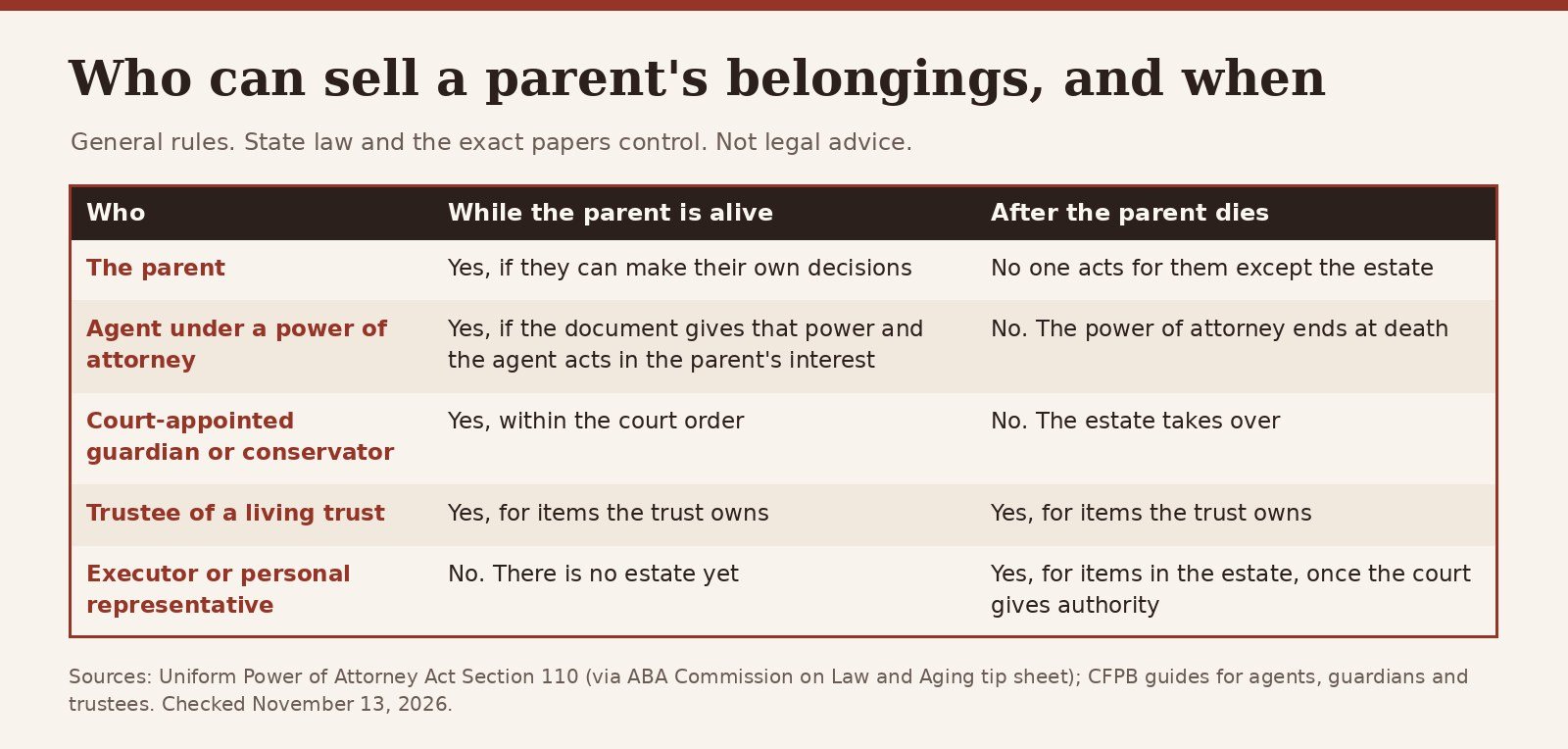
| Who | While the parent is alive | After the parent dies |
|---|---|---|
| The parent | Yes, if they can make their own decisions | No; the estate takes over |
| Agent under a power of attorney | Yes, if the document allows it | No. The power of attorney ends at death |
| Court-appointed guardian or conservator | Yes, within the court's order | No |
| Trustee of a living trust | Yes, for items the trust owns | Yes, for items the trust owns |
| Executor or personal representative | No; there's no estate yet | Yes, once the court gives authority |
This table follows the Uniform Power of Attorney Act's termination rule and the CFPB's guides for agents, guardians and trustees (CFPB). Your state's law may differ, and some states haven't adopted the uniform act.
What to check in the power of attorney document
Before you call an estate sale company, read the whole document and look for:
- Is it a financial power of attorney? A health care power of attorney covers medical decisions, not selling belongings.
- Is it durable? If your parent has lost capacity, the document must be durable to still work. Under the uniform act, durable means "not terminated by the principal's incapacity" (Michigan's Uniform Power of Attorney Act).
- Does it start now, or only on incapacity? Some "springing" documents only take effect after a doctor's letter or other trigger.
- What powers does it list? Look for personal property, tangible property or "all acts" language.
- Does it allow gifts? If you plan to give family items away, the document has to say so. More on this below.
- Are there co-agents? If two people are named to act together, both may need to sign.
- Has it been revoked or replaced? A newer document can cancel an older one.
If anything is unclear, ask the attorney who drafted it, or an elder-law attorney.
Can a power of attorney sell without the parent's OK?
Legally, the document may allow it, but that's not the whole answer. The CFPB guide for agents explains that you should involve the person as much as you can and respect their wishes (CFPB guide for agents).
In practice:
- If your parent can still decide, they should decide. A power of attorney doesn't take away their right to make their own choices.
- If your parent can't decide, follow what you know they'd want, and keep notes on why you sold what you sold.
- If your parent objects, stop and get advice. Selling over a capable parent's objection can lead to family disputes or claims of financial abuse.
The move to assisted living, step by step

Thanksgiving and holiday visits are often when families notice a parent can't live alone anymore. When the move comes, this order keeps it calmer:
- Get the floor plan of the new room. Measure what will fit.
- Pick what moves first. Favorite chair, bed linens, photos, a few pieces of art. Our downsizing checklist for seniors helps.
- Let family choose keepsakes, with your parent involved if possible, and write down who took what.
- Pull out papers and valuables. Wills, deeds, tax records, jewelry, cash and anything with account numbers.
- Book estate sale walkthroughs. Compare at least two companies. Our senior move manager vs. estate sale company guide explains who does what.
- Sign the contract as agent, and have the settlement paid to your parent's account.
- Keep the records from the sale, the cleanout and any donations.
For harder conversations, see how to talk to aging parents about downsizing.
Signing the estate sale contract as their agent
When you sign, sign as the agent, not as yourself. A common format is your parent's name, then "by [your name], as attorney-in-fact" or "as agent." Ask the company how they want it written.
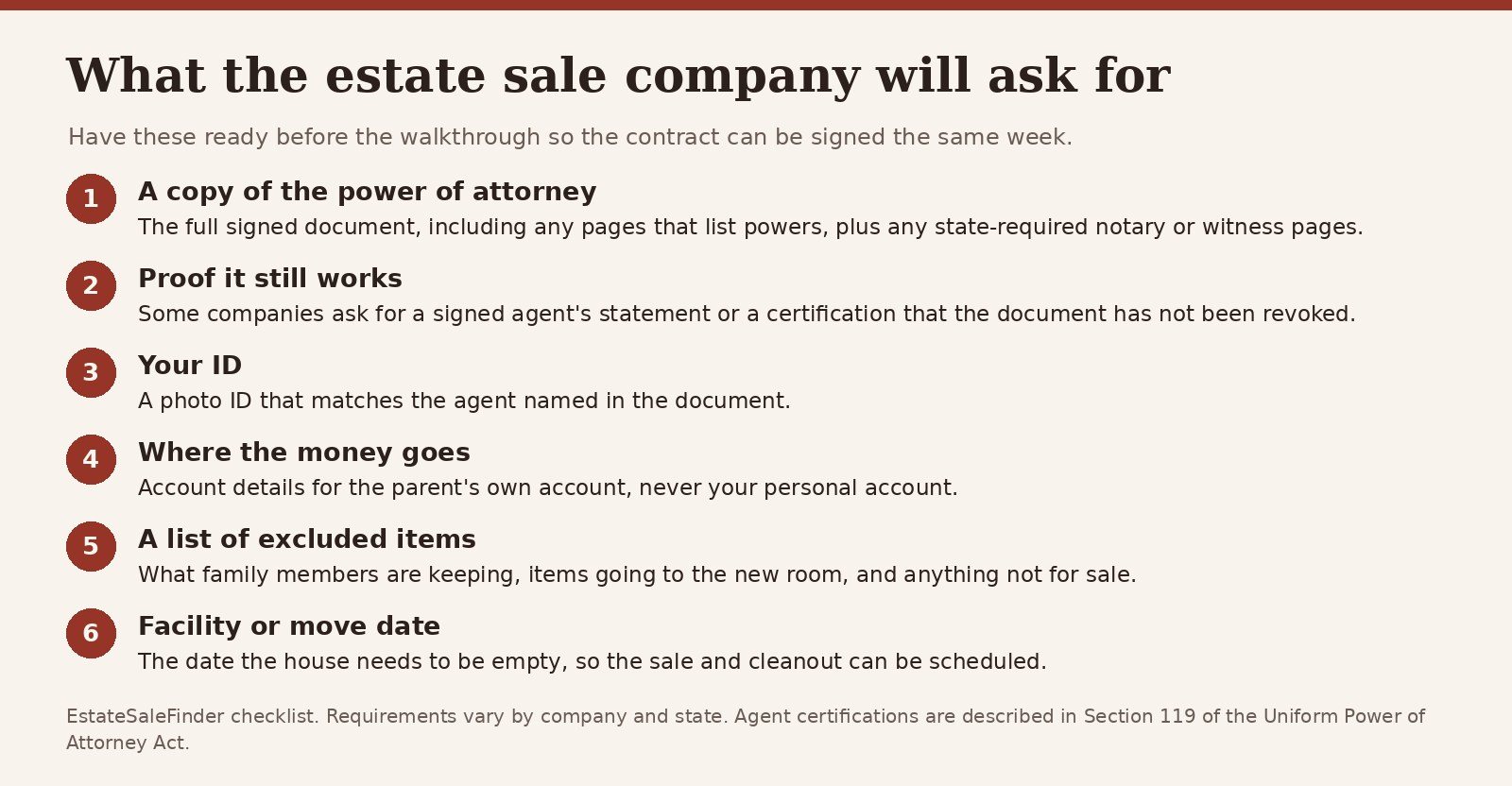
Estate sale companies commonly ask for:
- A full copy of the signed power of attorney
- A photo ID that matches the agent named
- Sometimes a signed statement that the power of attorney is still in effect. Under the uniform act, a person asked to accept a power of attorney may request an agent's certification (Section 119)
- The account where the proceeds should go
- A list of items that are excluded from the sale
- The date the home must be empty
For what else belongs in the contract, use our estate sale contract checklist.
Where the money goes, and keeping records
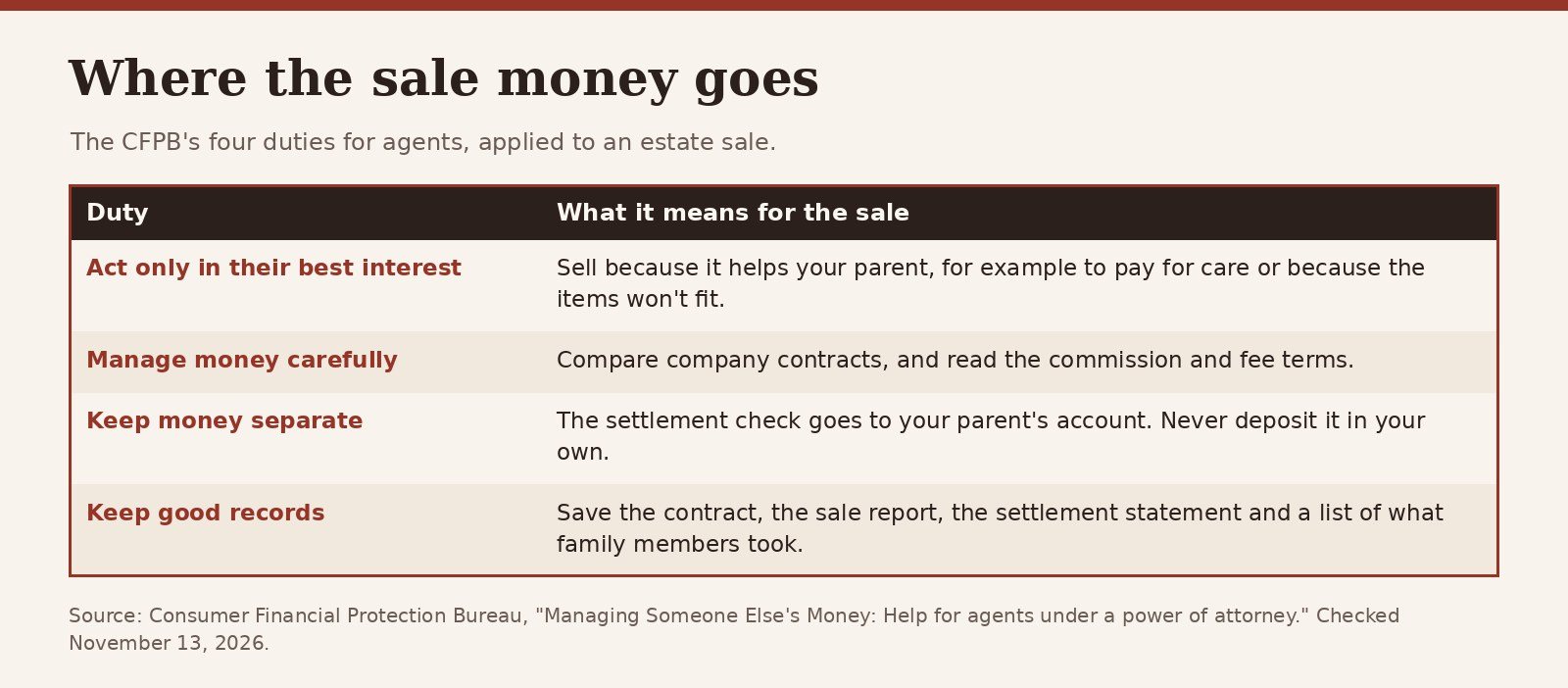
The CFPB lists four basic duties for anyone managing someone else's money (CFPB):
- "Act only in their best interest."
- "Manage their money and property carefully."
- "Keep their money and property separate. Never mix their money or property with your own or someone else's."
- "Keep good records. You must keep true and complete records of their money and property, or you could face legal consequences."
For an estate sale, that means:
- The settlement check goes to your parent's account. Never deposit it in your own account, even "temporarily."
- Pay your parent's bills from your parent's account, such as the facility deposit or movers.
- Keep a folder with the contract, the sale report, the settlement statement, receipts and a list of what family members took.
- Don't pay yourself unless the document allows reasonable pay, and then keep records of it.
Siblings, and giving family items away first
This is where many families get into trouble. Giving away your parent's belongings is a gift, even when it's to family. Under the uniform act, an agent may "make a gift" only if the power of attorney "expressly grants the agent the authority" (Michigan Compiled Laws 556.301).
To keep things fair and safe:
- Check the document for gift language before anyone takes anything.
- Have your parent decide while they can, and write down their wishes.
- Write a list of who received what, with rough values for anything valuable.
- Treat siblings openly. Share the list and the settlement statement.
Our guide to dividing parents' belongings among siblings has ways to make choices fairly.
The Medicaid trap
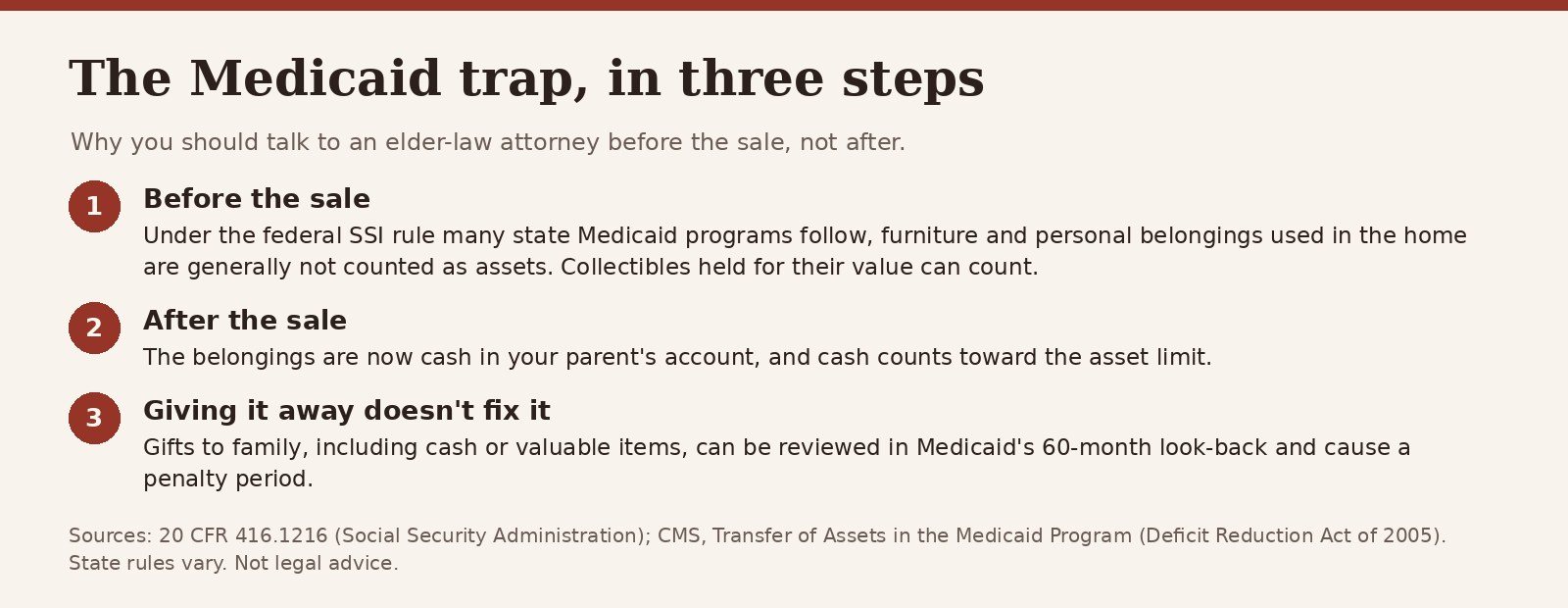
If your parent may need Medicaid to pay for long-term care, talk to an elder-law attorney before the sale. Here's why:
- Belongings generally don't count. The federal SSI rule, which many state Medicaid programs use, says "we do not count household goods as a resource" when they are used in the home, including "furniture, appliances, electronic equipment... and dishes." Personal effects like wedding rings and books aren't counted either. But "items that were acquired or are held for their value or as an investment," such as gems or collectibles, are counted (20 CFR 416.1216).
- Cash does count. Once the belongings are sold, the money is in your parent's account, where it can count toward the asset limit.
- Giving it away isn't the fix. Medicaid reviews transfers made for less than fair market value during a "look-back period" of "60 months (five years) prior to the date the individual applied for Medicaid" (CMS). Gifts to family can cause a penalty period.
Rules and limits vary by state, and there are legal ways to plan. That's exactly why to ask an elder-law attorney first.
What changes when your parent dies
The moment your parent dies, the power of attorney stops working. You can't sign a new estate sale contract, collect the proceeds or keep selling under it.
- If there's a will, the executor named in it applies to the probate court for authority.
- If there's a living trust, the successor trustee handles items the trust owns.
- If a sale is already booked, tell the company right away. The contract may need to be confirmed or re-signed by the executor.
See can you have an estate sale during probate? for the next steps.
Notes for estate sale companies, realtors and senior move managers
- Check who can sign. Ask for the power of attorney, ID and, if needed, an agent's certification before the contract is signed.
- Ask if the parent is living. If they've died, the power of attorney is no longer valid. You need the executor or trustee.
- Pay the parent, not the agent. Make the settlement payable to the parent or their account.
- Watch for family conflict. If siblings disagree or the parent objects, pause and suggest the family get legal advice.
- Don't give legal advice. Point families to an elder-law attorney, especially when Medicaid is involved.
Realtors can share this guide with sellers; see our realtor's guide to estate sales. Companies can list services and get found by families on EstateSaleFinder, and families can hire an estate sale company near them.
FAQ
Does a power of attorney end at death?
Yes. Under the Uniform Power of Attorney Act, a power of attorney terminates when the principal dies. After that, the executor or a trustee handles the property.
Can a power of attorney sell property without consent?
The document may allow it, but an agent must act in the parent's best interest and should follow their wishes. If a capable parent objects, stop and get legal advice.
Can a power of attorney give family items to siblings?
Only if the power of attorney expressly allows gifts. Write down who received what, and be careful if Medicaid might be needed.
Where should estate sale money go when a parent is in assisted living?
Into the parent's own account, never the agent's. Keep the contract, sale report and settlement statement as records.
Does selling a parent's furniture affect Medicaid?
It can. Household goods generally aren't counted under the federal SSI rule, but the cash from selling them is. Talk to an elder-law attorney before the sale.
Can a power of attorney sell a car?
Often, yes, if the document covers personal property or vehicles. Your state's motor vehicle agency may require its own form or a copy of the power of attorney.
Related guides
Sources
- ABA Commission on Law and Aging: Power of Attorney Revocations 101 (June 2024)
- Michigan Uniform Power of Attorney Act (Act 187 of 2023), definitions
- Michigan Compiled Laws 556.301 (Uniform Act Section 201)
- Utah Code 75A-2-201 (Uniform Act Section 201)
- Uniform Law Commission: Power of Attorney Act
- CFPB: What is a fiduciary?
- CFPB: Managing Someone Else's Money, help for agents under a power of attorney
- CFPB: Guides for managing someone else's money
- Social Security Administration: 20 CFR 416.1216
- CMS: Transfer of Assets in the Medicaid Program (2008)
Sources checked November 13, 2026. Photos are Ai-generated illustrations; charts are EstateSaleFinder diagrams built from the sources above. This guide is general information, not legal advice. State law varies; talk to an elder-law or probate attorney about your situation.
Keep exploring
Ready to start your own treasure hunt?
Discover estate sales near you and find incredible deals.
Explore Sales Near Me
About the author
Andy
Founder, EstateSaleFinder.net
Hi, I'm Andy — a retired commercial photographer turned developer with a five-year (and counting) obsession with estate sales. I started EstateSaleFinder.net because I knew there had to be an easier, smarter way to find and list estate sales. Now I get to chase treasure and build the tool I always wished existed.