The Dishwasher Did It: Why Two Identical Pyrex Bowls Sell for Wildly Different Money
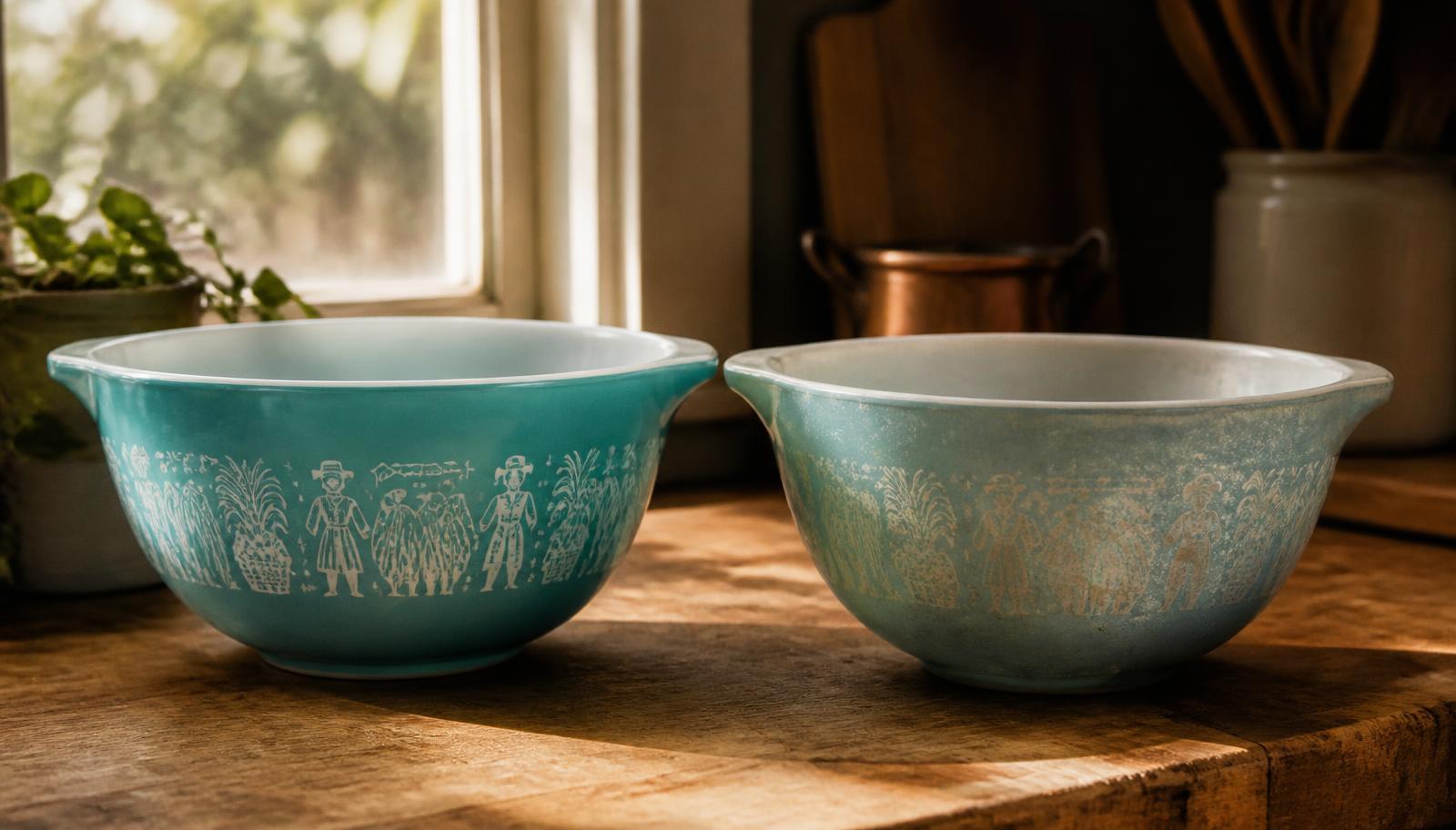
Two turquoise bowls, same pattern, same year, same shelf. One is glossy and sells like a collectible. The other is chalky, dull, and nearly worthless — and the only difference is that somebody loved it enough to run it through the dishwasher. The Corning Museum of Glass's chief conservator has a one-line rule about this, and almost nobody's grandmother heard it in time.
Quick answer
Yes — a dishwasher permanently damages vintage patterned Pyrex, and condition is one of the biggest levers on what a piece is worth. The authority here is not a collector forum but Stephen Koob, chief conservator at the Corning Museum of Glass, who writes: "First, never, ever put any Pyrex through a dishwasher. This is the fastest and most damaging thing that you can do. It will slowly etch the Pyrex" (Corning Museum of Glass). The hot, strongly alkaline wash chemistry microscopically etches the opal glass and erodes the fired-on enamel pattern, turning a glossy piece chalky and faded. Collectors call it DWD — dishwasher damage — and the change is permanent and unrestorable. Wash vintage Pyrex by hand, in warm water, with a soft cloth and a plain clear detergent.
There is a specific kind of heartbreak that happens in a kitchen in Ohio, or Michigan, or Iowa, and it goes like this.
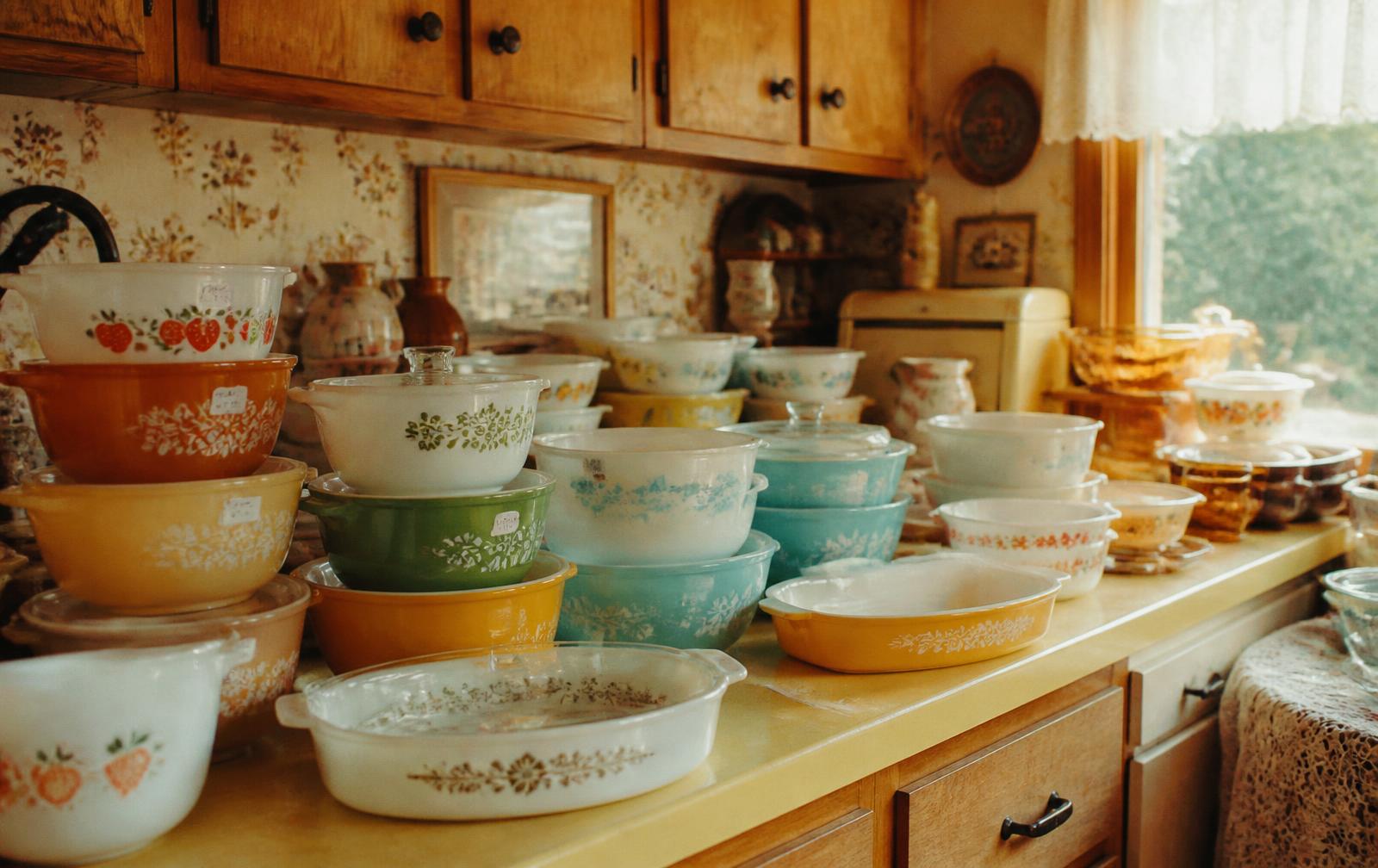
A daughter is cleaning out her mother's house. On the counter, in a row, is the Pyrex — the turquoise bowl with the little farm people on it, the pink one, the yellow nesting set that lived on top of the refrigerator. She remembers all of it. Stuffing in the big one. Jell-O in the small one.
She takes them home. She loves them. And because she loves them, she takes care of them — which in 2026 means she puts them in the dishwasher.
Four years later she looks up what they're worth, and finds out that a bowl exactly like hers, in a photograph from a collector's site, is bright and glossy and looks almost new. Hers looks like it was left in a driveway. Same bowl. Same pattern. Same factory, probably the same week. Hers just went through about two hundred wash cycles, and the other one never went through a single one.
Nobody told her. Nobody tells anybody. That's what this article is for.
About that "3 to 5 times" number
Let's deal with this honestly up front, because you have probably seen it repeated.
There is a widely shared claim online that dishwasher damage cuts vintage Pyrex value by "50 to 80 percent," or that glossy pieces sell for "three to five times" the price of faded ones. I could not verify those specific figures against any primary source. They circulate from blog to blog without an origin, and I am not going to launder them into a statistic by repeating them here.
What is verifiable is more useful anyway:
- The damage mechanism is real and documented by a museum conservator — not folklore.
- Collectors treat it as disqualifying. PyrexCollector.com's damage reference notes that published guide values "are only applicable to pieces in excellent condition," and that collector interest in stripped and heavily damaged pieces is effectively nil.
- Real dated sales show enormous condition-driven spreads within a single pattern — which you can see for yourself in the table further down.
So the honest version of the headline is this: condition, and specifically surface gloss, is one of the things that separates a $60 bowl from a several-hundred-dollar bowl. That's not as punchy as "3 to 5x." It has the advantage of being true.
What the pattern actually is
To understand why a dishwasher ruins these and not your dinner plates, you have to know what you're holding.
From 1945 until roughly 1986, Corning made its colored Pyrex on an opaque white milk-glass body called opal ware. The Corning Museum of Glass dates the end of the line to the mid-1980s — its own pattern library notes that Shenandoah and Forest Fancies (1981 to 1986) were among the last patterns released "before production on all opal Pyrex ceased" (CMOG pattern library).
The decoration was screen printed onto that white body and then fired on. You can see the technique stated plainly in CMOG's own object record for the legendary "Lucky in Love" piece, which lists it as "Mold-pressed, tempered, screen printed" (CMOG collection). PyrexCollector.com's decoration reference confirms screen printing was the most-used method across the whole patterned era.
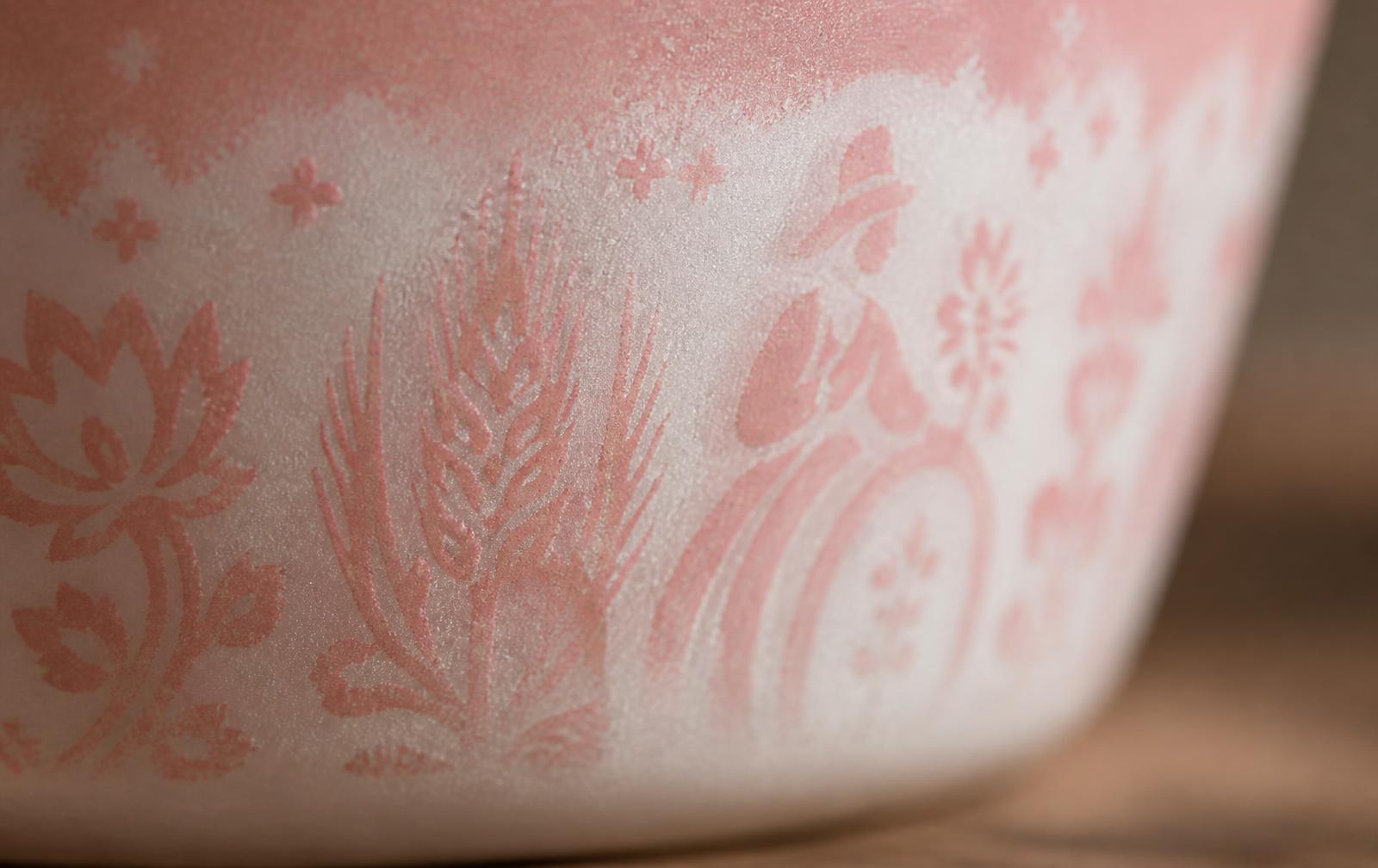
That matters enormously. The color is not in the glass. It is a thin layer of fired enamel sitting on the surface of the glass. It is closer to paint than to pigment. Anything that attacks a surface, attacks the pattern.
Your white dinner plates have a glaze that survives a dishwasher fine. Your grandmother's Butterprint bowl has a printed enamel skin, and it does not.
Why the dishwasher is uniquely brutal
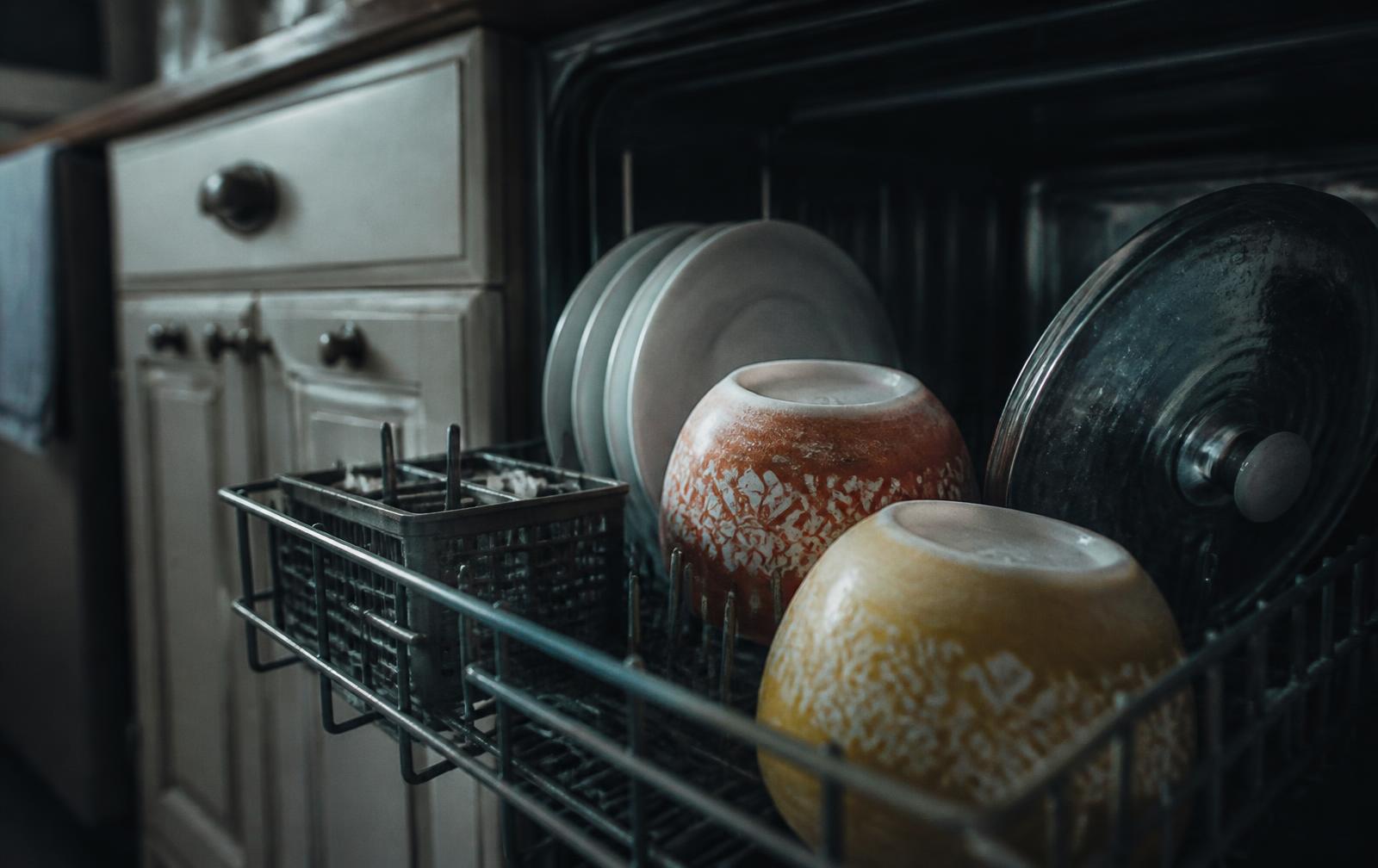
A dishwasher is not a sink. It is a small chemical reactor, and it is doing three things at once:
It is hot. Wash and dry cycles run far hotter and far longer than any hand wash, and heat accelerates chemical attack on glass.
It is strongly alkaline. This is the important one. Automatic dishwasher detergent is built to be a strong base, because that is what dissolves baked-on food. Consider the company it keeps: the Corning Museum's conservator, when he needs to remove truly stubborn stains from Pyrex, reaches for lye — sodium hydroxide — which he describes as "a very strong alkali (or base)" that "in high concentrations is dangerous and can cause serious burns." Dishwasher detergent is a milder relative of exactly that chemistry, applied hot, over and over, for decades. Strong alkali attacks silica. That is the whole ballgame.
It is relentless. One cycle does nothing you can see. Three hundred cycles is a slow polish-and-etch that removes the enamel a molecule at a time.
There is also a plausible reason your mother's bowls survived better than yours. Until 2010, American automatic dishwasher detergents were built around phosphates, which did much of the cleaning work. Then roughly fifteen or sixteen states banned them, and the major manufacturers reformulated industry-wide effective July 1, 2010 (American Chemical Society, Chemical & Engineering News; USA Today). The replacement formulas lean harder on enzymes and alkaline builders. I want to be careful here — I have not seen a controlled study comparing pre- and post-2010 detergent damage to opal glass, so treat this as context rather than proof. What is not in dispute is that modern detergent is aggressive, alkaline, and not designed with 1958 enamel in mind.
The collector shorthand: DWD
Walk into any serious Pyrex community and you will see three letters used as a verdict: DWD. Dishwasher damage.
It is used the way a coin collector says "cleaned" — a single word that takes a piece out of the conversation. A listing that says "no DWD" is making the most important claim it can make about condition. A listing that carefully photographs a piece in flat, shadowless light is sometimes making the opposite claim by omission.
The reason it functions as a disqualifier is simple: it cannot be undone. A chip is damage. A crack is damage. But etching is removed material. There is no polish, no oil, no "restoring" product, no baking-soda trick that puts fired enamel back onto glass. Anyone selling you a Pyrex restoration miracle is selling you a temporary oily film that looks better for a week and traps grime after that.
The five-second test
You can do this at an estate sale, in bad light, holding a coffee.
Tilt the piece until a light source reflects off the colored area, and look at the reflection.
- Good piece: the highlight is a sharp, wet-looking, mirror-like streak. The color is saturated. The white print has crisp edges. It looks like a shine.
- DWD piece: the highlight is a diffuse, cloudy smear. The surface scatters light instead of bouncing it. The color reads chalky or faded, like a photograph left in a window. Print edges look soft and slightly bled.
Then run these four confirmations:
- Fingertip test. Original enamel is glassy and slick. Etched surfaces have a faint dry, matte drag to them — some collectors describe it as feeling like eggshell.
- Compare the rim to the middle. Rims and high points take the worst of the spray. If the color fades noticeably as it approaches the lip while the protected areas stay richer, that's wash damage, not sun fade.
- Check the base and the underside. These are the most sheltered surfaces on the piece. If the underside is glossy and the outer wall is dull, the wash cycle did it.
- Look for ghosting. In advanced cases the print has eroded down to a faint outline — you can see where the pattern was. That piece is decorative only.
One caveat worth knowing so you don't misdiagnose: cloudiness on the clear parts of a piece can be limescale, not etching, and mineral film does wipe off with a little white vinegar. Etching does not. If a soak-and-wipe brings the shine back, you were looking at deposits and you got lucky.
What condition is actually worth
Here are individually dated, real sold results. Read them as evidence that the spread inside one pattern is enormous — but read the caveat under the table too, because I am not going to pretend these are perfectly matched pairs.
| Pattern | Form | Condition as described | Sold | Date |
|---|---|---|---|---|
| Gooseberry (pink) | #442 Cinderella, 1.5 qt | "Used" | $60 | Jun 25, 2021 |
| Gooseberry (pink) | Cinderella set, 441–444 | "EUC" (excellent used condition) | $379.99 | Feb 28, 2022 |
| Gooseberry (pink) | Cinderella 4-pc set | New in original box | $850 | Jan 2, 2025 |
| Gooseberry (pink) | #443 Cinderella, 2.5 qt | "Perfect condition" | $4,280 | Sep 17, 2023 |
| Snowflake Blue | #664 casserole, 4 qt | "Nice condition, minor marks" | $160 | Mar 10, 2024 |
| Snowflake Blue | 400-2 nesting set, 401–404 | New old stock, never opened | $499.99 | Jun 27, 2021 |
| Golden Poinsettia | #045 casserole, 2.5 qt | "Great condition" | $149.99 | Oct 23, 2024 |
| Golden Poinsettia | #045 casserole, 2.5 qt | "EUC, vivid graphics, no chips" | $180 | Feb 14, 2024 |
Sold results archived at pyrex.collectionhero.com, which indexes completed eBay listings.
The honest caveat
these are not laboratory comparisons. The $4,280 Gooseberry bowl is expensive largely because that form is genuinely scarce, not purely because it was glossy — rarity and condition are tangled together in every one of these numbers. What the table honestly demonstrates is that the words sellers use about surface condition — "vivid graphics," "perfect," "never opened" — sit at the top of the market, and the word "used" sits at the bottom. That is the real, observable pattern.
And at the very top, condition stops being a discount and becomes the entire proposition. The famous "Lucky in Love" casserole reportedly sold for $22,100, a figure I will flag as widely reported in the press rather than something I could confirm against a primary listing archive. Nobody pays that for a bowl with a tired pattern.
If you want to know what you're actually holding before you worry about its shine, our vintage Pyrex dating guide covers the all-caps logo test, backstamps by decade, and how to read model numbers.
The thing nobody mentions: don't cook in it anyway
This deserves its own section, because it changes the advice.
Independent XRF testing by Tamara Rubin, who tests consumer goods using CPSC-style methodology, has repeatedly found very high lead levels in the decorated exterior enamel of vintage Pyrex — including a vintage pink refrigerator dish measuring 179,000 ppm lead, and Spring Blossom Green mixing bowls at 109,900 ppm (test results). For scale, the modern limit for lead in paint on children's products is 90 ppm.
Some context so this lands accurately: these readings are of the painted decoration on the outside, not the white glass food surface, and XRF measures total elemental content rather than what actually leaches into food. Corning's own institutional record hints the industry knew the distinction — CMOG specifically notes the rare Lucky in Love prototype was made from "Non-lead Opalware Glass," which is only worth flagging if lead-bearing material was otherwise normal. There is no recall and no regulatory finding here, and I am not going to overstate it.
But it points somewhere sensible, and it happens to align perfectly with protecting value:
Display it, serve dry food in it, and don't bake in it, microwave it, or scour it. A worn, scratched, heavily etched decorative surface is exactly the condition where the coating is least stable — which means the pieces most likely to shed something are the same pieces already ruined for collectors. The dishwasher is degrading the paint layer either way.
Also worth knowing: Pyrex's American consumer bakeware moved from borosilicate to tempered soda-lime glass around 1998 under World Kitchen — a change well documented in secondary sources though not in a primary corporate statement I could locate. Thermal shock behavior differs between the two, which is one more reason not to treat a sixty-year-old collectible as everyday ovenware.
How to actually wash it
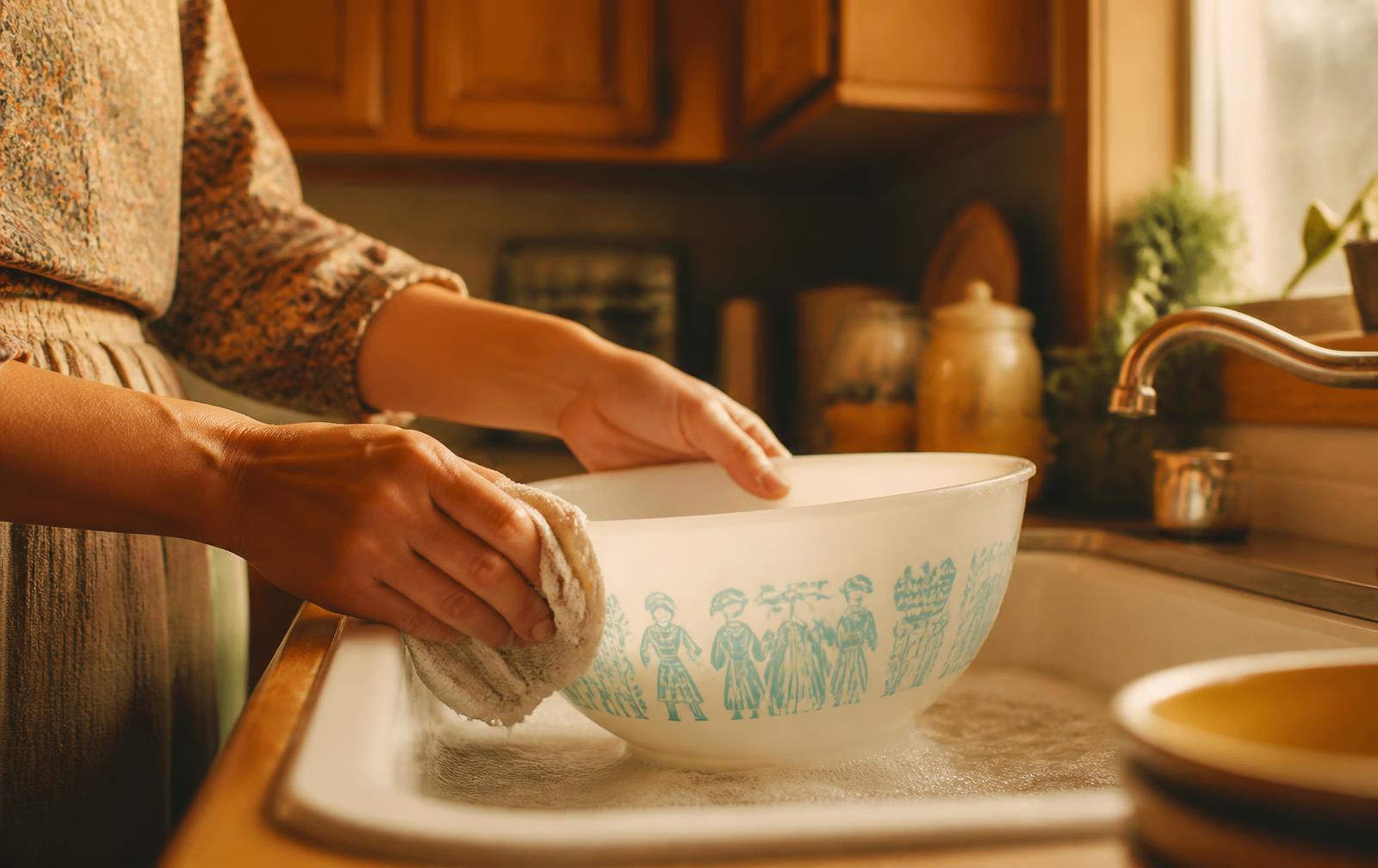
Straight from the Corning Museum of Glass conservator's protocol, condensed:
- Never the dishwasher. Koob extends this to all glass, not just Pyrex.
- Never abrasive pads — not steel wool, and not even sponges labeled "safe for glass" or "non-scratch." No sharp implements on baked-on food.
- Start gentle. Warm or hot water, a soft sponge or cotton towel, and a clear, unperfumed dish detergent. Koob specifically advises against dyed green or orange detergents and added fragrance, on the grounds that you don't need unknown extra chemistry touching the piece.
- Soak instead of scrubbing. If wiping doesn't do it, soak in hot soapy water for an hour or overnight, then repeat the gentle clean.
- Rinse and towel-dry gently. Don't air-dry to hard-water spots.
The museum's published protocol continues into a dilute lye treatment for badly stained pieces, with goggles, gloves, and real safety warnings. Read the original article in full before attempting that — lye causes serious burns, and it is not something to improvise from a summary.
For interior stains that aren't worth chemistry, a paste of baking soda and water left to sit, then wiped with a soft cloth, handles most of it. Just keep it off the printed exterior.
If you're shopping estate sales this weekend
Kitchens are the last room most shoppers hit, and the Pyrex is usually priced by the piece by someone moving fast. This is where the skill pays.
- Bring the light to the glass. Tilt every piece into the window or your phone's flashlight and read the reflection before you read the price sticker.
- Buy the ugly-pattern glossy piece over the great-pattern dull piece. A common pattern in mint condition outperforms a desirable pattern that's been cooked. Beginners do this backwards every single time.
- Check lids separately. Lids are handled more and washed more, and a mint base with a dull lid is a very common mismatch. Complete, condition-matched sets are what carry the premium.
- Look on top of the refrigerator and in the basement. Seriously. The pieces that got retired from daily rotation in 1979 and went into storage are the ones that never met a dishwasher. The best-condition Pyrex in the house is usually the piece the family stopped using.
- Don't dismiss the boring browns and golds. Butterfly Gold and Old Orchard are common, but a gleaming complete set still sells.
The broader version of this skill — walking into a room and finding the one good thing — is in how to spot valuable items at estate sales, and the pricing side is in how to appraise estate sale items. If mid-century kitchen glass is your thing generally, Depression glass and uranium glass live in the same cabinets and reward the same eye.
Not sure what you're looking at while you're standing there? The Ai Appraiser will identify a pattern from a photo. And if you'd rather the good pieces come to you, set a wishlist alert on Pyrex, Butterprint, Gooseberry or Cinderella and we'll email you when a listed sale posts a matching item.
If you run estate sales
Vintage Pyrex is one of the easiest categories to leave money on the table with, and the fix costs you nothing but attention.
Photograph the gloss on purpose. Shoot the piece at an angle where the light streaks off the enamel. A flat, straight-on, evenly lit photo of a mint bowl looks exactly like a photo of a ruined one, and the buyer paying collector money cannot tell the difference from your listing — so they assume the worst and bid accordingly. One angled shot with a visible highlight is worth real money.
Then say it in words. "Pyrex bowl, blue" is a $12 listing. "Pyrex Snowflake Blue #444 Cinderella bowl, glossy, no dishwasher damage" is found by the collector who has a saved search for that exact phrase. Put the pattern name, the model number, and the condition language in the title — that is what the search engine and the buyer are both matching on.
Sort the kitchen by condition before you price it. Put the mint pieces together, price them like collectibles, and price the faded ones as the usable kitchenware they still are. Selling them all at one blended price means you underprice the good ones and can't move the bad ones.
And tell the family. If they're keeping some of it, this is the one piece of advice they will actually thank you for.
Questions & answers
Frequently asked questions
Can you put vintage Pyrex in the dishwasher?
No. The chief conservator at the Corning Museum of Glass is unambiguous: "never, ever put any Pyrex through a dishwasher. This is the fastest and most damaging thing that you can do. It will slowly etch the Pyrex, and probably will not even do a decent job cleaning it." The combination of sustained heat and strongly alkaline detergent etches the opal glass and erodes the fired-on enamel decoration. Damage accumulates gradually over many cycles, so people rarely notice it happening — they notice it years later when they compare their piece to a mint one. Hand wash in warm water with a soft cloth and a plain clear detergent.
Can dishwasher damage on Pyrex be repaired or restored?
No. This is the hard part. Etching is not a film sitting on top of the piece; it is glass and enamel that has been chemically removed. There is nothing to polish back. Products marketed as restoring faded Pyrex — oils, waxes, glass polishes, mineral-oil rubs — deposit a temporary layer that makes the color look richer for a few days, then wears off and attracts grime. Worse, in the collector market a treated piece is considered altered, and applying something oily before selling without disclosing it will damage your reputation with buyers who can spot it instantly.
How can I tell if Pyrex has dishwasher damage?
Tilt it into a light and look at the reflection off the colored area. Intact pieces throw a sharp, wet-looking highlight; damaged pieces scatter it into a cloudy smear and read chalky. Confirm by comparing the exposed outer wall against sheltered areas like the underside and base — if the protected surfaces are glossier than the exposed ones, that's wash damage rather than fading from light. Run a fingertip across the color: original enamel is slick and glassy, etched surfaces have a slight dry matte drag. In advanced cases you'll see "ghosting," where only a faint outline of the pattern survives.
Does dishwasher damage lower the value of vintage Pyrex?
Substantially, though I'd be inventing a number if I gave you a precise percentage — the commonly repeated "50 to 80 percent" figure has no primary source I could find. What's documented is that collector price guides explicitly apply only to pieces in excellent condition, that collectors use "DWD" as a disqualifying label, and that real dated sold listings show the top of every pattern's market occupied by pieces described as glossy, vivid, mint or boxed. A heavily etched piece typically drops out of the collector market entirely and sells as decorative or usable kitchenware.
Is vintage Pyrex safe to use for food?
The white glass interior is inert; the concern is the decorated exterior. Independent XRF testing has found very high lead levels in the exterior enamel of many vintage patterns — including 179,000 ppm on a pink refrigerator dish — although XRF measures total content rather than what leaches into food, and there has been no recall or regulatory finding. The sensible position, which also happens to preserve value: use vintage Pyrex for display and for dry or cold food, avoid baking and microwaving in it, and never scour the painted surface. Pieces with already-worn, scratched or etched decoration are the ones to be most conservative with.
What years is vintage Pyrex from?
The collectible opal ware era runs from 1945, when Corning introduced its opaque white body, to roughly 1986, when opal Pyrex production ceased — the Corning Museum of Glass identifies Shenandoah and Forest Fancies (1981–1986) as among the last patterns released. The fastest dating shortcut is the logo: PYREX in all capitals generally means pre-mid-1970s, while lowercase pyrex means later. Separately, American consumer Pyrex bakeware shifted from borosilicate to tempered soda-lime glass around 1998.
Why does old Pyrex look better than mine?
Almost always because it was used less, not because it was made better. The glossiest surviving pieces are typically the ones that got promoted out of daily use — the holiday casserole, the boxed set that stayed boxed, the promotional piece someone thought was too nice for everyday. Meanwhile the bowl that got used weekly for forty years accumulated hundreds of wash cycles. This is exactly why the best pieces at an estate sale are usually found in a basement, a top cabinet, or on top of the refrigerator rather than in the working kitchen rotation.
Sources and further reading
- Corning Museum of Glass — How To Clean Pyrex — Stephen Koob, chief conservator; the dishwasher warning and the full cleaning protocol
- Corning Museum of Glass — Pyrex pattern library — pattern dates and the end of opal production
- Corning Museum of Glass — "Lucky in Love" object record — screen-printed technique and the non-lead opalware note
- PyrexCollector.com — Damage & Defects — how collectors grade condition
- PyrexCollector.com — Opal Ware Decoration — screen printing and decoration methods
- Pyrex Collection Hero — archive of completed eBay sold listings
- American Chemical Society, C&EN — Goodbye, Phosphates — the July 1, 2010 detergent reformulation
- USA Today — 16 states ban phosphate-laden dishwasher soap
- Lead Safe Mama — vintage Pyrex XRF test results — independent testing of decorated surfaces
- American Ceramic Society — thermal stress and glass cookware — borosilicate vs. soda-lime behavior
Related reading:
- Vintage Pyrex dating guide: how to tell what you have
- Free With Oatmeal: the Depression glass guide
- Uranium glass: the salad bowl that glows
- Boomer estates: the last generation of stuff
- How to spot valuable items at estate sales
- How to appraise estate sale items
- The most valuable items at estate sales
- The grandmacore shopping list
This article is general collecting information, not appraisal, safety or medical advice. Sold prices are individually dated results as of 2026 and reflect rarity as well as condition — confirm recent completed sales for your exact pattern, form and condition before buying or pricing. Lead testing figures cited are from independent XRF testing of exterior decoration and represent total elemental content, not leaching rates. Photographs illustrating this article are original illustrative images, not photographs of the specific pieces whose prices are cited.
Keep exploring
Ready to start your own treasure hunt?
Discover estate sales near you and find incredible deals.
Explore Sales Near Me
About the author
Andy
Founder, EstateSaleFinder.net
Hi, I'm Andy — a retired commercial photographer turned developer with a five-year (and counting) obsession with estate sales. I started EstateSaleFinder.net because I knew there had to be an easier, smarter way to find and list estate sales. Now I get to chase treasure and build the tool I always wished existed.