
Den shelf finds · Sold-price guide
Is Old Stereo Equipment Worth Anything? Receivers, Turntables, Speakers and Console Stereos, With Real 2026 Sold Prices
November 18, 20269 min readSource-checked guide
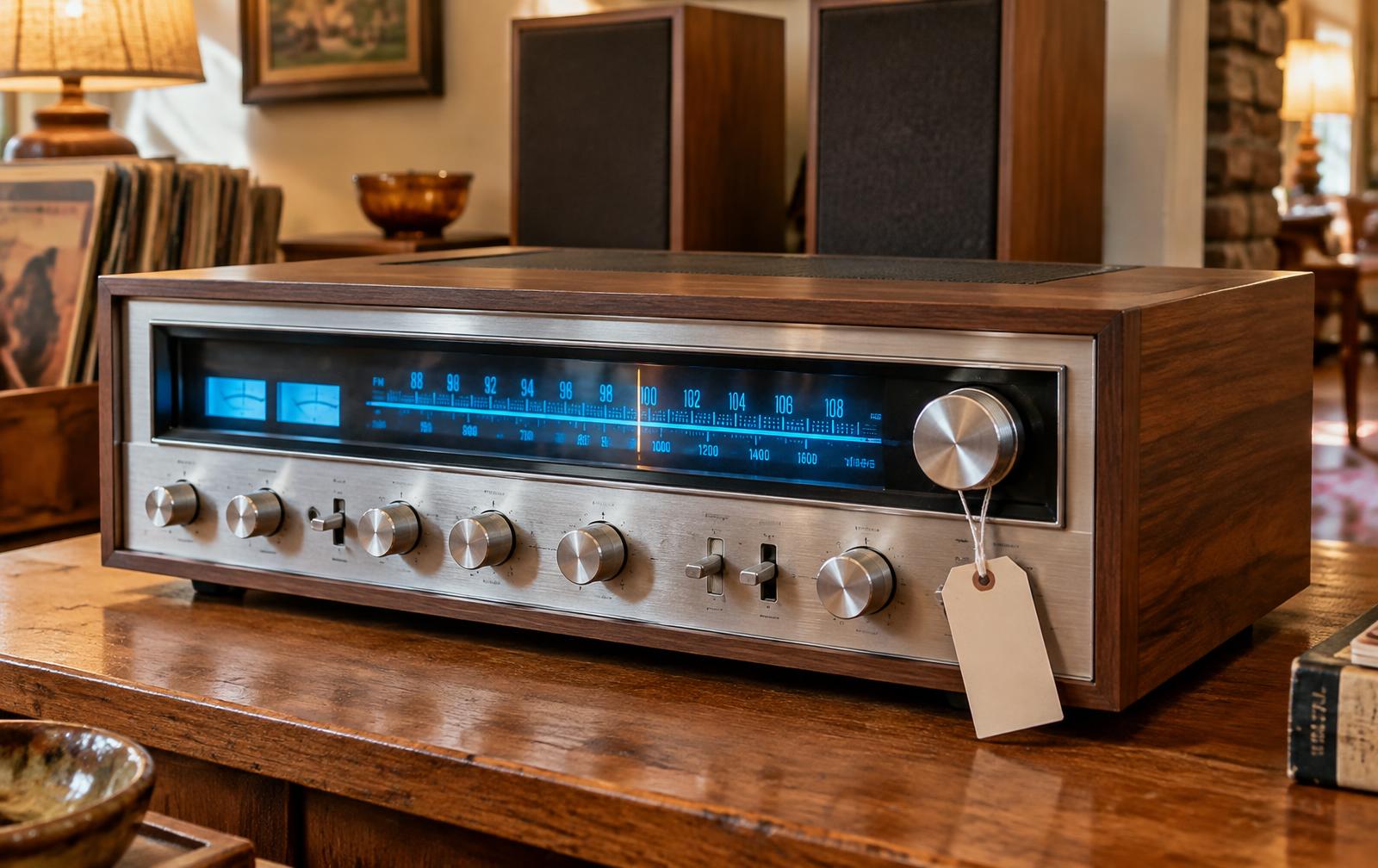
Is old stereo equipment worth anything? Most sells for $20–$80, but working 1970s Marantz and Pioneer receivers bring hundreds. Sold prices, tests, where to sell.
Most old stereo gear sells for $20 to $80. The exceptions are working 1970s receivers from Marantz, Pioneer, Sansui, Kenwood and McIntosh, which can bring hundreds to a few thousand dollars, plus a short list of turntables. A working Marantz 2230 recently sold for a median of about $680 on eBay. Console stereos rarely bring much. Testing, original knobs and a clean faceplate matter most.
Every estate sale has a den. And every den has a receiver on a shelf, two wooden speakers the size of end tables, a turntable under a dusty lid, and maybe a cassette deck nobody has touched since 1994.
Some of it is worth real money. Most of it isn't. The difference usually comes down to three things you can check in ten minutes: the model number, whether it works, and whether it still has its original parts. This guide shows how to check each one, what things actually sold for this fall, and where to sell.
All prices here are sold prices, not asking prices, checked in November 2026. Asking prices on eBay and Reverb are often much higher than what buyers pay. A sold price tells you what someone actually paid.
Is old stereo equipment worth anything?
Some of it, yes. A rough guide:
| Type of gear | Typical sold range | What makes it worth more |
|---|---|---|
| Common 1980s–90s receiver (black plastic face) | about $20–$80 | Very little; these were made by the million |
| Mid-size 1970s receiver, working (e.g. Pioneer SX-450) | about $225–$320 | Tested on every input, original knobs |
| Popular 1970s receiver, working (e.g. Pioneer SX-780, Marantz 2230) | about $385–$1,100 | Clean faceplate, working lamps, wood case |
| Big 1970s "monster" receivers (100+ watts per channel) | often $2,000+ | Fully working, serviced; these are heavy and costly to ship |
| Ordinary vintage turntable, working | about $50–$200 | A good cartridge, a dust cover |
| Technics SL-1200 MK2 | about $490–$720 | Steady speed, working tonearm |
| Console stereo (furniture cabinet) | usually little | The cabinet, if it's an attractive mid-century design |
Sources for the ranges: completed eBay sales collected by FlipTip (September to October 2026), the sold ranges on Guestimator (November 2026), the turntable guide at WorthPic and the market notes at StereoWorth.
Sold prices, checked Nov 2026
Where does it land?
Marantz 2230, working
$597–$1,096
Middle half of 12 eBay sales; median $682. Source: FlipTip.
Sold prices, not asking prices. Ranges are for working units; a unit that only powers on brings much less.
Which vintage receivers are worth the most?
The receivers collectors want are mostly from about 1970 to 1980, with silver aluminum faces, a long lit tuning dial and heavy metal knobs. The brands that come up again and again are Marantz, Pioneer, Sansui, Kenwood, Yamaha, Technics and McIntosh.
Recent sold numbers from FlipTip's eBay tracking, September to October 2026 (FlipTip):
- Marantz 2230, working: median $682 over 12 sales. The middle half sold between $597 and $1,096.
- Pioneer SX-780, working: median $500 over 17 sales. The middle half sold between $385 and $750.
- Pioneer SX-450, working: median $277 over 16 sales. The middle half sold between $225 and $322.
Guestimator's November check found higher recent Marantz 2230 sales, from $656 to $1,450 across four listings, including "beautifully restored" ones (Guestimator). That gap shows how much condition and servicing matter.
At the top end are the big flagship receivers: the Pioneer SX-1250 and SX-1980, the Marantz 2270 and up, the Sansui G-series and 9090, the Kenwood KR-9600 and the McIntosh MAC 1900. StereoWorth's market table lists asking prices for these in the thousands. It also says sold prices typically run 10 to 20 percent lower for common models (StereoWorth). Treat those as a reason to research carefully, not as a price.
A warning about price sites: different sites can give very different numbers for the same model. StereoWorth's own Marantz 2230 page shows a "market value" around $79 while asking prices run $550 and up. It notes the gap is "unusually wide," likely because parts and faceplates get mixed in with complete units (StereoWorth, Marantz 2230). Always click through to the actual sold listings and compare complete, working units.
How do I identify a piece?
- Find the model number. It's on the front panel, usually near the power switch, and on a label on the back. Write down the brand and the full number, including letters like "B" or "DB."
- Look at the face. A silver aluminum face, a long lit dial and big metal knobs usually means 1970s. A black plastic face with buttons usually means mid-1980s or later, and much lower value.
- Check the power rating. It's often on the back panel or in the manual. More watts per channel usually means a bigger, more valuable model in the same line.
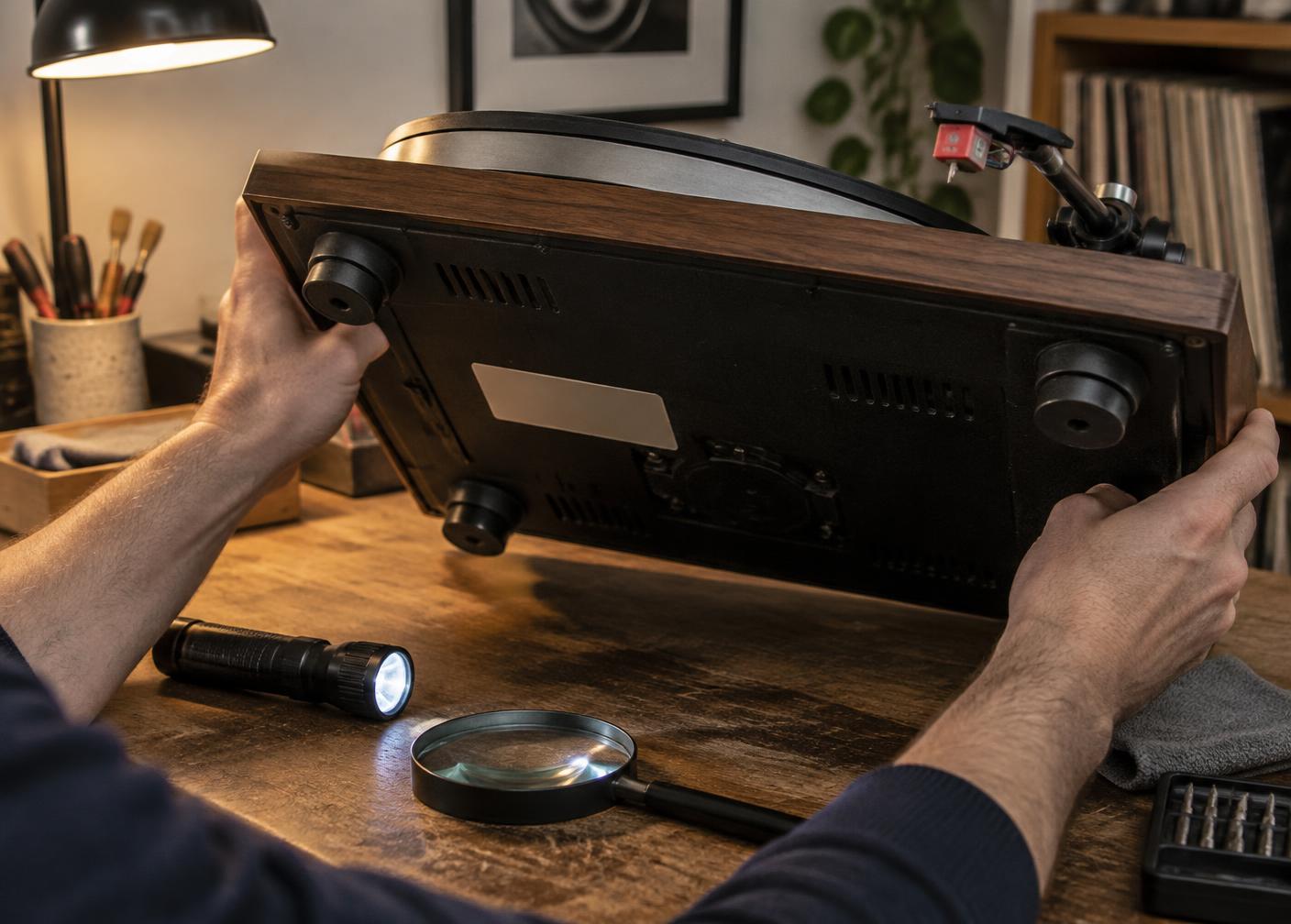
- On a turntable, check the cartridge. The cartridge is the small piece at the end of the arm that holds the needle. A good one can be worth more than an ordinary deck (WorthPic).
Are old record players worth anything?
Most are worth about $50 to $200 if they work and have a usable cartridge (WorthPic). The Technics SL-1200 family is the big exception: recent eBay sales for the SL-1200 MK2 ran about $489 to $719 (Guestimator). A few high-end decks, like the Thorens TD-124, Garrard 301 and 401, and Linn LP12, bring more, and these are worth having checked by someone who knows them.
What sets the price: steady speed, a tonearm that lifts and returns, a stylus with life left, and an uncracked dust cover. All-in-one "record players" with built-in speakers are a different thing and usually bring little.
Are old speakers worth anything?
Sometimes. Large, well-known speakers from the 1970s, in good wood cabinets with the original grilles and working drivers, sell to local buyers who don't want to pay shipping. Small unmarked speakers that came with a cheap system usually don't. Test them by playing music quietly through a working amplifier. Listen for buzzing, rattling or a dead speaker. Look behind the grille for torn or rotted speaker surrounds, which usually need repair.
Are console stereos worth anything?
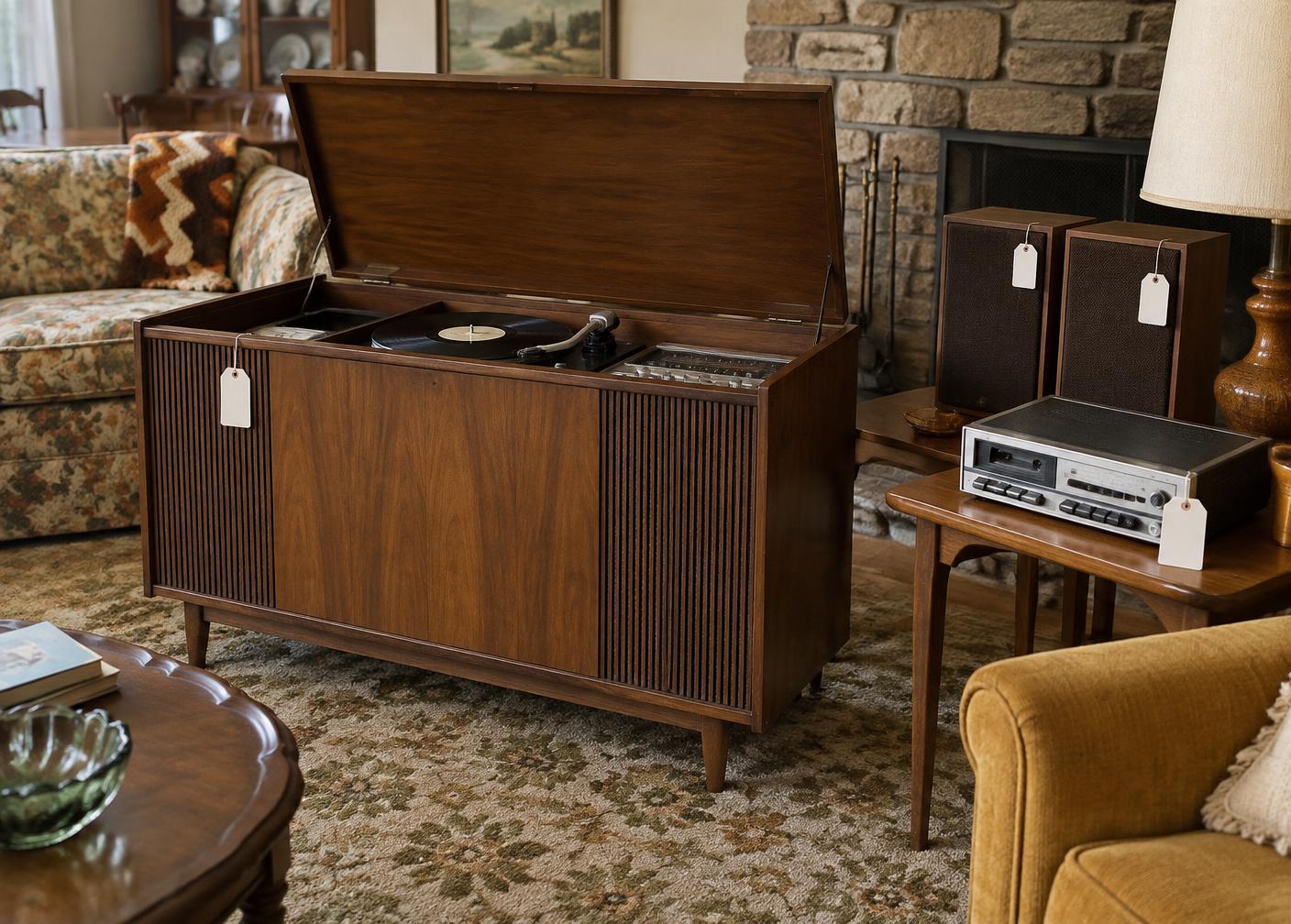
Usually not much as a stereo. The electronics in most console cabinets from the 1960s and 1970s were basic, and they're big and heavy to move. StereoWorth says console stereos are almost always worth nothing as audio gear (StereoWorth). The cabinet itself can sell to buyers who want a mid-century look, especially a clean walnut design on tapered legs. Some people turn them into bars or modern speaker setups. Price it as furniture.
How do I test old stereo gear safely?
Go slowly. These units are 40 to 50 years old, and many have never been serviced.
Ten-minute test bench
Tick what you could confirm
Untested or faulty: sell "as is, for parts or repair" and price at the bottom of the range.
Stop if you smell burning, hear a loud hum or see smoke. Old capacitors fail; a technician should open the case, not you.
- Look before you plug it in. Check the power cord for cracks, and smell for burning. Don't plug in anything with a damaged cord.
- Plug it into a power strip, with the volume at zero and nothing else connected.
- Turn it on and watch. The dial and meters should light up. If you see smoke, smell burning or hear a loud hum, turn it off at once.
- Connect a pair of cheap test speakers and play something. Try every input: tuner, phono and aux. Use a phone with a cable for aux.
- Turn each knob slowly. Crackling or sound cutting out means dirty controls, a common and fixable problem, but it lowers the price.
- Check both channels. Use the balance knob. Sound only on one side is a real fault.
Don't open the case. Old capacitors can hold a charge. Repairs belong with a technician. When selling, describe what you tested in plain words: "Tested: plays on all inputs, both channels, all lamps lit" is worth much more than "powers on."
What kills value
- Missing or replaced knobs. Buyers want originals.
- A scratched or dented faceplate.
- Dead dial lamps. Fixable, but it shows in photos.
- One channel dead or weak.
- A cracked wood case or missing cover.
- "Untested." Buyers assume the worst.
Where to sell vintage stereo equipment
- At the estate sale itself. Local buyers want the big receivers and speakers that cost a lot to ship. A good tag with the model number and "tested" pulls them in.
- eBay. It has the biggest audience for named models, but packing and shipping heavy receivers is expensive and risky.
- Reverb. A marketplace for musicians and audio buyers.
- Local vintage audio shops and repair techs. They may buy untested or faulty units for parts or restoration.
- Local listings. Speakers and console cabinets often sell best locally.
A pricing guide for estate sale companies
- Write the full model number on the tag. Serious buyers search by model before they come.
- Test before you price. Mark each piece "tested working," "works with faults (describe)" or "untested / as is."
- Price working, named 1970s receivers from sold listings for that exact model, then adjust for condition. Leave room for buyers who need to service them.
- Price common 1980s and 1990s gear in a low bin or bundle it.
- Price console stereos as furniture.
- Put the best pieces in pre-offers so serious buyers can claim them before the sale. See how to price items for an estate sale.
The Ai Appraiser can suggest an identification from a photo of the front panel and model label. Always confirm the exact model and sold listings yourself.
For treasure hunters: grab or skip
Look closer
silver-faced receivers with wood cases; the names Marantz, Sansui, Pioneer SX, Kenwood KR, McIntosh, Yamaha CR; Technics direct-drive turntables; heavy speakers from well-known brands with clean grilles; turntables with a branded cartridge.
Usually skip unless they're nearly free: black plastic receivers from the 1990s, all-in-one boom systems, console stereos (unless you want the cabinet), unbranded speakers, and anything with a cut or damaged cord.
If you love this hunt, see our guides to vinyl records worth money, vintage cameras, items to resell on eBay, overlooked brands that sell high and vintage Christmas gifts from estate sales. Find estate sales near you this weekend.
Questions & answers
Frequently asked questions
Which vintage receivers are worth the most?
1970s silver-faced receivers from Marantz, Pioneer, Sansui, Kenwood, Yamaha and McIntosh, especially the big high-power models. Working popular models like the Marantz 2230 sold for a median of about $680 on eBay in fall 2026. Flagships can bring thousands.
Are old record players worth anything?
Most working vintage turntables sell for about $50 to $200. The Technics SL-1200 MK2 sells for about $490 to $720, and a few high-end decks bring more. All-in-one record players with built-in speakers usually bring little.
Are old speakers worth anything?
Large, well-known 1970s speakers in good cabinets with working drivers can sell locally. Small, unbranded speakers usually don't. Check for torn speaker surrounds behind the grille.
Are console stereos worth anything?
Rarely as audio equipment. The cabinet can sell as mid-century furniture if it's attractive and in good shape.
Where can I sell vintage stereo equipment?
Locally at the estate sale, on eBay or Reverb, or to vintage audio shops and repair technicians. Heavy pieces usually sell best locally.
Should I restore a receiver before selling it?
Usually not, unless you already know a trusted technician and the model is valuable. Servicing costs money, and many buyers prefer to do it themselves. Test it, describe it honestly and price it to match.
Prices are sold prices from the sources linked, checked November 2026. They change. Asking prices are not values. This is general guidance, not an appraisal.
Keep exploring
Photograph the faceplate and model label
Get a suggested identification from a photo, then confirm the exact model and sold listings yourself.
Open the Ai Appraiser
About the author
Andy
Founder, EstateSaleFinder.net
Hi, I'm Andy — a retired commercial photographer turned developer with a five-year (and counting) obsession with estate sales. I started EstateSaleFinder.net because I knew there had to be an easier, smarter way to find and list estate sales. Now I get to chase treasure and build the tool I always wished existed.