The $5 Necklace That's $500: Costume Jewelry Brands Worth Knowing
The jewelry box is the most-opened drawer at any estate sale, and it is also the most consistently mispriced. Almost everything in it is worth a few dollars — but five American makers put signatures on the back of pieces that now sell for hundreds, and occasionally thousands. Here's the real history, honestly dated auction results, and how to check a mark in under a minute.
Quick answer
Most costume jewelry in an estate sale jewelry box is worth $5 to $30. The exceptions are signed pieces from a handful of mid-century American makers — Miriam Haskell, Trifari, Hattie Carnegie, Weiss and Coro/Corocraft — where strong 1940s–1960s designs regularly bring $75 to $400 and the best examples go far higher: a c.1965 Miriam Haskell parure sold at auction for $4,148, and an early Trifari "KTF" Art Deco necklace-and-bracelet set brought $2,300 (Invaluable). Turn the piece over: the maker's name is stamped on the back, the clasp, or a tiny oval plaque. If the metal is marked STERLING on a rhinestone piece, it is almost certainly wartime, roughly 1942–1946, because the government had taken the base metals away.
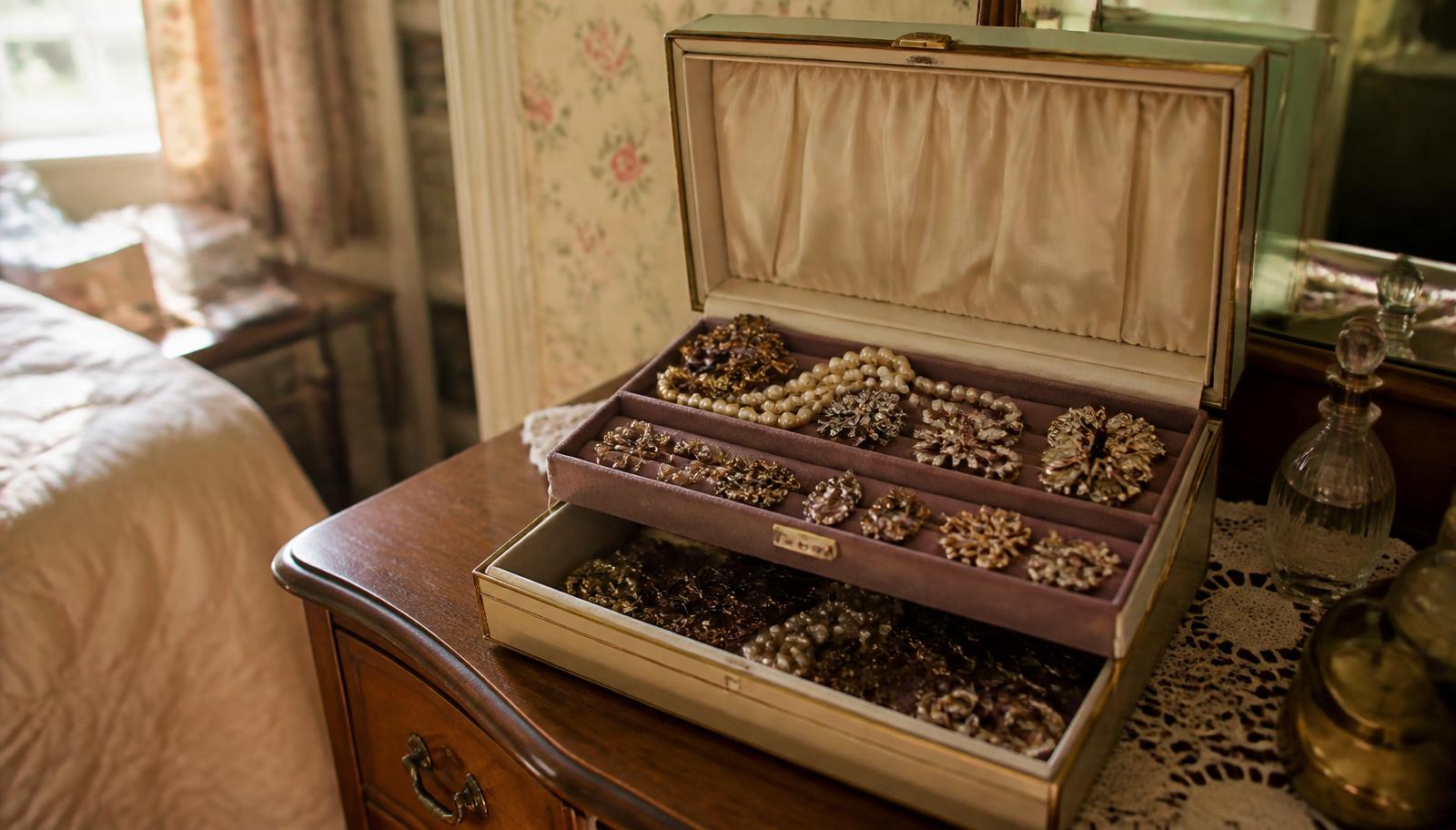
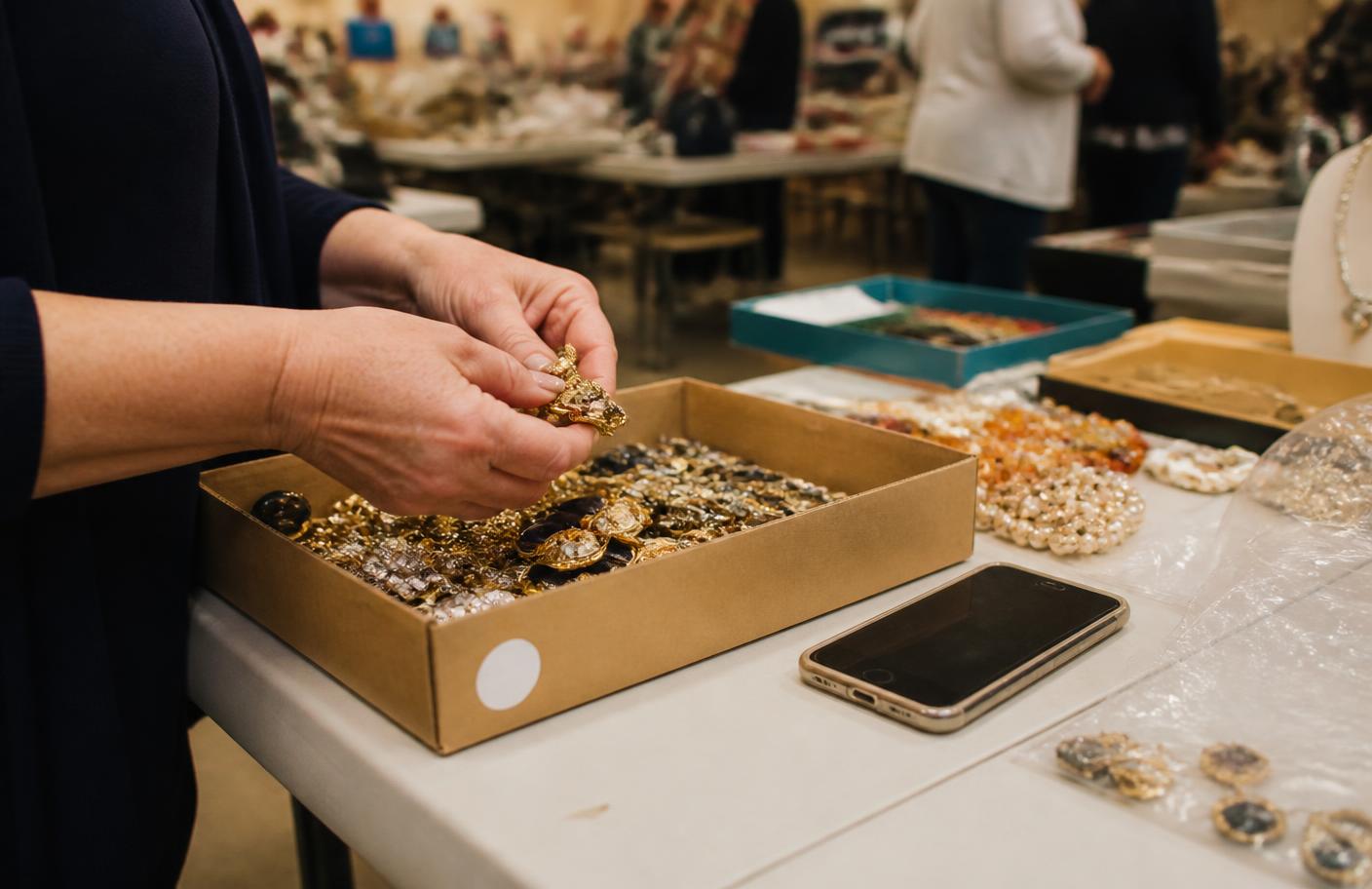
There is a jewelry box on a dresser at every estate sale in America. It is the most-opened drawer in the house — more than the silverware, more than the tool chest — and it is almost always the most casually priced. Costume jewelry gets sorted into a shoebox, labeled $3 each or 4 for $10, and set near the register.
That pricing is correct about ninety percent of the time.
The other ten percent is why serious jewelry dealers show up before you do, work the box with their fingers rather than their eyes, and leave in eleven minutes with four things.
What "signed" actually means
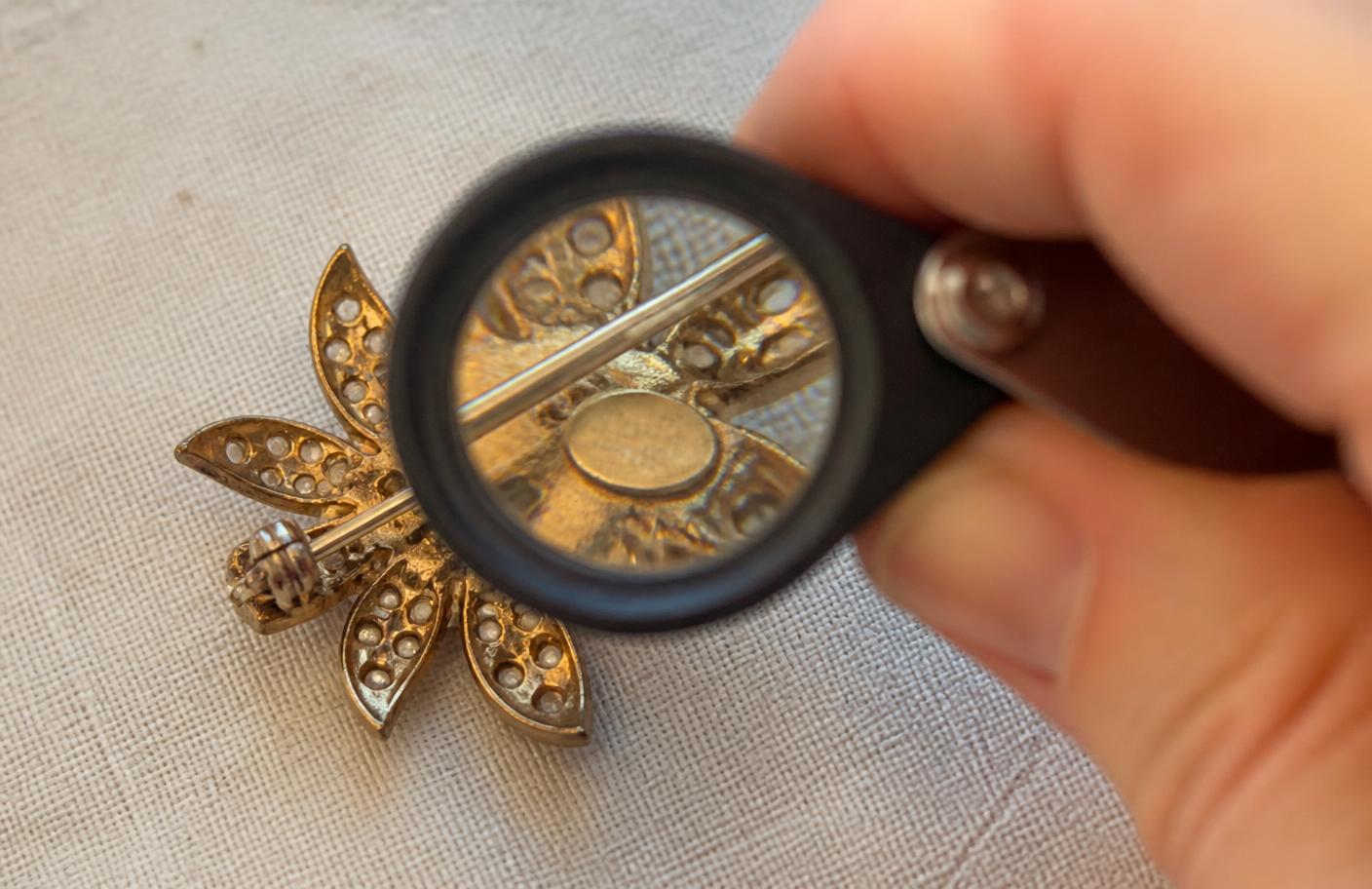
In costume jewelry, "signed" means the manufacturer put its name on the piece. Not a designer's autograph — a stamp in the casting, an engraved line on the clasp, or a tiny oval plaque soldered to the back.
That's it. That's the entire difference between a $4 brooch and a $250 brooch, most of the time. Two rhinestone flower pins can come out of the same box, in the same condition, made in the same decade, in the same Rhode Island factory district — and the one with four letters on the back is worth thirty times the other one.
Sellers underprice signed pieces because "costume" sounds like a synonym for worthless. Buyers overlook them because the mark is 2mm tall, on the back, under a pin stem, in a dim bedroom.
Miriam Haskell: the one that surprises people
Miriam Haskell (1899–1981) was born in Tell City, Indiana, moved to New York in 1924 with $500, and opened a jewelry boutique in 1926 in the old McAlpin Hotel. Her creative partner Frank Hess joined the same year, and the two of them worked together for decades — with a long-running collector argument over which of them deserves the credit for the designs (Wikipedia).
Her clients were not modest. Joan Crawford owned a set of nearly every Haskell design produced from the 1920s through the 1960s. Lucille Ball, Gloria Vanderbilt and the Duchess of Windsor wore the pieces. The Saks Fifth Avenue shop that carried Haskell also carried Chanel.
What matters in a jewelry box is the construction. Haskell pieces are hand-sewn, not glued: irregular baroque glass pearls and seed beads wired and stitched onto gilt filigree backplates, so the reverse of a Haskell brooch looks almost as considered as the front. Once you have turned one over, you never mistake it again.
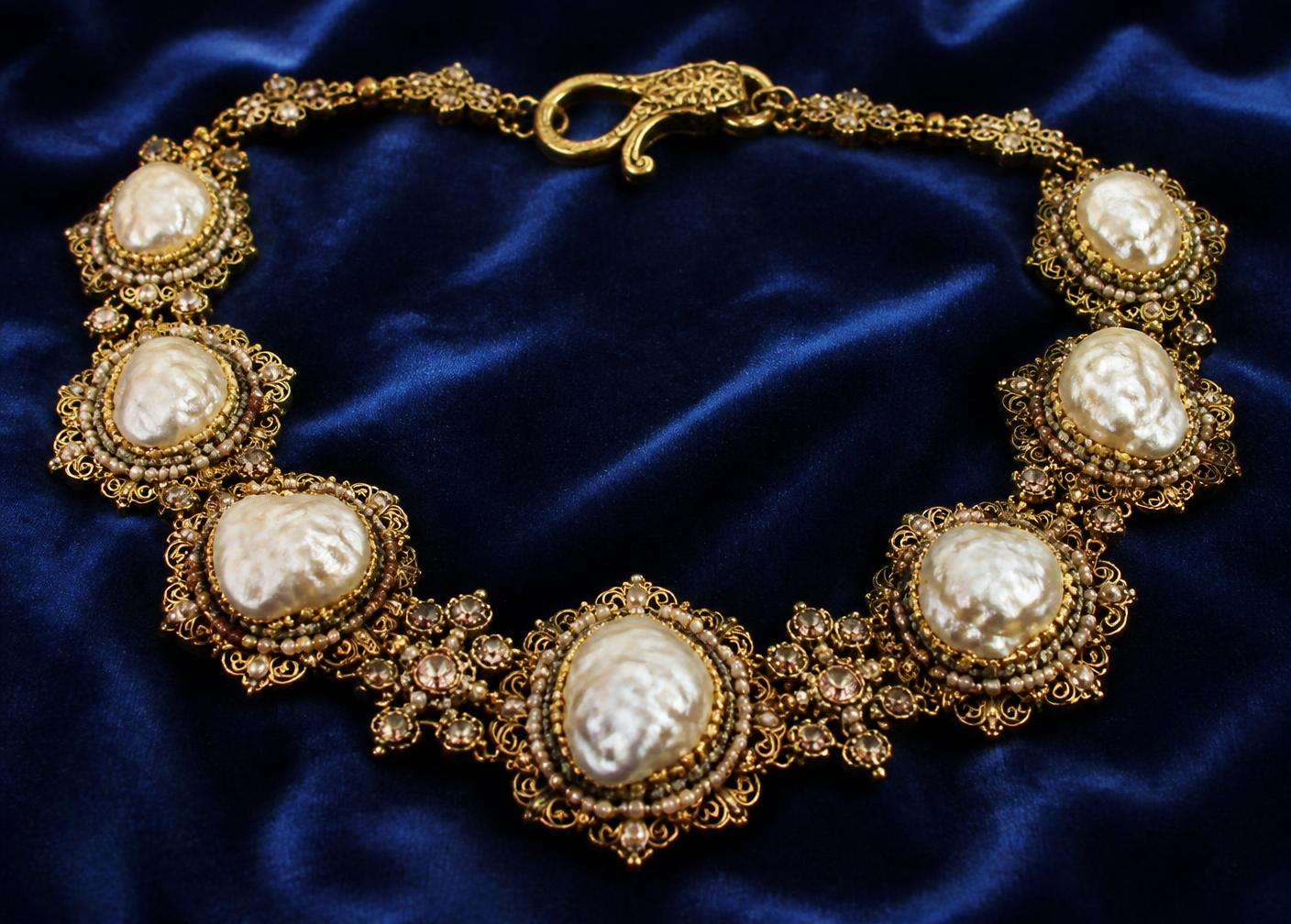
One trap: Haskell was seldom signed before about 1950. Her brother Joseph introduced the first regularly signed pieces, and for a brief period in the 1940s a New England shop asked for a horseshoe-shaped plaque reading Miriam Haskell — those are rare. So an unsigned piece is not automatically a fake, and an unsigned piece is also not automatically a Haskell, which is exactly how the "attributed to Haskell" market got so noisy. Buy the construction, not the story.
The Metropolitan Museum of Art holds Haskell in its Costume Institute collection, if you want to study real examples: a glass-and-metal bead necklace, 1928–48, an earlier jewelry set, and a 1960–67 set.
Trifari: the crown and the court case
Trifari was founded in New York in the 1910s by Gustavo Trifari, an immigrant from a Naples goldsmithing family, and became Trifari, Krussman & Fishel after Leo Krussman and Carl Fishel joined. In 1930 the company hired Alfred Philippe, who had previously designed for Cartier and Van Cleef & Arpels — which is the whole Trifari story in one sentence. Fine-jewelry technique, base-metal budget: hand-set stones, invisible-set panels, real proportion.
Trifari is also the reason costume jewelry has legal standing as art. In 1955, in Trifari, Krussman & Fishel, Inc. v. Charel Co., a copycat argued that the plaintiff's product was mere "junk jewelry" that "does not rise to the dignity of a 'work of art'" and therefore could not be copyrighted. Judge Bicks disagreed, holding that "costume jewelry may express the artistic conception of its 'author' no less than a painting or a statue," and granted the injunction (134 F. Supp. 551, S.D.N.Y. 1955).
There is a dating gift buried in that opinion. The court examined Trifari's copyright notice and described it: a "c" enclosed within a circle, together with the name of the copyright owner, placed on the clasp, where the maker's name customarily appears. That is why a © beside a costume-jewelry mark is a rough dating line — pieces carrying it are generally from the mid-1950s onward.
Other Trifari shortcuts worth memorizing:
- KTF — the early mark, used before the crown; KTF-era Art Deco pieces are the ones that reach four figures.
- Crown over the T — the familiar "Crown Trifari" mark of the late 1930s onward.
- Jelly Bellies — 1940s figural pins with a big clear Lucite body. Trifari's sterling wartime versions are the collectible ones.
The Met holds Trifari as well, including a ca. 1935 metal-and-glass bracelet and a 1966–70 collar.
Hattie Carnegie: the couturier who added jewelry
Hattie Carnegie was born Henrietta Kanengeiser in Vienna, took the Carnegie name as a teenager in homage to Andrew Carnegie, started with hats in 1909, and by 1929 was running a $3.5 million-a-year New York fashion business. She could not sew or cut a pattern; what she had was an eye for talent — Norman Norell, Pauline Trigère, Claire McCardell and Jean Louis all passed through her company. A young Lucille Ball modeled for her (Wikipedia).
Jewelry came out of the fashion house, which is why Carnegie pieces look like accessories designed for a specific outfit rather than a catalog: figural Asian-influenced faces, heavy enameled fruit and animal pins, chunky glass necklaces. Carnegie died in 1956, the couture line ended in 1965, and the company closed for good in 1976 — so the signed jewelry has a firm end date.
Weiss: the rhinestone specialist
Albert Weiss worked for Coro before founding his own New York company in 1942; it closed in 1971 (Lilly's Vintage Jewelry). Weiss is a stone-quality story: exceptionally bright, well-matched rhinestones, often set in japanned matte-black metal so the color reads harder, and a signature line of realistic floral and figural brooches. Weiss also made "black diamond" grey-stone pieces that people routinely mistake for something much more expensive.
Weiss is the most attainable name on this list. A signed japanned floral brooch commonly carries auction estimates in the $40–$60 range (FindArtInfo) — a fine buy at a dollar, an honest resale, not a lottery ticket.
Coro and Corocraft: the volume king
Coro began in 1901 as Cohn & Rosenberger, founded by Emanuel Cohn and Carl Rosenberger in New York, and grew into the largest costume jewelry manufacturer in the world, with an enormous plant in Providence, Rhode Island. It went out of business in 1979 (Wikipedia, Rhode Island Historical Society company records).
Because Coro made so much, the mark alone tells you very little — and that is the useful part:
- Coro — the mass-market line. Usually modest money.
- Corocraft — the better-quality line, including sterling wartime pieces.
- Vendôme — the upscale line, the one collectors chase.
- Duette — the patented double-clip frame; complete Duettes with the frame intact are worth meaningfully more than an orphaned single clip.
The Met holds a ca. 1940 Coro brooch in metal, paste and enamel.
The wartime tell: why a rhinestone brooch says STERLING
This is the fastest date stamp in the whole category, and most people misread it as "this is real silver, so it must be fine jewelry."
In March 1942, TIME reported that jewelry makers had been "denied all use of tin, copper, aluminum, chrome, nickel and iridium" — the war took the base metals (TIME, "Junk Jewelry, 1942 Style"). Costume jewelry manufacturers had two options: switch to wood, felt, raffia, plastic and glass, or switch to sterling silver, which was not restricted.
So they did both. That is why the wartime years produced a distinct look — sterling-bodied rhinestone brooches, sterling Jelly Belly figurals, plastic and wood novelty pins — and why "STERLING" stamped on a rhinestone or Lucite piece dates it to roughly 1942 through 1946. Collectors treat the sterling wartime output of Trifari and Corocraft as its own small, desirable window.
If the piece is sterling but unsigned, weigh it and check our silver hallmark identification guide — and remember that scrap value is a floor, not a ceiling.
What the money actually looks like
Real, dated results, so you can calibrate instead of guessing. Auction prices are individual outcomes driven by rarity, completeness and condition — not a price list.
| Piece | Result | Source |
|---|---|---|
| Miriam Haskell parure (brooch, earclips, more), c.1965, designed by Robert F. Clark | $4,148 | Archived auction record |
| Early Trifari KTF Art Deco necklace + bracelet set | $2,300 (Ripley Auctions, Nov 2016) | Invaluable |
| Trifari Jelly Belly sailfish brooch in a 5-piece group lot | $275 | Archived auction record |
| Trifari Jelly Belly brooch, mother-of-pearl Lucite belly | $244 (Leslie Hindman, 2010) | Archived auction record |
| Trifari "Big Fly" brooch, 1944, sterling + Lucite, by Alfred Philippe | €175 | Aste Bolaffi |
| Signed Weiss japanned floral brooch | est. C$40–60 | FindArtInfo |
| Mixed group: Hattie Carnegie + Miriam Haskell + Trifari, sold as one lot | $80 (March 2025) | Brown Button Estate Sales |
Read that last row carefully, because it is the honest one. Three great names in a single lot brought $80. Signatures raise the floor; they do not guarantee a payday. What produces the four-figure results is a complete original set, a rare design, excellent condition, and a buyer who collects that specific maker.
The realistic version of this article's headline: a signed brooch bought for $5 out of a jewelry box is usually a $40 to $150 piece, sometimes a $400 piece, and once in a while — early Trifari, a full Haskell parure, a rare figural — genuinely a $500-plus piece.
The 60-second field test
You are standing at a dresser. There are two hundred pieces in front of you and someone else is reaching in from the other side. Work in this order.
- Turn it over first. Always. Mark on the back plate, on the clasp, on the pin stem, or on a small applied oval. A loupe or your phone's camera zoom is enough.
- Feel the weight. Good mid-century costume jewelry has heft — cast metal, not stamped foil. Feather-light and flexible usually means later mass production.
- Check how the stones are held. Prong-set stones in little metal claws are a quality signal. Glue blobs around the stones point to cheaper or repaired work.
- Look at the reverse construction. Sewn seed beads and filigree backplates say Haskell-school hand work. A flat, empty stamped back says volume production.
- Read the metal words. STERLING = roughly 1942–46. © = mid-1950s onward. Pat. Pend. and design patent numbers narrow the year further.
- Count the damage. Missing stones, dead-grey "sick" rhinestones from moisture, worn plating, a broken clasp, a snapped pin stem. Condition is most of the spread between $40 and $400.
What quietly destroys the value
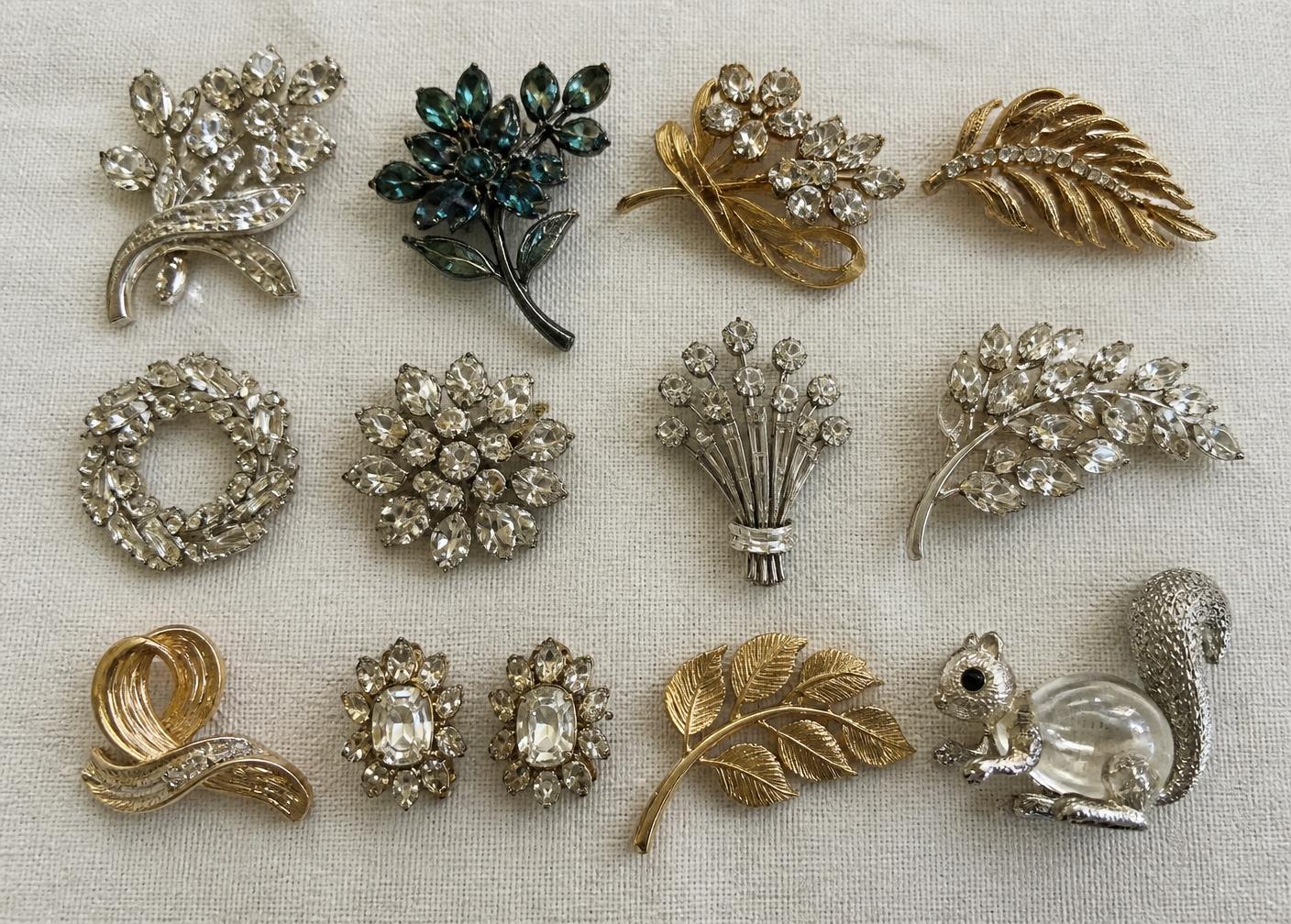
- Breaking up a set. A necklace, bracelet and earrings sold together are worth more than the sum of the three sold separately. If the box has matching pieces, keep them together.
- Cleaning it. Never soak rhinestone jewelry. Most vintage stones are foil-backed; water gets behind the foil and the stone permanently goes grey and dead. A dry soft brush and a barely damp cloth on the metal only.
- Losing the plaque. That little oval signature plaque is soldered on and it does come off. Once it is gone, the piece is worth what an anonymous piece is worth.
- Storing it tangled. Bent prongs and abraded plating come from a shoebox, not from wear.
Sellers: this is a category you are probably giving away
If you run sales, the jewelry box is worth thirty minutes of triage before it becomes a $3 bin.
Sort by feel and by mark, not by sparkle. Pull anything signed, anything sterling, anything hand-sewn, and anything with a Lucite belly. Photograph the back of signed pieces along with the front — the mark is the listing. Then price the marked pieces individually and let the rest be the bin that draws people to the table.
Listing them as individual items on EstateSaleFinder does two things at once: buyers who collect a specific maker can actually find them, and where you allow it they can make an offer before your doors open. Shoppers can also save a wishlist for "Miriam Haskell" or "Trifari" and get alerted the moment a matching item is posted at a brand-new sale in their city — which is precisely the audience you want walking into a jewelry-heavy sale.
Not sure what you're holding?
Photograph the front and the mark on the back and run it through the Ai Appraiser. It reads makers' marks, identifies the category, and pulls live comparable sold listings so you get a market reference instead of a guess. Treat the number as a suggestion to check against recent completed sales — especially in costume jewelry, where condition and completeness move the price more than the name does.
Questions & answers
Frequently asked questions
Is vintage costume jewelry worth anything?
Most of it is worth $5 to $30. The value is concentrated in signed pieces from a small group of mid-century makers, in original complete sets, and in excellent condition. A signed brooch from Trifari, Miriam Haskell, Hattie Carnegie, Weiss or Coro/Corocraft commonly falls in the $40–$400 band, with rare designs and full sets going into the low thousands at auction.
Which costume jewelry brands are worth the most money?
For American mid-century pieces the consistent top names are Miriam Haskell, early Trifari (especially KTF-marked and Alfred Philippe designs), Hattie Carnegie, Weiss, and Coro's better lines Corocraft and Vendôme. Eisenberg, Schreiner, Boucher, Schiaparelli and Juliana pieces are also actively collected.
Where is the maker's mark on costume jewelry?
On the reverse. Look on the back plate of a brooch, on the inside or the tongue of a clasp, on the reverse of an earring clip, and on any small soldered oval or rectangular plaque. Marks are often only 1–2mm tall, so use a loupe or your phone camera's zoom.
Why does my rhinestone brooch say STERLING?
Because it is almost certainly wartime. From 1942 the U.S. government restricted jewelry makers' use of tin, copper, aluminum, chrome, nickel and iridium for the war effort, so manufacturers switched to unrestricted sterling silver and to plastics, wood and glass. Sterling-marked rhinestone and Lucite costume pieces generally date to about 1942–1946.
What does the copyright symbol on jewelry mean?
It means the design was registered for copyright, and it is a dating clue: costume-jewelry copyright notices came into use after the mid-1950s, following the 1955 ruling in Trifari, Krussman & Fishel, Inc. v. Charel Co. that costume jewelry qualifies as a "work of art." A © beside the maker's name generally indicates a piece from the mid-1950s or later.
How can I tell if a Miriam Haskell piece is real if it isn't signed?
Judge the construction, not the label. Haskell pieces are hand-sewn rather than glued: seed beads and rose montees stitched to pierced gilt filigree backplates, irregular baroque glass pearls, and a reverse that is finished with as much care as the front. Haskell was seldom signed before about 1950, so plenty of authentic pieces are unmarked — and plenty of unmarked pieces are wrongly "attributed."
Sources and further reading
- Trifari, Krussman & Fishel, Inc. v. Charel Co., 134 F. Supp. 551 (S.D.N.Y. 1955) — the "junk jewelry" copyright ruling and the description of the © notice on the clasp
- TIME, March 16, 1942 — "Junk Jewelry, 1942 Style" — the wartime metal restrictions, contemporary reporting
- Wikipedia — Miriam Haskell — biography, Frank Hess, signing history
- Wikipedia — Hattie Carnegie — business history and dates
- Wikipedia — Corocraft — Coro's 1901 founding as Cohn & Rosenberger, Duettes, 1979 closure
- Rhode Island Historical Society — Coro Company Records (MSS 237) — the Providence manufacturing archive
- Invaluable — Trifari jewelry value — KTF set result, brand chronology
- Costume Jewelry Collectors Int'l — Coro history and marks — mark reference
- Lilly's Vintage Jewelry — Weiss — Albert Weiss, 1942–1971
- Real examples in museum collections: Miriam Haskell necklace, 1928–48 · Haskell jewelry set · Haskell set, 1960–67 · Trifari bracelet, ca. 1935 · Trifari collar, 1966–70 · Coro brooch, ca. 1940 — all Metropolitan Museum of Art
Related reading:
- Digging gold and silver out of the costume jewelry bin
- Sterling silver hallmarks: a full identification guide
- How to tell if gold is real
- Vintage fashion at estate sales
- How to spot valuable items at estate sales
- How to appraise estate sale items
- The most valuable items at estate sales
- Set up wishlist alerts for a maker you collect
This article is general collecting information, not an appraisal. Sold prices are individually dated auction results as of 2026 and reflect rarity, completeness and condition as much as the maker's name — check recent completed sales for your exact piece before buying or pricing. Photographs illustrating this article are original illustrative images of representative mid-century costume jewelry, not photographs of the specific pieces whose prices are cited; links to the Metropolitan Museum of Art collection are provided for documented examples of each maker.
Keep exploring
Ready to start your own treasure hunt?
Discover estate sales near you and find incredible deals.
Explore Sales Near Me
About the author
Andy
Founder, EstateSaleFinder.net
Hi, I'm Andy — a retired commercial photographer turned developer with a five-year (and counting) obsession with estate sales. I started EstateSaleFinder.net because I knew there had to be an easier, smarter way to find and list estate sales. Now I get to chase treasure and build the tool I always wished existed.