

Is an Estate Sale Worth It for Your House? Minimums, Real Proceeds, and What to Do If a Company Says "Too Small"
How estate sale companies decide whether to take a sale, what minimums really look like, a worked gross-vs-net example, a 10-question self-check, and the five steps to try, in order, if a company says your sale is too small.
An estate sale is usually worth it when the house has to be emptied anyway and the contents could bring in roughly $3,000 to $10,000 or more. Every company sets its own minimum. Below that, the commission and labor can eat most of the money. If a company says your sale is "too small," sell the valuables separately, then try an online auction, a combined sale or a buyout, and call a cleanout last.
That's the short answer. This guide explains how companies decide whether to take a sale, what minimums look like, what a family actually takes home, a 10-question self-check, why companies say no and exactly what to do next.
Quick summary for skimmers:
- There's no universal minimum. Consumer guides put the floor anywhere from about $3,000 to $10,000 in expected sales.
- Companies take a commission on gross sales, commonly 30% to 50%. Some charge a minimum fee instead of turning a small sale down.
- The question isn't only money. An estate sale also empties the house, which a cleanout charges you for.
- If a company says no, don't call the junk hauler yet. There's a set order of better options.
- Realtors: a 10-minute walkthrough by an estate sale company before a cleanout can be worth thousands to your seller.
Is an estate sale worth it?
It's worth it when two things are true: the house needs to be emptied, and what's inside will sell for enough to cover the company's costs and still pay you.
Consumers' Checkbook, a nonprofit consumer group, says "a home with $3,000 or more in furnishings, clothing, and other household goods merits an estate sale" (Consumers' Checkbook). It also notes that liquidators "take a big cut of sales proceeds—30 to 50 percent is typical," so the main goal for many families is to clear the house quickly without sending everything to a landfill.
That second point is the one families miss. Compare an estate sale to the alternative, not to zero. If the house has to be emptied, the real choice is often between being paid for the contents or paying someone to haul them away. Our side-by-side of estate sale vs. auction vs. cleanout walks through that comparison.
How estate sale companies decide whether to take a sale
Most of an estate sale's work costs about the same whether the house holds $3,000 or $30,000 in contents. A company still has to sort, research, price, stage, advertise, staff two or three sale days, handle checkout and settle up afterward.
So on the first walkthrough, a company is asking itself:
- How much will this sell for? Mostly furniture in good shape, jewelry, silver, art, tools, collectibles and full kitchens.
- How much work is it? Clutter, hoarding, damage, stairs and how many rooms are full.
- Can shoppers get in? Parking, street access, HOA or gated-community rules.
- How much time is there? A closing date in two weeks can be a no.
- Who decides? An executor who can sign, and family who are done taking things.
What estate sale minimums really look like
"Minimum" can mean two different things:
- A minimum contents value. The company won't take a sale it expects to gross less than its floor.
- A minimum fee. The company takes the sale but charges at least a set amount, whatever it earns.
Published guidance varies:
| Source | What it says |
|---|---|
| Consumers' Checkbook | About $3,000 or more in household goods generally merits a sale; commissions of 30% to 50% are typical |
| iStuffSellers | Published minimums run from about $3,000 to $10,000 or more in expected sales; some companies take smaller estates for a minimum fee |
| Charles Schwab | Explains how an estate sale works and the fees families should expect before deciding to hire help |
Treat any single number as one company's choice, not a rule. A company in a busy metro area with a strong buyer list may take a smaller sale than a company that has to drive an hour each way.
A worked example: what you actually take home
Here's a simple example, rounded:
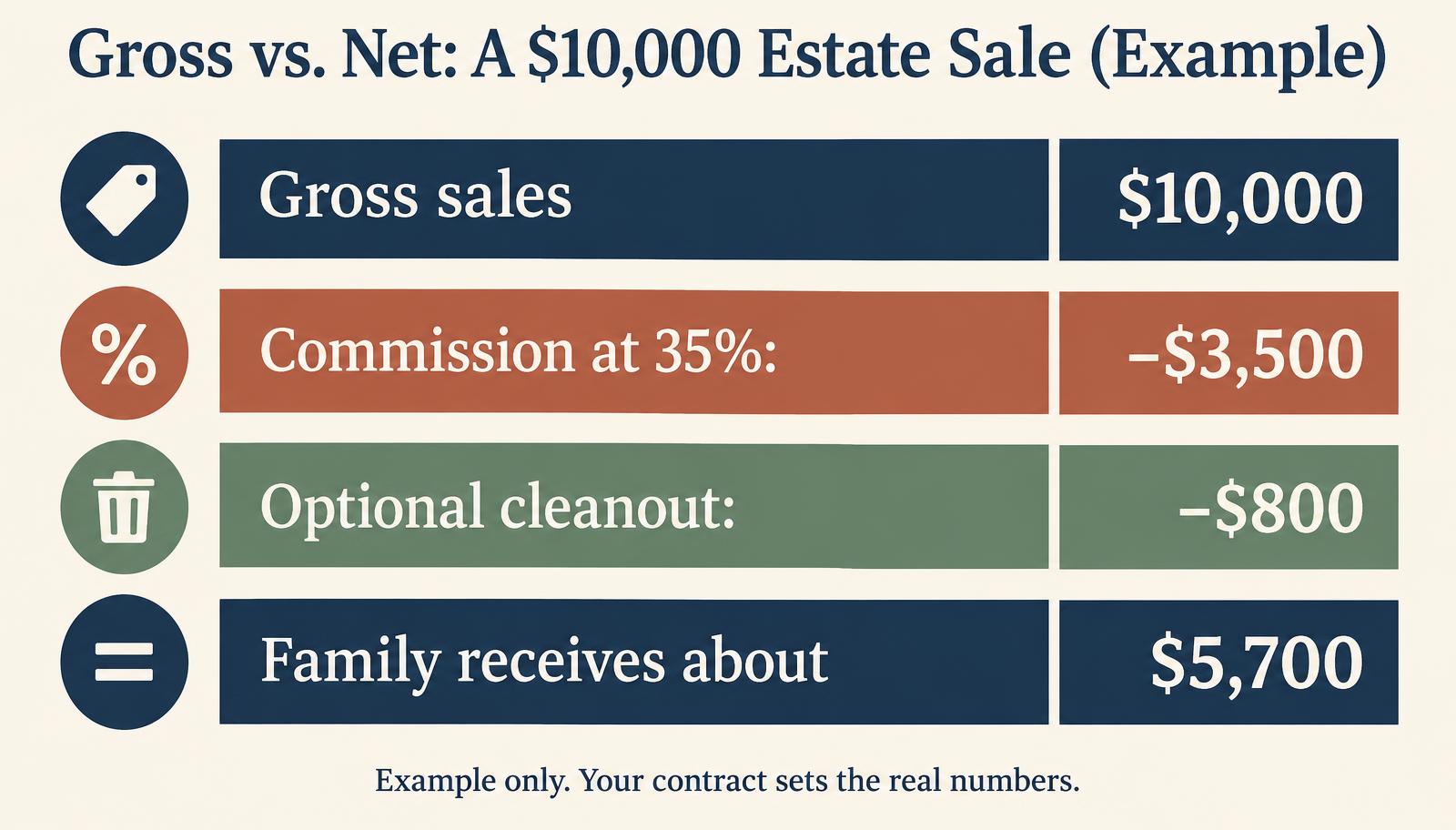
- Gross sales: $10,000
- Commission at 35%: –$3,500
- Optional cleanout of what's left: –$800
- Family receives about $5,700
Commission is almost always figured on gross sales, before anything else comes out. Some contracts also deduct card processing, advertising or cleanout. Others include them. Ask for every possible deduction in writing. Our guide to how much estate sale companies charge breaks down each fee.
Now compare: if that same house went straight to a cleanout, the family would get nothing for the contents and pay for the hauling.
The 10-question "is it worth it?" self-check
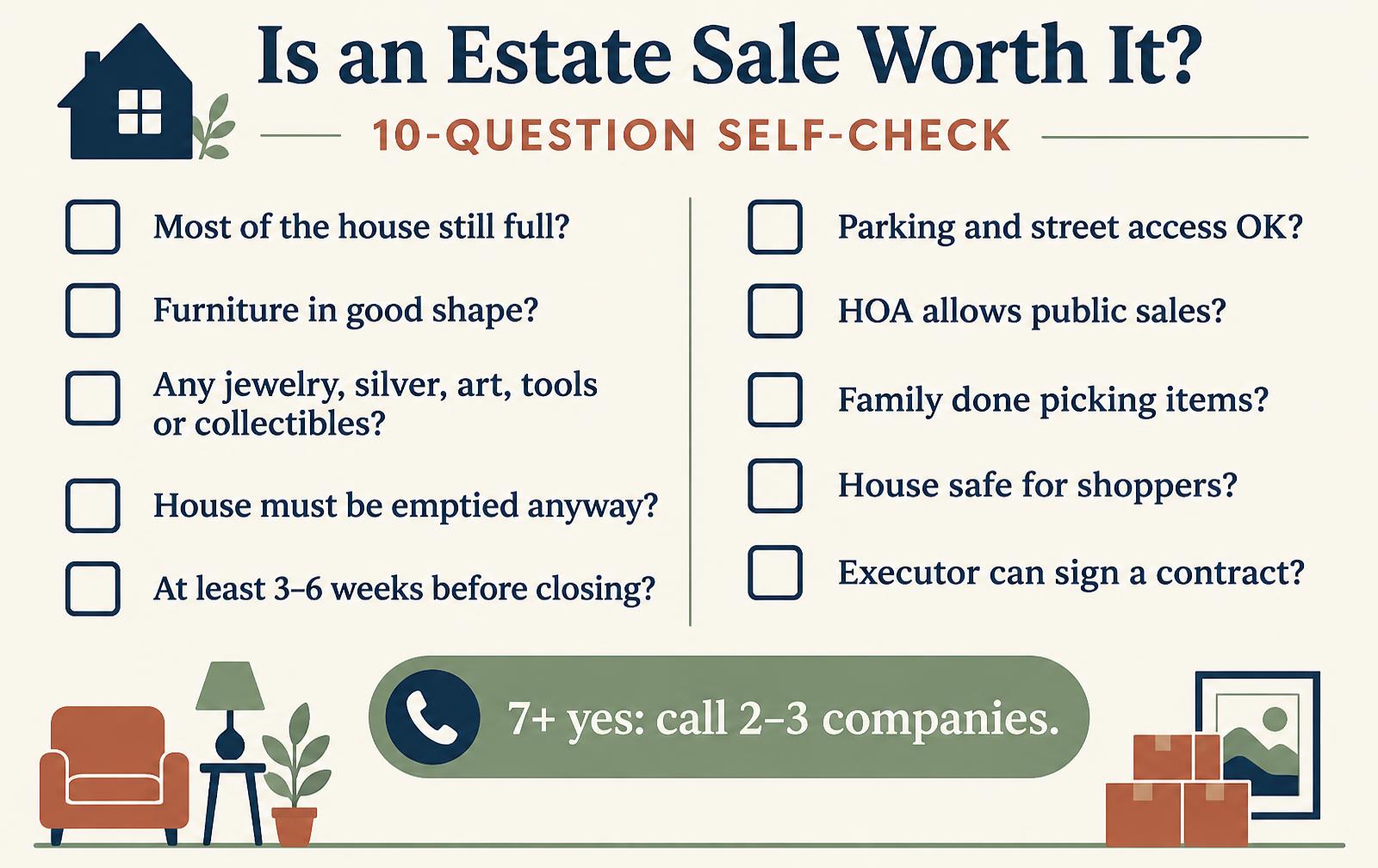
Answer yes or no:
- Is most of the house still full?
- Is the furniture in decent shape (no major water damage, smoke or pets)?
- Is there any jewelry, silver, art, tools, guns, coins or collectibles?
- Does the house have to be emptied anyway?
- Do you have at least three to six weeks before a closing or move?
- Is there parking and easy street access?
- Does the HOA or gated community allow public sales?
- Has the family finished taking what they want?
- Is the house safe for shoppers to walk through?
- Is there someone with legal authority to sign a contract?
Seven or more yes answers: call two or three companies for a walkthrough. Four to six: a company may still help, possibly with a smaller or combined sale. Ask. Three or fewer: start with the options in the "too small" section below.
Not sure about question 3? Snap a photo of anything that looks old or unusual with EstateSaleFinder's Ai Appraiser for a quick suggested value. It's a suggestion, not an appraisal, but it helps you know what to point out on the walkthrough.
Why estate sale companies say no

A "no" isn't always about value. Common reasons:
- Not enough to sell, or mostly everyday items that sell for a few dollars each.
- Too much work for the value, like heavy clutter or hoarding that needs a cleanout first.
- Condition, such as mold, smoke, pests or damage.
- Access, like no parking, a gated community that bans public sales or an upstairs apartment.
- Timing, because the company's calendar is full before your closing date.
- Family limits, such as too many items held back, or reserve prices higher than the market will pay.
- Someone is still living there and the sale would be partial. Our guide to downsizing sales covers what gets a yes in that case.
It's fair to ask a company, "What would make this work for you?" Sometimes the answer is a minimum fee, a one-day sale or combining with another estate.
What to do if a company says "too small"
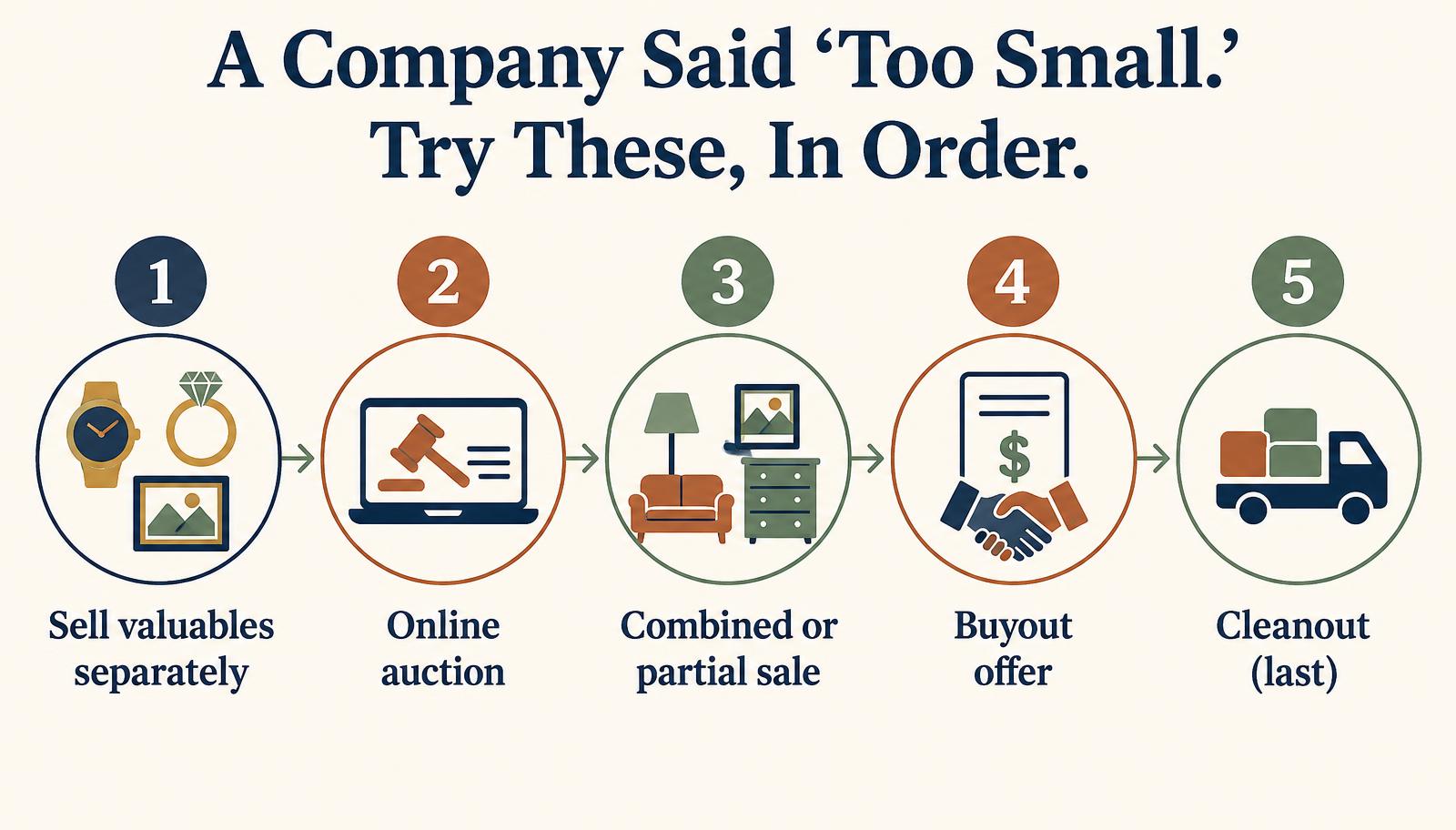
Work through these in order. Each step keeps more money than the next.
1. Sell the valuables separately
Pull out the few things that carry most of the value: jewelry, gold and silver, coins, watches, art, guns (following your state's transfer laws), and collections. A jeweler, coin dealer, auction house or specialist dealer can buy or consign them. This step alone can turn a "too small" house into real money.
2. Try an online auction
Many companies run online-only auctions for smaller estates. Buyers bid from home and come for a pickup window, so no one needs to stage a public sale. Read estate sale or online auction? for how to choose.
3. Ask about a combined or partial sale
Some companies add the contents of a smaller home to another sale, or hold a shorter one-day sale. Others will take part of the contents to their warehouse or shop.
4. Get a buyout offer
A buyout means a company or dealer pays one price for everything, or for a group of items, and takes them away. It's fast. You'll usually get less than an estate sale would bring, because the buyer takes all the risk and labor. Get two offers if you can, and get the price and the removal date in writing.
5. Call a cleanout last
When the valuable items are gone and no one will buy the rest, a cleanout company empties the house. Ask whether they donate usable items, and get receipts. Our guide to estate cleanout or estate sale explains how cleanouts are priced.
For realtors and senior move managers: before you call the junk hauler
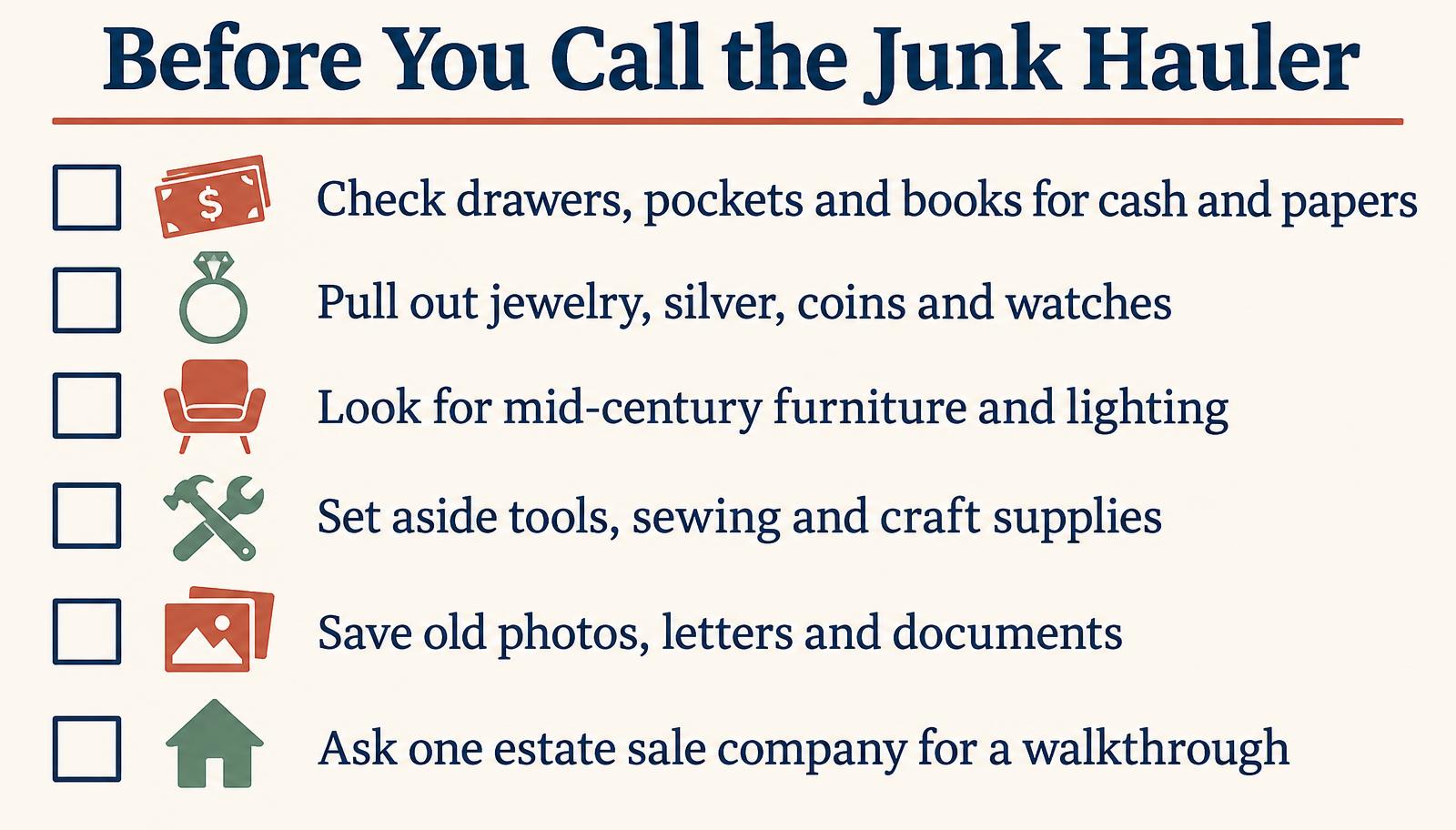
When a listing needs to be empty, a cleanout is the fastest call to make. It's not always the best one for your client. Before you schedule a hauler, run through this list with the family:
- Check drawers, pockets, books and freezers for cash, papers and small valuables.
- Pull out jewelry, silver, coins and watches, including costume jewelry, which can have gold or sterling mixed in.
- Look for mid-century furniture and lighting. Pieces from the 1950s to 1970s often sell well.
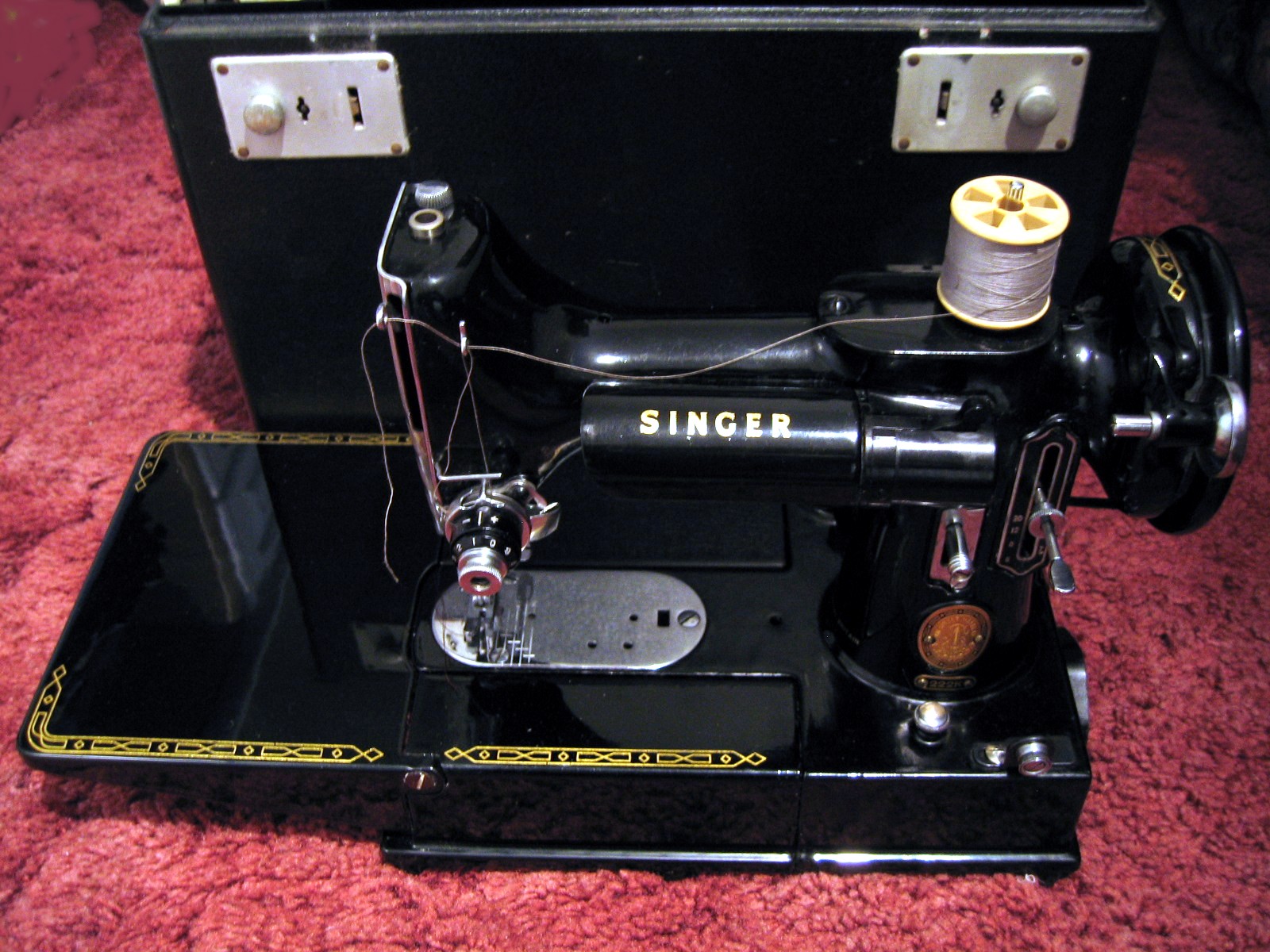
- Set aside tools, sewing machines and craft supplies. They sell steadily at estate sales.
- Save photos, letters and documents for the family before anything leaves.
- Ask one estate sale company for a walkthrough. It's usually free, and they'll tell you quickly whether there's a sale.
Our realtor's guide to estate sales shows how to fit a sale into a listing schedule, and can you sell a house with furniture still in it? covers the contract side. If you work with seniors, our comparison of a senior move manager vs. an estate sale company explains how the two work together.
Estate sale vs. buyout vs. cleanout at a glance
| Estate sale | Buyout | Cleanout | |
|---|---|---|---|
| You get paid? | Yes, after commission | Yes, one lump sum | No, you pay |
| Typical time | About 3 to 6 weeks start to finish | Days | Days |
| Best when | Good contents and some time | Little time, moderate value | Nothing left worth selling |
| Main risk | Needs a company and a few weeks | Lower price than a sale | Valuable items thrown out |
For a week-by-week look at sale timing, see how long does an estate sale take?

Timing matters too. Here's the best time of year for an estate sale and what waiting until spring really costs.
Questions & answers
Frequently asked questions
Is an estate sale worth it for a small house?
It can be. The size of the house matters less than what's in it. A small home with good furniture, jewelry or collections can be worth a sale. A large home with worn, everyday items may not be. Ask for a walkthrough.
What is the minimum for an estate sale?
There's no standard minimum. Consumer guides put the floor at roughly $3,000 to $10,000 in expected sales, and each company sets its own. Some companies charge a minimum fee instead of turning a small sale down.
How much money do you get from an estate sale?
You get the gross sales minus the company's commission and any fees in your contract. Commissions are commonly 30% to 50% of gross sales. For example, $10,000 in sales at 35% commission leaves $6,500 before any cleanout or other fees.
Is a buyout better than an estate sale?
A buyout is faster and simpler, but usually pays less, because the buyer takes on all the work and risk. It makes sense when there's little time or the contents have moderate value. Get at least two offers.
What do you do if an estate sale company won't take your sale?
Sell the most valuable items separately first. Then try an online auction, a combined or partial sale, or a buyout. Call a cleanout company last, after anything worth money is gone.
Do estate sale companies charge if nothing sells?
Most work on commission, so they earn only when things sell. Some contracts include a minimum fee or charges for cleanout and advertising. Read the contract and ask what you'd owe in a slow sale.
How do I find an estate sale company near me?
Search the estate sale company directory on EstateSaleFinder by state and city, look at each company's past sales, and call two or three. Our guide to finding an estate sale company lists the questions to ask.
Next steps
- Take the 10-question self-check above.
- Pull out and photograph anything that might be valuable.
- Call two or three companies from the estate sale company directory for walkthroughs.
- Compare written offers, including commission and every fee.
- If the answer is "too small," work through the five steps in order.
If you're an executor, our guide to taxes on estate sale proceeds explains what records to keep from the sale.
Sources:
Related reading:
Sources checked October 28, 2026. General information, not legal or financial advice.
Keep exploring
Ready to start your own treasure hunt?
Discover estate sales near you and find incredible deals.
Explore Sales Near Me
About the author
Andy
Founder, EstateSaleFinder.net
Hi, I'm Andy — a retired commercial photographer turned developer with a five-year (and counting) obsession with estate sales. I started EstateSaleFinder.net because I knew there had to be an easier, smarter way to find and list estate sales. Now I get to chase treasure and build the tool I always wished existed.