
What to Do With Old Family Photos, Letters & Slides No One Wants: Scan, Share, Donate, or Let Go
A calm plan for the photo box: a 90-minute family sort, keep/scan/share/donate/shred, scanning prints and slides, calling an archive first, protecting private letters, and what to pull before the estate sale company arrives.
What to do with old family photos: sort them in one short family session, keep the best and labeled ones, scan the ones people want to share, offer historically useful collections to an archive (call first), and shred private papers. Pull every photo, letter, slide and negative out of the house before the estate sale company arrives. Unlabeled snapshots can be let go without guilt.
Quick summary
- Start small: one 90-minute family session with five bins (Keep, Scan, Share, Donate, Shred) beats a month of guilt.
- Label first: a name and year in soft pencil on the back is worth more than any scan.
- Scan only what people want: the Library of Congress suggests 300 dpi for documents and 400 to 600 dpi for photos you may enlarge (Library of Congress).
- Call before you donate: archives want a coherent, identified collection and ask that nothing be dropped off unannounced (Society of American Archivists).
- Protect privacy: letters, diaries, IDs, medical and money papers never go on a sale table.
- Free printable: download the Photos, Letters & Slides checklist (PDF).
Why the photo box is always the last job
Photos and letters are usually the hardest part of a house. Furniture is a yes or no. A shoebox of 1960s snapshots is a hundred small decisions, and each one has a face in it.
That's why the best advice from Swedish death cleaning is to do photos and letters last, once you've built up some decision muscle. It's also why families so often run out of time and leave the boxes in a closet when the estate sale company starts staging.
We checked our own listings on November 7, 2026. Of 40,545 live sale items on EstateSaleFinder.net, 25 were described by our Ai as old or vintage photo lots, cabinet cards or tintypes, plus 5 photo albums and 5 slide projectors. That's small, but it's real: family photos do reach sale tables. This guide helps you decide which ones should, and which never should.
What to do with old family photos no one wants
Short answer
if no one in the family wants them after a fair chance to look, you can keep a small labeled sample, scan a handful of the best, offer anything with local history to a historical society, and let the rest go. Unlabeled pictures of people no one can name are not a family duty.
Give everyone a deadline, for example two weeks, to claim or ask for scans. After that, you have permission to decide. Most families find that a few dozen photos tell the story better than 4,000.
Photos with local history value are the exception. Main Street storefronts, a family farm, a factory floor, a parade, a church or school, or a known local person can matter to a historical society even when the family doesn't want them.
The 90-minute family sorting session
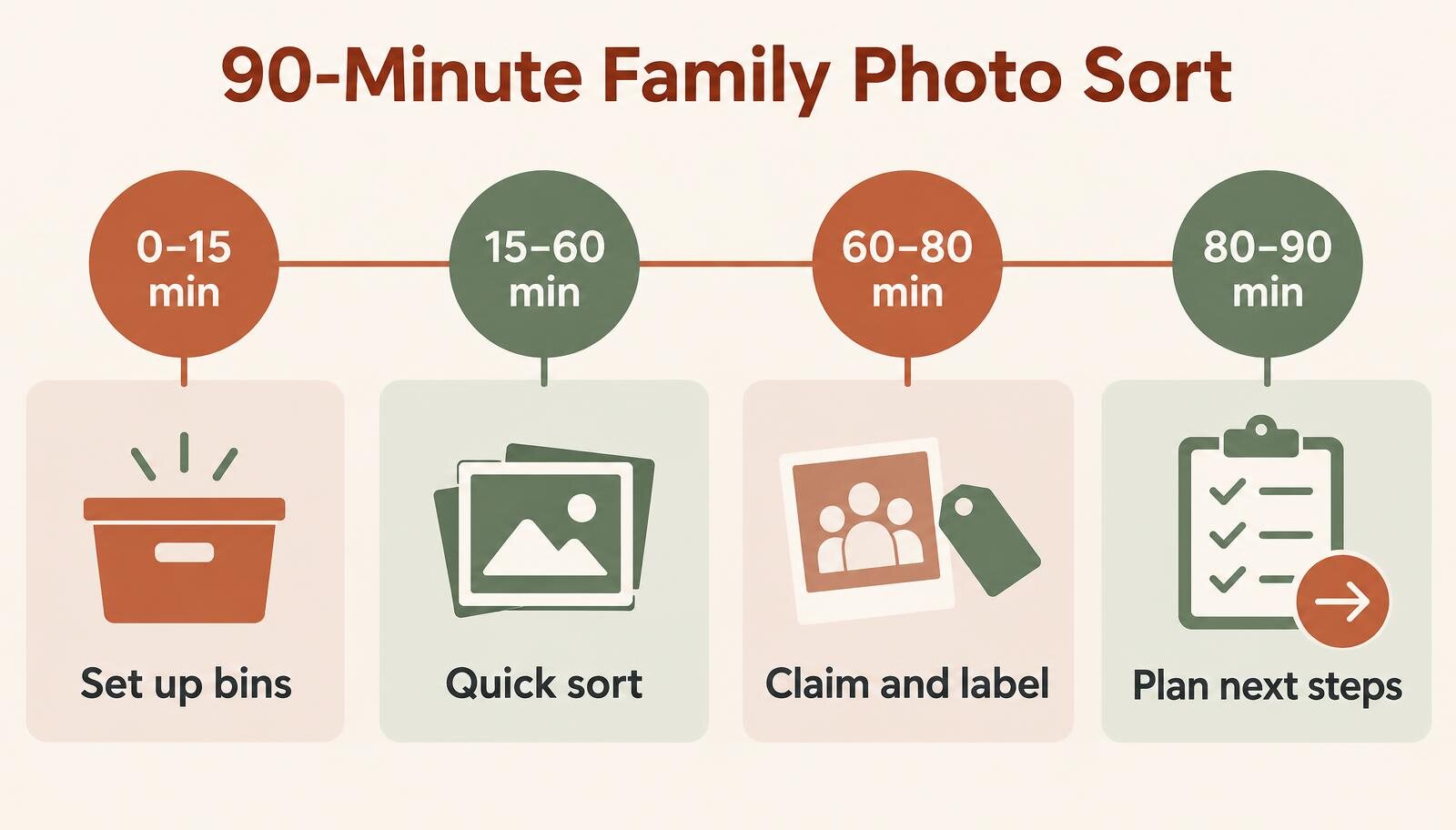
One session won't finish a big collection, but it sets the rules and gets the obvious decisions done. Invite siblings in person or on a video call.
| Time | What happens | Tip |
|---|---|---|
| 0–15 min | Set up five labeled bins or boxes, pencils, sticky notes and a phone for quick snaps | Work on a clean, dry table, away from food and drinks |
| 15–60 min | Quick sort: one look per photo, into a bin | Duplicates, blurry shots and scenery with no people go straight to Shred or Share |
| 60–80 min | Claim and label: each person names the photos they want; write names and years on the back | Use a soft pencil, never ballpoint or marker |
| 80–90 min | Plan next steps: who scans, which archive to call, the deadline for claims | Write it down and text it to everyone |
Rules that keep it calm:
- Nobody throws away a photo someone else asks to keep.
- One person keeps the "Scan" bin so it doesn't scatter.
- If two people want the same original, scan it and draw for the print. Our guide to dividing parents' belongings has fair-pick methods.
Keep, scan, share, donate or shred
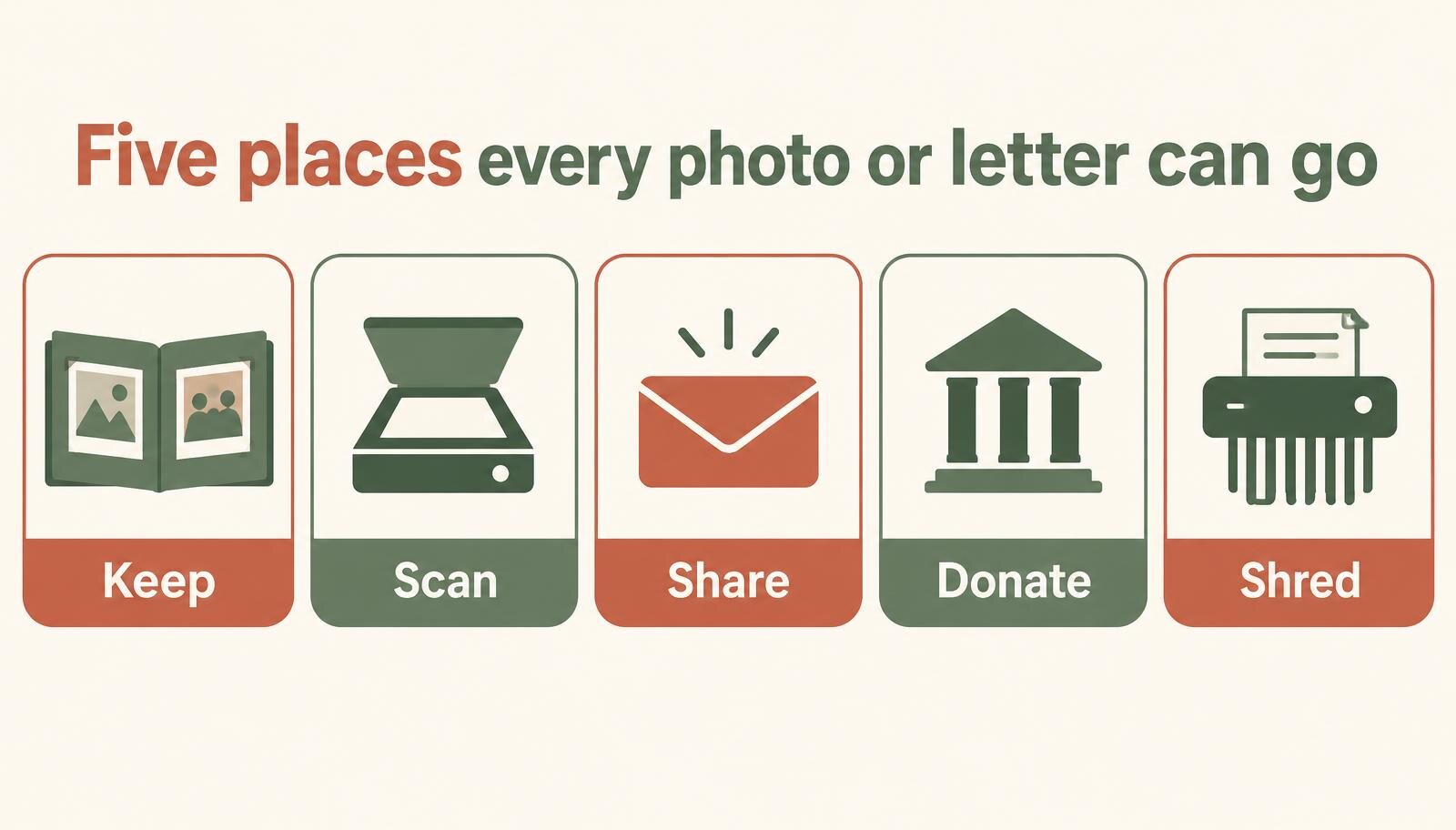
Keep
Originals someone actually wants, labeled photos of named relatives, wedding and baby photos, and anything with a story attached. Store them in acid-free boxes or sleeves in a cool, dry room of the house, not in an attic, garage or basement.
Scan
The photos many people want copies of: the best portrait of each grandparent, holidays, the house, the family pets. You don't need to scan everything. Scanning 200 good photos is a weekend; scanning 4,000 is a second job.
Share
Photos that belong to someone else's story: a cousin's wedding, an old friend's family, a neighbor's kids. Mail them or hand them off. People are often moved to get them.
Donate
Collections with research value, especially when they're labeled. See "Donating to an archive" below.
Shred
Duplicates, blurry shots, unlabeled scenery, and any private papers no one needs. Old bank statements and tax returns go to a shredder, not a trash bag.
Manageable scanning options for prints, slides and negatives
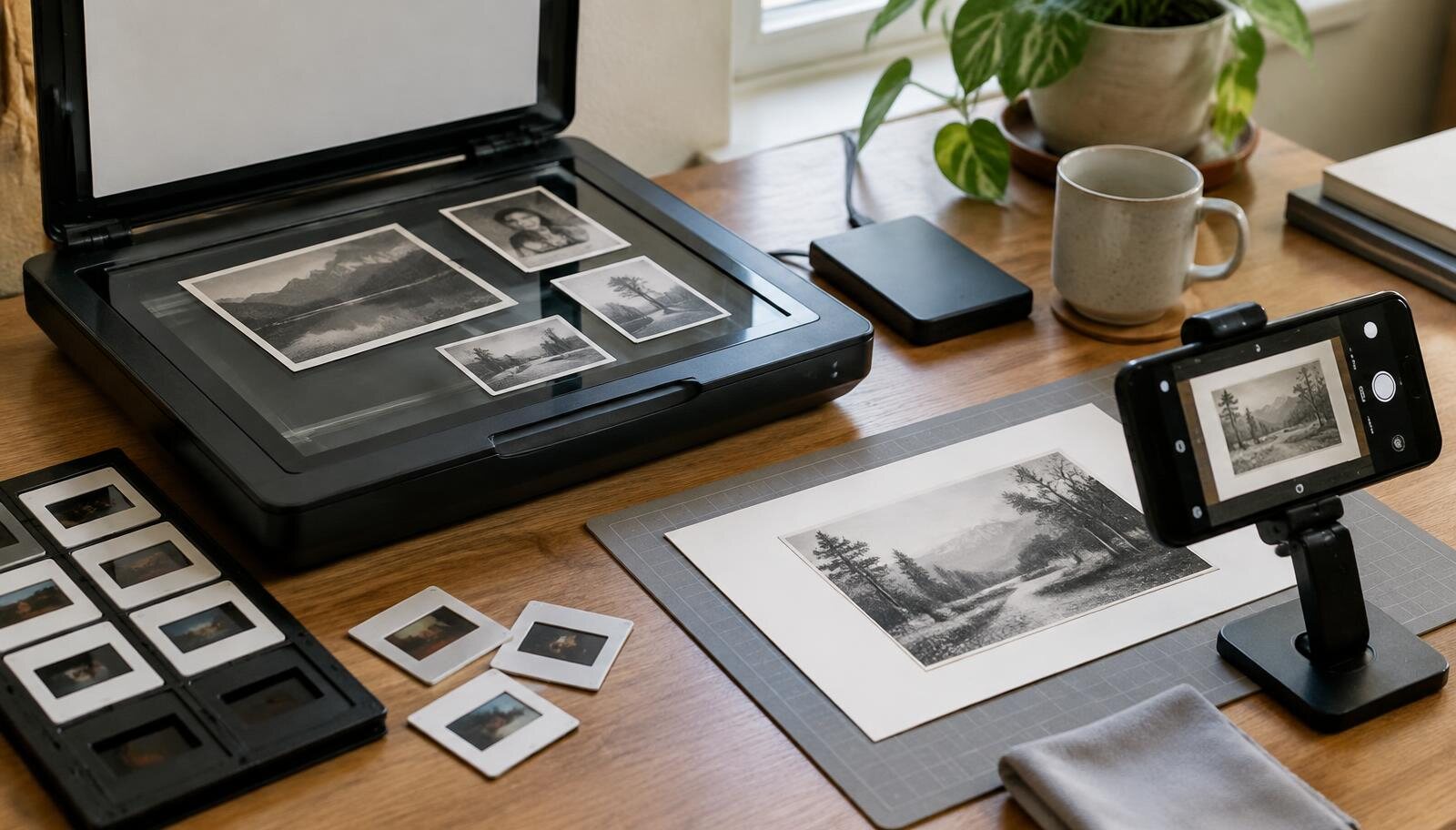
| Option | Best for | Good to know |
|---|---|---|
| Phone scanning app | Quick copies to text to family | Fast and free, but glare and curl lower quality. Fine for sharing, not for enlarging. |
| Flatbed scanner | Prints and letters you want to keep long term | The Library of Congress suggests 300 dpi for documents and 400–600 dpi for photos you may print at 8x10 or larger. Above 600 dpi may be unnecessary for prints. |
| Scanner with film holder or a film scanner | Slides and negatives | Film frames are small, so they need much higher resolution than prints. |
| Scanning service | Large slide or negative collections | Ask whether originals are shipped, how they're tracked, and what file format you get back. |
The Library of Congress guidance comes from its personal digital archiving handout, which also recommends cleaning the scanner glass and the photo before each batch (Library of Congress). Its blog also walks through the choice between doing it yourself and outsourcing (The Signal).
Why slides need more resolution
a 35mm slide frame is only about 1.4 inches wide. To print it 10 inches wide at 300 dpi, you need roughly 3,000 pixels across, which means scanning at about 2,100 ppi or more. That's simple math, not a brand recommendation.
Name and back up your files. Use names like "1968_Smith_Thanksgiving_01.jpg". Keep at least two copies in different places, such as a hard drive plus a cloud folder the whole family can reach.
What about negatives and slides?
Slides and negatives are often the only copy of the color photos from the 1950s through the 1990s, so pull them all, even if you never look at them.
One safety note
very old negatives on cellulose nitrate film are highly flammable. The National Park Service's museum handbook explains how to identify and manage nitrate and other unstable film (National Park Service). A 1978 fire at a National Archives film vault destroyed about 12.6 million feet of nitrate film (National Archives). If you find old sheet negatives or rolls that smell sharp or look sticky, brown or crumbly, keep them away from heat and ask a local archive or conservator before handling more.
Film that smells like vinegar is deteriorating acetate film. Scan the best frames soon.
Donating to an archive: call first
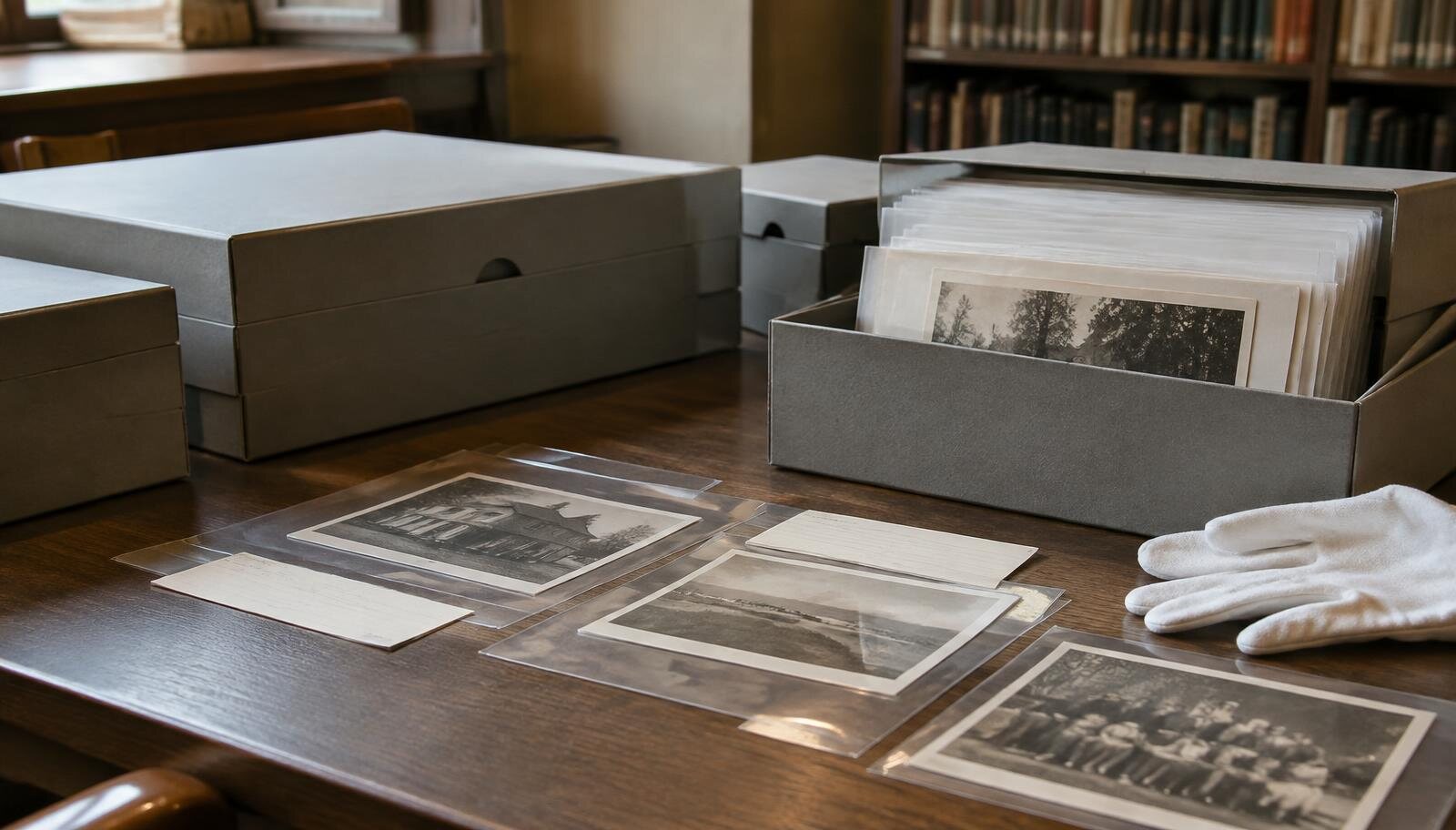
The Society of American Archivists' guide for donors is clear on a few points (Society of American Archivists):
- Repositories (archives, historical societies and special collections libraries) preserve letters, diaries, photos and other family records for future research.
- Your family doesn't have to be famous for its papers to matter.
- They're usually more interested in a coherent body of material than single items, and photos, tapes and films should be identified.
- Don't mail or drop off material without talking to the staff first. A repository evaluates what's offered and asks the donor to sign a donation agreement.
- Don't reorganize or cull papers before an archivist sees them. Removing items or rearranging them can lower their research value.
Where to start
your county or town historical society, the state archives, a university special collections library, or an archive tied to your family's work, faith, military service or heritage. Call or email with a short description: who, where, what years, how many boxes, and whether things are labeled.
Tip
scan the photos the family wants before the donation. Ask the archive how they handle copies and access.
Protecting private correspondence
Letters and diaries are the most private things in a house. They can mention health, money, marriages, adoptions and old arguments involving people who are still alive.
- Read before you decide, or have one trusted person do it.
- Ask living people before sharing letters that mention them.
- Keep or shred anything with Social Security numbers, account numbers or medical details.
- Never put letters, diaries or papers with names and details in a box lot at an estate sale.
If the family has legal or estate questions about records after a death, the executor decides. Our guide to estate sales during probate explains who has authority to sell.
What should never reach a sale table
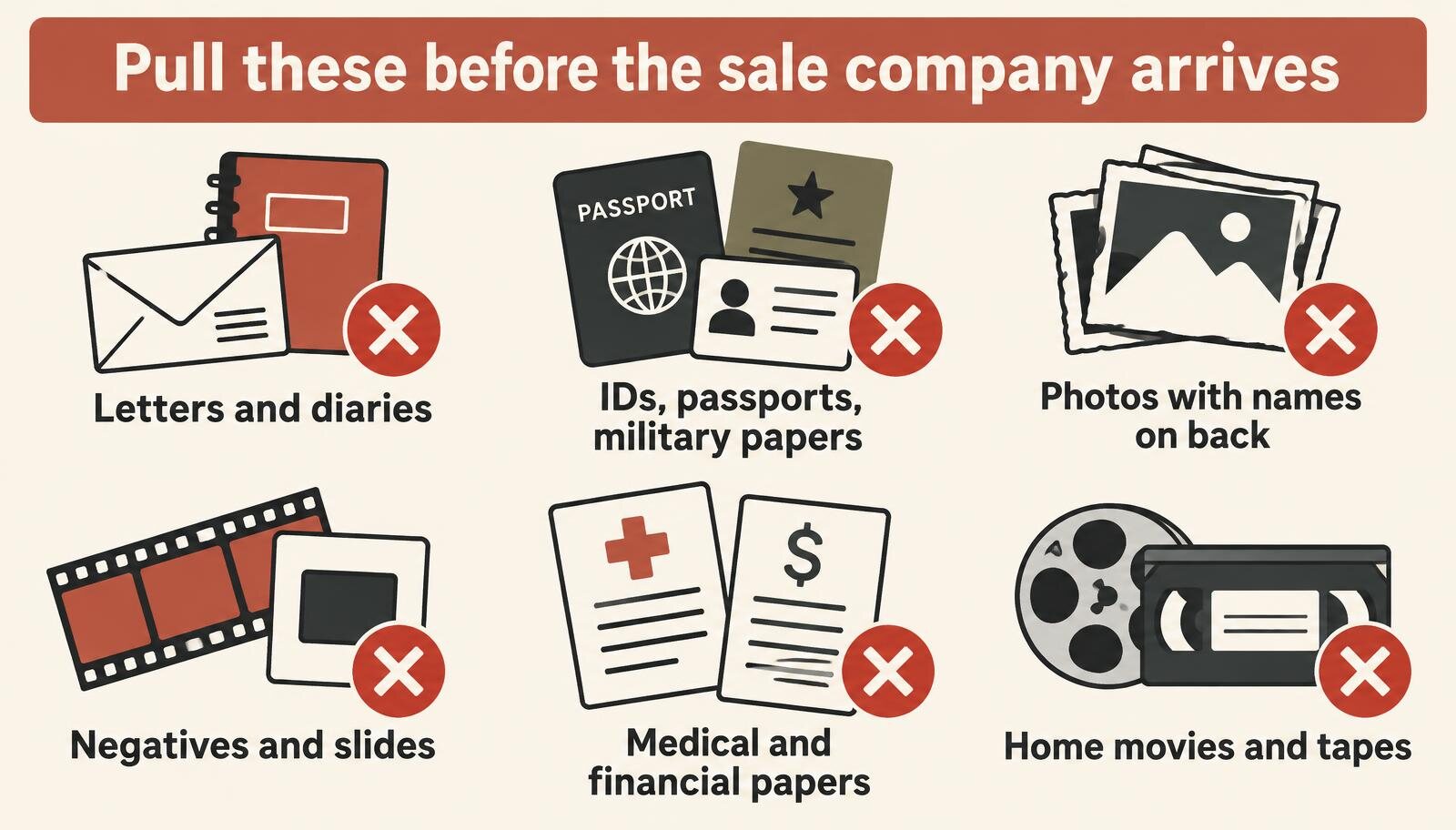
Before the first walkthrough with an estate sale company, box up and remove:
- Letters, cards and diaries.
- IDs, passports, birth and marriage certificates, military discharge papers. Medals have their own rules; see can you sell military medals?.
- Photos with names written on the back, and any photos of living family members.
- Negatives, slides and photo CDs.
- Medical, tax, bank and legal papers.
- Home movies, video tapes, audio tapes and memory cards.
Tell the company directly: "Please set aside any photos, papers or film you find, and don't sell them." Good companies do this anyway, but it's worth putting in writing. Our estate sale contract checklist shows where to add it, and what not to throw away before an estate sale covers the opposite mistake.
Should old photos be sold at an estate sale?
Family photos of identifiable relatives: no. Pull them.
Anonymous antique photos are different. Unlabeled cabinet cards, tintypes, real photo postcards and old snapshots sometimes sell to collectors and artists. Some families are comfortable with that, and some are not. It's your call; tell the company your preference.
Not sure if a photo lot is old or special? Snap a picture with our free Ai Appraiser for a suggested identification and range. It's a suggestion, not an appraisal.
Is it wrong to throw family photos away?
No. Keeping every photo can mean no one ever sees any of them. Once the family has had a fair chance to claim and scan, letting go of blurry, duplicate and unlabeled photos is a normal part of settling a home. Many families keep one small "best of" box and feel lighter for it.
Printable checklist
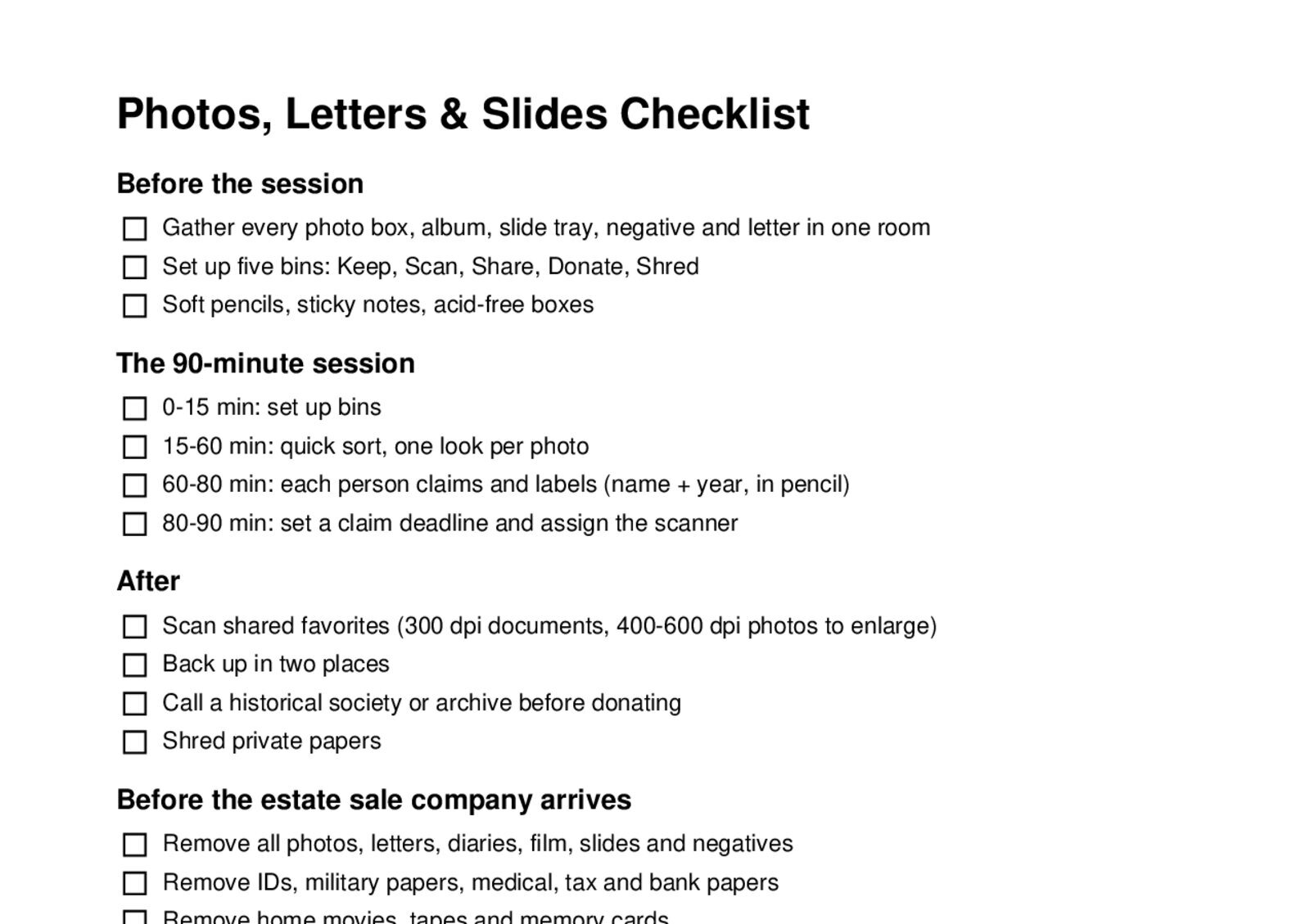
Download the Photos, Letters & Slides checklist (PDF)
Before the session
- Gather every photo box, album, slide tray, negative and letter in one room
- Set up five bins: Keep, Scan, Share, Donate, Shred
- Pencils, sticky notes, acid-free boxes
The session
- Quick sort, one look per photo
- Each person claims and labels what they want
- Set a claim deadline
After
- Scan the shared favorites; back up in two places
- Call a historical society or archive before donating
- Shred private papers
Before the sale company arrives
- Remove all photos, letters, film, IDs and papers
- Put "set aside papers and photos" in the contract
When you're ready for the rest of the house
Once the photos and letters are safely out, the rest of the house is easier. Start with our guide to cleaning out a parent's house after a death, or our downsizing checklist for seniors if a parent is moving. When you're ready, find estate sale companies near you.
FAQ
What do you do with old family photos no one wants?
Give relatives a deadline to claim or request scans, keep a small labeled sample, offer anything with local history to a historical society, and let the rest go.
Is it wrong to throw family photos away?
No. Once the family has had a fair chance to look, letting go of blurry, duplicate and unlabeled photos is normal.
Where can I donate old family photos?
A county or town historical society, state archives, or a university special collections library. Call first; the Society of American Archivists advises against mailing or dropping off material without talking to staff.
What should I do with old letters when someone dies?
Have one trusted person read them, ask living people before sharing letters that mention them, keep the meaningful ones, offer historically useful collections to an archive and shred private papers.
What should I do with old photo slides and negatives?
Pull them all before a sale, scan the best frames with a film scanner or service, and keep very old, flammable nitrate negatives away from heat.
What dpi should I scan old photos at?
The Library of Congress suggests 300 dpi for documents and 400 to 600 dpi for photos you may enlarge to 8x10 or larger. Slides and negatives need much higher resolution.
Should old photos be sold at an estate sale?
Not photos of identifiable family. Anonymous antique photos like cabinet cards and tintypes sometimes sell to collectors; tell the sale company your preference.
Sources
- Society of American Archivists: Donating Your Personal or Family Records to a Repository
- Library of Congress: Scanning Your Personal Collections (PDF)
- Library of Congress, The Signal: Scanning, DIY or Outsource
- National Park Service: Management of Cellulose Nitrate and Cellulose Ester Film (PDF)
- National Archives: The 1978 Suitland Film Vault Fire
- EstateSaleFinder.net live listing data, November 7, 2026 (40,545 live sale items)
Sources checked November 7, 2026.
Keep exploring
Ready to start your own treasure hunt?
Discover estate sales near you and find incredible deals.
Explore Sales Near Me
About the author
Andy
Founder, EstateSaleFinder.net
Hi, I'm Andy — a retired commercial photographer turned developer with a five-year (and counting) obsession with estate sales. I started EstateSaleFinder.net because I knew there had to be an easier, smarter way to find and list estate sales. Now I get to chase treasure and build the tool I always wished existed.